Mindset· 10 min read
Psychological Flexibility: Stop Getting Trapped in Your Mind
The ACT framework that predicts wellbeing better than positive thinking alone. Steven Hayes's research — and five practical exercises to start today.

Psychological Flexibility: Stop Getting Trapped in Your Mind

There's a psychology experiment that gets to the heart of psychological flexibility — and you can run it on yourself in the next thirty seconds. Ready? Whatever you do — don't think about a white bear.
Most people find the bear materializes almost immediately. The harder they push it away, the more insistently it returns. Daniel Wegner at Harvard documented this in 1987 and called it ironic process theory: the mental monitor checking whether you're not thinking about something requires you to think about it first. Suppression generates its own failure mechanism. The target of the suppression becomes the most activated thing in working memory.
That experiment is easy to laugh off. But the thing it points to isn't.
Because most of us are running a version of that white bear game with thoughts and feelings that actually matter. The self-doubt that surfaces every time you step toward something important. The anxiety that arrives before a difficult conversation. The quiet voice that says you're not ready on the morning of something significant. You've learned — consciously or not — to fight those signals. To push them down, override them, replace them with something more palatable. And if you're honest with yourself, that strategy hasn't been working as reliably as you'd like.
The Psychologist Who Couldn't Stop His Own Panic Attack
In the fall of 1978, a psychology professor named Steven Hayes was sitting in a department meeting at the University of North Carolina at Greensboro. When he tried to make a point, he couldn't speak — his mouth opened and closed wordlessly, his heart raced, and he thought he might be having a heart attack. He was 29, and it was his first panic attack.
He was a trained psychologist. He understood exactly what was happening. He deployed every technique he knew — controlled breathing, cognitive reframing, rational self-talk, all of it. Nothing worked. Over the next two years, the panic attacks grew more frequent. What eventually pointed toward relief was something he didn't yet have a solid theory for: stopping the fight. Acknowledging what was present, accepting that discomfort was here right now, and moving forward anyway.
That experience seeded what would become Acceptance and Commitment Therapy — ACT — now supported by over 1,000 randomized controlled trials across clinical and non-clinical populations, and widely regarded as one of the most empirically robust psychological frameworks of the past four decades.
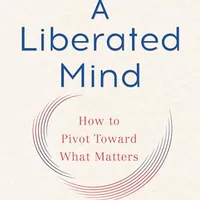
A Liberated Mind: How to Pivot Toward What Matters — Steven C. Hayes
Steven Hayes built ACT after his own panic attack — his definitive book on psychological flexibility, referenced directly in the article's closing line.
As an Amazon Associate, we earn from qualifying purchases — at no extra cost to you.
The central concept isn't happiness, confidence, or peak motivation — though ACT research predicts all three. It's psychological flexibility: Hayes defines it as the ability to "contact the present moment fully as a conscious human being, and to change or persist in behavior when doing so serves valued ends."
In plain language: the capacity to be with what's actually present and move in the direction that matters most — regardless of whether the internal weather cooperates.
Here's what makes that distinction sharp enough to be genuinely useful: research consistently shows that psychological flexibility predicts wellbeing, work performance, relationship quality, and behavioral resilience better than emotional positivity, symptom reduction, or goal attainment. The person who functions well isn't necessarily the person who feels good. It's the person who can move forward even when they don't.
The Problem Isn't Your Thoughts. It's What They Make You Do.
Before ACT, most therapeutic approaches — and virtually all mainstream self-help — operated on a deceptively logical model: negative thoughts cause negative outcomes, so better thoughts produce better outcomes. Replace the distortion. Challenge the belief. Install more useful mental content. The intervention targets the thought.
ACT arrived at a different conclusion, starting with a distinction that sounds subtle but changes everything.
Hayes's framework separates cognitive fusion from cognitive defusion. When you're fused with a thought, you experience it as literal truth and respond accordingly. "I'm not good enough" isn't a thought you're having — it's a fact about reality you're navigating. The thought and the world are merged. There's no gap between the story your mind tells and the situation itself.
Defusion creates that gap. Not by eliminating the thought, not by replacing it with a positive affirmation, but by noticing it as a mental event. "I'm noticing I'm having the thought that I'm not good enough." The content doesn't change. Your relationship to it does.
The research supporting this is unambiguous. Studies on cognitive defusion have consistently demonstrated that it reduces the distress caused by negative self-relevant thoughts without requiring those thoughts to change in frequency or content. The intervention is relational, not editorial.
Try this: say the word "milk" out loud, repeatedly, for thirty seconds. Milk. Milk. Milk. Milk. Somewhere around the halfway point, the word loses its referential weight and becomes just a sequence of sounds. Semantic satiation — the mind's own decoupling mechanism. Language loses its stickiness when the illusion that word equals thing is broken.
That's the principle operating beneath defusion. "I can't do this" is a story your mind is running. When you can hold it that way — as a mental event among others, rather than a verdict handed down — its capacity to stop you shifts.

Sony WH-1000XM5 Noise Cancelling Headphones
Defusion and present-moment contact need quiet. A physical barrier to noise makes it easier to observe thoughts as mental events rather than commands.
As an Amazon Associate, we earn from qualifying purchases — at no extra cost to you.
Why Acceptance Is the Opposite of What You Think It Is
When people first encounter ACT's emphasis on acceptance, the immediate reaction is often suspicion. Doesn't acceptance mean giving up? Tolerating things that should change? Going passive in the face of difficulty?
The ACT definition of acceptance is something meaningfully different from those readings — and the distinction has concrete behavioral consequences.
Acceptance in the ACT framework means making full, non-defensive contact with what is currently present in your experience. Not approving of it. Not deciding it should stay. Not enjoying it. Just not allocating cognitive resources to resisting its presence.
Hayes uses the quicksand metaphor. When you fall into quicksand, every instinct fires toward resistance — struggle, thrash, fight your way out. That's precisely what accelerates sinking. The physics of quicksand require a counterintuitive response: spread your weight, move slowly, stop treating the medium as an enemy. The medium doesn't respond well to being fought.
Emotional avoidance works similarly. The person burning cognitive resources resisting the presence of anxiety before a high-stakes presentation has less processing capacity available for the presentation itself. The anxiety doesn't require defeating before you can proceed — it requires acknowledging. Acknowledgment without resistance frees up what resistance was consuming.
Hayes and colleagues identified what they call "experiential avoidance" — the sustained effort to prevent, escape, or modify unwanted thoughts, feelings, or bodily sensations — as a transdiagnostic mechanism showing up across anxiety, depression, substance use, chronic pain, and organizational burnout. The common denominator isn't the specific difficult content. It's the sustained attempt to avoid having it. In significant measure, the cure that's been prescribed turns out to be a component of the disease.
The Chessboard: You Are Not the Pieces
One of the most practically powerful concepts in ACT has no catchy name, which may explain why it's underrepresented in popular psychology coverage. Hayes calls it self-as-context, or the observing self.
Most of us experience ourselves as the content of our mental lives. You are your thoughts, your feelings, your recurring narratives and identities. When things get difficult, those contents become the whole territory — you're not observing the storm, you're inside it, convinced the storm is you.
ACT proposes a different experiential register: you are the arena in which mental content arises, not the content itself. Hayes uses the chessboard image. There are black pieces and white pieces. They battle — sometimes viciously. But you're not a piece. You're the board. The battle happens on you, not as you. It can be intense without threatening your underlying continuity.
This isn't philosophy for its own sake. The capacity to access the observing perspective — to step briefly into the viewpoint of the one watching the experience rather than the one submerged in it — is one of the most robust predictors of psychological resilience in Hayes's research.
Frank Bond and colleagues at Goldsmiths, University of London, found this playing out in organizational contexts with particular clarity. Their studies show that workers with higher psychological flexibility report lower burnout, higher performance ratings, greater resilience to ambiguous roles, and better learning outcomes when tackling novel task environments. The common thread across all of these: the capacity to observe one's own internal experience without being defined by it — and to act from values rather than from whatever the internal weather happens to be on a given Tuesday.

Values vs. Goals: The North Star That Doesn't Move
Goals can be achieved, ticked off, and replaced. Values can't be finished.
This is one of the most practically useful distinctions in ACT, and one of the most consistently overlooked in mainstream personal development conversation. Most goal-setting frameworks treat goals as the fundamental unit of motivation. ACT treats values as the fundamental unit — and treats goals as useful waypoints in service of those values, not as the organizing principle itself.
Goals are destinations. Values are directions. You can finish a goal; you can never arrive at a value. "Write a book" is a goal. "Create things that contribute something real" is a value. The person operating from the goal has a clear finish line and no inherent guidance beyond it. The person operating from the value has a compass that keeps pointing regardless of what they've achieved and regardless of how uncomfortable the terrain is.
The operative question shifts accordingly. "Is this worth the discomfort?" is a goal question. "Is this consistent with who I'm choosing to be in this domain?" is a values question. Those two questions produce meaningfully different behavior under pressure, particularly in the specific situations where most self-improvement effort breaks down: when the goal feels distant, when progress isn't visible, when someone else appears to be moving faster.
Hayes's values clarification process isn't about writing a mission statement. It's about identifying the directions of living that matter most — independent of whether they feel comfortable at any given moment, independent of external validation, independent of what you've already achieved. The question that cuts through the noise: "What do I want to be about in this area of my life?"

Clever Fox Habit Calendar Circle (Habit & Values Tracker)
A place to run the 'I'm noticing I'm having the thought that...' defusion exercise and to write three values rather than goals.
As an Amazon Associate, we earn from qualifying purchases — at no extra cost to you.
Committed Action: The Part Nobody Wants to Hear About
Everything above is interior architecture. Necessary. But insufficient by itself.
Committed action is where ACT earns its second word. It means building increasingly large patterns of behavior that align with your values — even when anxiety is present, even when confidence is absent, even when the conditions are not what you'd prefer. It's the bridge between psychological understanding and actual change.
Here's the friction point most people don't name honestly: committed action in the ACT framework doesn't wait for readiness. It doesn't require motivation to arrive first or fear to subside before proceeding. It requires only that the action is workable — that it moves in the direction of a value — and that you do it anyway.
This is not willpower in the conventional sense. Willpower is suppression applied to behavior: forcing yourself past resistance through direct force, essentially fighting your own nervous system. Committed action operates from a different mechanism. You act not because you feel ready but because you're clear on the direction. The discomfort is present. You're not pretending it isn't. You're choosing to move anyway because the alternative — not moving — is less consistent with who you're becoming.
The 1,000+ RCTs supporting ACT include populations with chronic pain (where the intervention doesn't eliminate pain but significantly improves functioning and quality of life despite pain), anxiety disorders, depression, burnout, and health behavior change. What the research consistently shows is that psychological flexibility produces clinically significant improvements not just in symptoms but in functioning — how people actually live, not just how they report feeling in controlled conditions.

Kindle Paperwhite 2024 (12th Gen, 16GB)
The article points readers to ACT books and exercises. A dedicated reading device lowers friction for actually doing the work (high-ticket anchor).
As an Amazon Associate, we earn from qualifying purchases — at no extra cost to you.
How to Start Today
The six ACT processes are interconnected, and you don't need to work through them sequentially. But if you're starting from scratch, these five steps produce the fastest useful contact with the framework:
1. Try one defusion exercise this week. Pick a thought that regularly stops you. Write it as a statement: "I'm not ready for this." Now rewrite it in the defused form: "I'm noticing I'm having the thought that I'm not ready for this." Say the original out loud, slowly, 20 times, until it starts to sound like just syllables. Notice whether its authority over your behavior changes — even slightly.
2. Write down three values, not goals. Use the format: "I want to be someone who..." in three life domains that matter to you right now. These should be directions, not destinations. "Showing up consistently for people I care about" rather than "call friends more often." "Creating work I'm genuinely proud of" rather than "finish the project by Q3." The difference in how these feel when you read them back is the difference between a value and a goal.

Full Focus Planner by Michael Hyatt (Linen Hardcover)
Values clarification across life domains — a structured place to write 'I want to be someone who...' in three areas that matter now.
As an Amazon Associate, we earn from qualifying purchases — at no extra cost to you.
3. Find the one action you've been postponing because conditions aren't right. You know exactly what it is. Apply the values lens: is this action consistent with who you're choosing to be? If yes, the conditions question becomes irrelevant. Don't do the whole thing today — do one piece that counts. The piece that requires showing up.
4. Get the practical guide and actually work the exercises. Russ Harris's The Happiness Trap is the most accessible entry point to ACT for non-clinical readers — built around exercises rather than theory, and most people find one or two techniques that produce immediate behavioral shift. Don't just read it. Do the exercises.
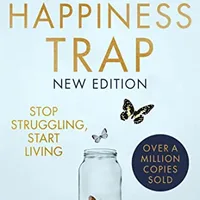
The Happiness Trap (2nd Edition) — Russ Harris
The article's recommended practical guide — exercise-driven ACT for non-clinical readers. Named directly in step 4.
As an Amazon Associate, we earn from qualifying purchases — at no extra cost to you.
5. Expect discomfort. Build around it. The most common practical failure in self-directed ACT is expecting that psychological flexibility will eventually make uncomfortable things comfortable. It won't. It will make you able to move toward what matters while discomfort is present. That's a different — and significantly more durable — outcome.

What You're Actually Building
Here's the thing about psychological flexibility that sets it apart from most frameworks in this space: it describes a capacity, not a state.
You're not trying to achieve flexibility and then maintain it as a permanent condition. You're training a muscle — through repeated contact with the ACT processes, through choosing the values-consistent action over the avoidance-consistent one, through practicing defusion when the stakes are real and the pull toward fusion is strong. The goal isn't a life without difficulty. It's the capacity to move through difficulty toward what actually matters without losing the thread of who you're becoming.
Bob Proctor spent decades talking about the mind's capacity to hold direction regardless of circumstances. Jim Rohn called it the work you do on yourself — the inner architecture that determines what outer conditions you can navigate. The ACT framework gives that aspiration something most of those traditions lacked: a set of specific, evidence-backed mechanisms with hundreds of clinical trials behind them, available to anyone willing to do the work.
Psychological flexibility doesn't remove the hard parts. It removes the extra suffering that comes from fighting the hard parts on top of the hard parts themselves.
That's evolution by design — not despite the difficult terrain, but through it.
What's the thought that's been running your behavior without much examination? The recurring voice that shows up every time you're on the edge of something that matters? You might find that naming it here — in the comments — is itself the first defusion move.
*Want to go deeper? Steven Hayes's own book,
A Liberated Mind: How to Pivot Toward What Matters — Steven C. Hayes
Steven Hayes built ACT after his own panic attack — his definitive book on psychological flexibility, referenced directly in the article's closing line.
As an Amazon Associate, we earn from qualifying purchases — at no extra cost to you.
, walks through the complete ACT framework with the kind of depth and warmth you'd expect from the person who built it.*
Related read: Why imagining their view makes you less judgmental
Was this helpful?