Mindset· 9 min read
Social Comparison Theory: How to Stop Comparing Yourself
Comparison is a 70,000-year-old brain circuit, not a flaw. Here's what Festinger's social comparison theory reveals—and how to redirect it.

Why You Keep Comparing Yourself to Others — And How to Finally Break the Loop
You're scrolling LinkedIn on a Tuesday evening, half-watching something on Netflix in the background, when you see it. Someone from your university — same graduating class, same starter job at a mid-size consultancy, same early chaos of figuring out what you actually want — just announced they've been named partner.
And there it is. That gut-clench. The specific, particular misery of social comparison — measuring yourself against someone who started exactly where you started. It's not that you want them to fail. But the feeling isn't pure joy either. And the worst part isn't the feeling — it's the conversation that follows. The one you have with yourself in the shower the next morning. Why am I so far behind? What have I been doing wrong? Here's what nobody tells you about that moment: it's not a character flaw. It's a feature of human cognition that is approximately 70,000 years old — and it ran perfectly well until someone invented Instagram.
Why Your Brain Was Built to Compare (And Why It Can't Stop)
In 1954, a psychologist at the University of Minnesota named Leon Festinger published a paper that described, with unsettling precision, a mechanism that was already universal before he named it. His social comparison theory had one central observation: human beings have a fundamental drive to evaluate their own opinions and abilities. When objective standards aren't available — no scoreboard, no grade, no clear benchmark — the brain evaluates by comparing itself to other people.
This isn't weakness. It isn't vanity. It's the brain's calibration system.
In the ancestral environment, knowing how your skills compared to others in your group had direct survival implications. The person who accurately understood that they were a better hunter than two specific others but a worse shelter-builder than three could make smarter decisions about division of labor, alliance formation, and resource negotiation. Your relative standing within the group wasn't abstract — it was your best predictor of survival.
The system worked beautifully for roughly 150 people, moving slowly, over decades.
Then we handed it inputs from a billion curated highlight reels and expected it to produce healthy self-assessments.
Festinger's theory distinguishes between opinion comparison (am I thinking about this correctly?) and ability comparison (am I capable enough?). The second is where most of the psychological damage happens — and where social media is most catastrophically efficient at triggering the mechanism. You've probably felt this: you can scroll through dozens of posts and feel broadly neutral, and then a single ability-relevant comparison from the right person hits you like a physical thing.
That isn't irrationality. That's the circuit doing exactly what it evolved to do — with a reference class it was never designed to handle.
cognitive-biases-that-secretly-run-your-life
The Two Directions Your Brain Can Compare — And Why One Wrecks You
Social comparison runs in two directions, and they feel completely different.
Upward comparison — measuring yourself against someone who's doing better on the dimension you care about — is what Festinger's successors have documented most extensively. Thomas Wills showed in a 1981 paper in Psychological Bulletin that upward comparison, in people whose self-concept is threatened, produces a reliable cluster of outcomes: decreased self-esteem, increased envy, and — here's the counterintuitive part — reduced motivation.
The reduced motivation surprises people. You'd think seeing someone further ahead would light a fire. Sometimes it does. But the research shows upward comparison is most likely to produce paralysis and demoralization when the comparison target is similar to you. The more you share in common — same starting point, same field, same age, same initial advantages — the more potent the comparison becomes.
A stranger becoming a billionaire is interesting. Your old classmate closing a Series B is destabilizing. Same circuit, wildly different voltage.
The reason: a similar other eliminates the self-protective story that "they're just categorically different from me." When the comparison target is clearly exceptional from the start, you can protect your self-assessment by attributing their success to exceptional circumstances. When they started exactly where you started? That attribution isn't available. The uncomfortable implication sits there: the gap between where they are and where you are has to be explained some other way.
Downward comparison is the other direction — comparing yourself to people doing worse on the relevant dimension. Wills documented that people under self-esteem threat actively seek these comparisons. And downward comparison does what you'd predict: it temporarily elevates mood and self-esteem.
The keyword is temporarily.
The research consistently shows that downward comparison generates its own costs: reduced motivation (you're already doing well relative to the reference point, so what's the urgency?) and something more uncomfortable — a tendency toward contempt for the people you're comparing down to. It's a mood regulation tool, not a growth strategy. At some level, you know that, which is why it doesn't make you feel better for very long.

Kitchen Safe kSafe Time Locking Container (Medium)
Lands right after the social-media-as-weapon section, supporting intervention #1 ('Audit your passive consumption'). A physical time-lock interrupts the passive-scroll comparison loop the article identifies as the pri…
As an Amazon Associate, we earn from qualifying purchases — at no extra cost to you.
How Social Media Turned a Useful Circuit Into a Weapon
Here's what Festinger couldn't have anticipated in 1954: the comparison system was calibrated for a social environment of roughly 150 people, changing slowly, with organic information about the full range of those people's lives. Social media today delivers billions of people across platforms, changing constantly, with algorithmically curated information weighted toward their best moments.
The reference class has expanded from "my actual peers" to "the highlights of millions of people whose incentive structure rewards presenting their best moments as their typical life."
The research on this specific problem is grim.
The distinction between passive and active social media use has become one of the most documented findings in this literature: looking at others' posts without engaging is consistently associated with significantly worse wellbeing outcomes than active participation. Passive mode is pure input without output, pure comparison without social connection. And passive mode is the default for most social media use.
Philippe Verduyn at KU Leuven used experience sampling in a 2015 study — measuring wellbeing in real time via smartphone throughout the day, not just asking people to reflect afterward — and documented that Facebook use predicted decreased momentary wellbeing. The mechanism was social comparison: the more participants compared themselves to others while on Facebook, the larger the wellbeing decrease.
This wasn't about time spent. It was about the comparison process the use triggered.
The particularly cruel twist: you're comparing your unedited interior to their curated exterior. You know exactly what your self-doubt sounds like at 2am. You only ever see their announcement posts.


Kindle Paperwhite (2024, 16GB)
High-ticket anchor (>£100). Sits after the passive-vs-active social media research — a deliberate swap of passive scrolling for active reading, the article's 'choose active over passive' principle made tangible.
As an Amazon Associate, we earn from qualifying purchases — at no extra cost to you.
The One Comparison That Actually Helps: Looking Backward, Not Sideways
Here's the thing about the comparison drive: you can't turn it off. The system is automatic, pre-conscious, and below volitional control. The goal isn't elimination — it's redirection.
The research distinguishes what it calls temporal comparison — comparing yourself to your own past self rather than to other people — as the reference point that produces dramatically different outcomes. Research has documented that temporal comparison is associated with increased motivation and positive self-evaluation without the costs of social comparison.
The logic is straightforward once you see it. Your past self is not threatening. You are, by definition, better than your past self in any area you've been deliberately working on. The comparison is inherently growth-confirming rather than status-threatening.
More importantly: your own behavioral history is the only evidence that directly pertains to your specific situation and starting conditions. Albert Bandura spent 40 years documenting that the most reliable predictor of future performance is your own past performance — not what others have achieved from different starting points with different resources and different constraints. Your self-efficacy — your belief in your capacity to perform in a specific domain — is best calibrated by what you've already done, not by what others are doing from circumstances you don't fully understand.
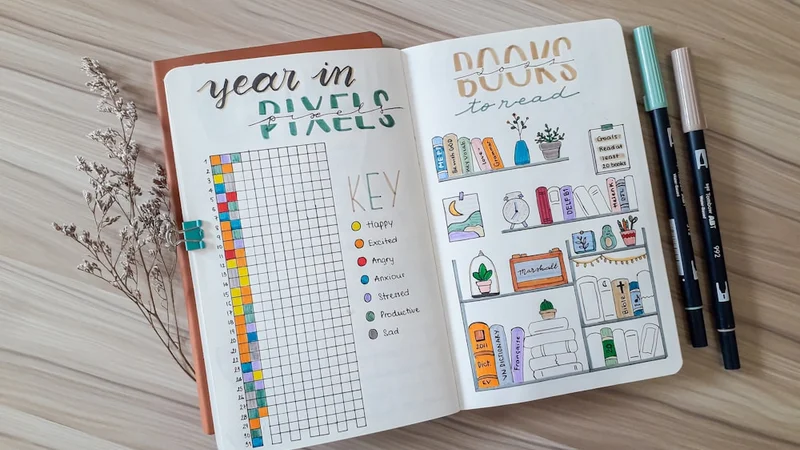
The practical implementation of temporal comparison is keeping a record. Not in a productivity-system sense, but as a way of giving the comparison drive a healthier target. A habit tracker that shows where you were six months ago. A journal where you can read what you were worried about a year ago and measure how far that particular anxiety has receded. A note in your calendar to review what you were working on at this time last year.

Clever Fox Habit Calendar (24-Month Tracker)
Drops into 'The One Comparison That Actually Helps' — the literal tool for the temporal-comparison record the article prescribes ('a habit tracker that shows where you were six months ago').
As an Amazon Associate, we earn from qualifying purchases — at no extra cost to you.
When the comparison drive activates — and it will — the functional response is to redirect it to the question: compared to who I was six months ago, am I moving?
That's the question that produces useful information. The other question — compared to that person on LinkedIn, where do I rank? — produces comparison data that cannot be acted on in any meaningful way, because the comparison target doesn't share your starting conditions, your constraints, your path, or your definition of success. You're comparing your rough draft to their published edition.
self-limiting-beliefs-holding-back-your-potential
The Self-Attack Mechanism Nobody Talks About
There's something the comparison research doesn't fully account for, and it's the part that explains why the aftermath of a comparison event often feels disproportionately damaging.
The comparison itself is rarely the source of sustained damage.
What produces the real psychological hit is what follows the comparison — the self-attack. The internal voice that converts "they're further along than me" into "there's something fundamentally wrong with me." That conversion is not automatic. It's a learned response, and it can be interrupted.
Kristin Neff at the University of Texas at Austin, whose research on self-compassion has produced some of the most consistent findings in positive psychology, documents that the same comparison event — a gap revealed between where you are and where someone else is — produces dramatically different downstream effects depending on how you respond to it.
The response that maximizes damage: treat the gap as evidence of personal inadequacy, then add a layer of self-criticism for feeling bad about the gap in the first place. The inner critic piles on. The comparison becomes an indictment.
The response that doesn't: acknowledge the discomfort, recognize that this kind of gap is part of the normal experience of anyone trying to build something (not unique to you, not evidence of your particular failure), and redirect attention to what you can control.
Neff calls this the "common humanity" component of self-compassion: the recognition that struggle, inadequacy, and comparison pain are not your personal affliction but part of what it means to be a human being trying to grow in a social world. Everyone who's ever tried to build something has felt exactly what you're feeling right now.
The Happiness Trap (2nd Edition) — Russ Harris
Anchors 'The Self-Attack Mechanism Nobody Talks About' (Kristin Neff / self-compassion). Harris's ACT framework is the practical counter to the comparison→self-attack chain the section describes.
As an Amazon Associate, we earn from qualifying purchases — at no extra cost to you.
This isn't soft. It's mechanically protective. The comparison → self-attack chain is the mechanism that turns a passing psychological event into a weeks-long confidence spiral. Interrupting the chain doesn't require denying the gap. It requires refusing to treat the gap as testimony about your worth.
How to Start Today
The practical intervention isn't a mindset shift you sustain through willpower. It's a deliberate redesign of the comparison system's inputs and outputs.
1. Audit your passive consumption. For the next week, notice how you feel after passive scrolling sessions — not during. The during is often numb. The after is where the comparison effects register. Identify the platforms and content types that reliably produce the worst aftermath. That data is actionable.
2. Build a temporal comparison record. Start a five-minute weekly review. Write one sentence about where you were on the thing that matters most to you six months ago. Write one sentence about where you are now. The gain — measured in your own terms — is your actual progress data.

Full Focus Planner — Michael Hyatt
Sits inside intervention #2 at the AMAZON_SLOT_5 marker ('Build a temporal comparison record... a five-minute weekly review'). The Full Focus weekly/quarterly review structure is exactly the cadence the article asks for.
As an Amazon Associate, we earn from qualifying purchases — at no extra cost to you.
3. Redirect comparison events deliberately. When you notice the gut-clench at someone else's visible success, practice one specific question: What's the evidence from my own history that I'm moving in the direction I want? It's not about suppressing the initial reaction. It's about what you do with the 30 seconds after it.
4. Choose active over passive. The research consistently shows that active engagement (commenting, creating, sharing something of your own) produces better wellbeing outcomes than passive consumption. When you use social platforms anyway, tilt toward the active end. You were built for connection, not comparison — the two feel similar in the scroll but produce entirely different downstream effects.
5. Change your reference class. Instead of measuring against a curated social feed, find a community that shares your actual constraints and starting conditions — not the end results, but the process. Other people in the same phase of the same kind of work, talking honestly about the friction. That's a reference class your comparison drive can actually learn from.

The Five Minute Journal (Intelligent Change)
Closes the action section near intervention #4/#5. Its daily gratitude + reflection prompts operationalise both the temporal record AND the self-compassion redirect the article ends on.
As an Amazon Associate, we earn from qualifying purchases — at no extra cost to you.
how-to-build-a-morning-routine-that-actually-sticks
Design the Comparison, Don't Just Endure It
The comparison drive is not going away. Festinger identified a feature of human cognition, not a bug that can be patched. But a feature can be configured.
The person who compares upward, uses millions of strangers' curated highlights as the reference class, and responds to the gap with self-attack is running a comparison system configured for maximum damage. The person who compares temporally, uses their own behavioral history as the primary reference, and responds to gaps with curiosity — and occasional self-compassion — is running the same system configured for maximum growth.
Same circuit. Radically different results.
You don't get to choose whether you have a comparison drive. You get to choose what it points at. You get to choose the reference class, the direction, and the story you tell yourself in the 30 seconds after the comparison fires.
Designing your evolution means designing what you measure yourself against. The default settings haven't been updated since the Pleistocene. And unlike 70,000 years ago, you actually have the tools to change them.
What does your comparison default currently point at — and is that actually the reference class that serves the person you're trying to become?
Was this helpful?