Mindset· 10 min read
Why You Can't Stop Comparing Yourself to Others
Social comparison is hardwired — Festinger proved it in 1954. Here's what 70 years of research reveals actually changes the pattern.

Why You Can't Stop Comparing Yourself to Others
It happened on a Tuesday. I was eating breakfast, barely awake, and I made the classic mistake of opening LinkedIn before my first coffee. Within ninety seconds I'd seen that a former colleague had been promoted to VP, another had just "closed a major strategic partnership," and a third announced their company's seed round. By the time I closed the app, my scrambled eggs tasted like cardboard.
Nothing about my life had changed. But I felt further behind than I had sixty seconds earlier.
You know this feeling — social psychologists call it social comparison. That specific, corrosive drop in the chest when someone else's highlight appears in your feed and your brain immediately triangulates where you stand in relation to it. It doesn't feel like a choice — because it isn't one. It's older than you are. Older than the internet. Older than ambition itself.
And if you've ever tried to "just stop comparing yourself to others," you already know that the advice doesn't work. Here's why — and what actually does.

Leon Festinger's 1954 Discovery: Why Comparing Yourself to Others Is Hardwired
Social comparison theory holds that humans have a fundamental drive to evaluate themselves by comparing to other people whenever no objective measure is available. Proposed by Leon Festinger in 1954 and replicated hundreds of times since, it is one of social psychology's most robust findings — and the root of most comparison-related anxiety.
In 1954, a social psychologist at the University of Minnesota named Leon Festinger published a paper on social comparison processes that would go on to become one of the most cited in the entire history of social science. His thesis was disarmingly straightforward: human beings have a fundamental drive to evaluate themselves. We need to know if our opinions are correct, if our abilities are adequate, if our outcomes are acceptable. And critically, when no objective external standard exists — no thermometer, no test score, no verifiable metric — we evaluate ourselves by comparing against other people.
He called it Social Comparison Theory.
The evolutionary logic is coherent. In the small groups where human cognition evolved — roughly 50 to 150 people, by most anthropological estimates — knowing your relative standing in skills, status, and resources was genuinely useful intelligence. The person who accurately understood that they were the third-best hunter in the band, behind two others with superior technique, had a navigable path: learn from those two, or specialize elsewhere. Social comparison wasn't anxiety; it was calibration.
What served calibration in a 150-person band becomes something quite different when you're exposed to thousands of curated highlight reels daily. The mechanism is the same. The environment is not.
Here's the part that matters most: Festinger never suggested this drive could be switched off. He documented it as structural — as fundamental to the human mind as hunger or sleep. Every piece of advice you've ever been given about "just stop comparing yourself" is, in research terms, telling a hungry person to simply stop noticing they're hungry.
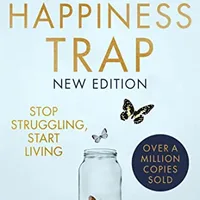
The Happiness Trap (2nd Edition) — Russ Harris
Festinger proved the comparison drive can't be switched off — so the leverage is in how you relate to the thoughts it produces. Harris's ACT framework is the clearest guide to defusing self-worth from automatic compar…
As an Amazon Associate, we earn from qualifying purchases — at no extra cost to you.
The Mechanism Your Brain Can't Override
Thomas Mussweiler at London Business School has done some of the most precise work on what actually happens inside the brain during social comparison — and his findings are humbling.
Social comparison is not a deliberate act you initiate. It initiates automatically, within milliseconds of encountering another person's performance information, operating below conscious awareness and prior to any voluntary evaluation. Through a series of priming experiments, Mussweiler showed that even subliminal exposure to another person's success activates comparison processes before any conscious thought is possible.
You don't decide to compare. The comparison happens, and then you become aware of it.
This distinction matters practically. Most self-help advice about comparison implicitly assumes it's a conscious choice you can opt out of — "just don't compare yourself to others," the wellness accounts instruct, with the casual confidence of someone who has never had a brain. What you can actually do is intervene at the downstream point: how you interpret and respond to the comparison once it's already running.
Research identifies two primary variables that shape the emotional outcome. First, the direction of comparison: upward (toward someone performing better) or downward (toward someone performing worse). Second, the perceived controllability of the gap between you. Upward comparison produces inspiration when the gap feels closeable — when the person ahead is seen as evidence of what's possible. It produces threat and demoralization when the gap feels fixed, permanent, or attributable to factors outside your control.
The same LinkedIn post about someone's promotion produces two completely different responses in two different people, because the comparison is identical but the perceived controllability is not. This is good news. The controllability framing is something you can change.
Why Your Friend's Promotion Hurts More Than a Stranger's
Here's the dynamic that nobody in the wellness space talks about, because it's uncomfortable. Abraham Tesser at the University of Georgia developed the Self-Evaluation Maintenance Model in the 1980s, and it explains something you've almost certainly experienced without having a framework for it.
Upward comparison hurts more when the person doing better is psychologically close to you.
Not a competitor you've never met. Not a celebrity whose world is visibly different from yours. The sharpest pain is the friend who got the promotion you were both targeting. The colleague who started the company you'd been talking about for two years. The person in your writing group who published first. The proximity amplifies the relevance of the gap — the closer the person, the harder it becomes to discount their success with "they had advantages I didn't."
Tesser documented this through studies showing that people actively manage their social environments to protect self-evaluation: distancing from close friends who outperform them in personally meaningful domains, subtly deflating others' achievements in their own minds, tending to excel in areas where their social circle performs poorly. The psychological gymnastics are sophisticated and largely unconscious.
The counterintuitive implication: your social circle shapes the comparison set you live inside, and that comparison set shapes your self-evaluation in ways that feel like objective reality. It isn't. It's an environmental artifact.
This doesn't mean surrounding yourself with people who perform worse — that's the downward comparison trap, briefly comforting, ultimately stunting. It means recognizing that your felt sense of "how I'm doing" is not a measurement of anything fixed. It's a ratio that shifts as the denominator shifts.
How Instagram Weaponized Your Brain's Most Ancient Drive

The attention economy didn't invent social comparison. It industrialized it.
The major social platforms are, in the most precise behavioral science sense, comparison engines designed to maximize engagement through comparison frequency. Variable-ratio reinforcement — the same schedule that makes slot machines neurologically irresistible — delivers unpredictable social validation signals (likes, follows, comments) on a timing that maximizes anticipatory attention. The content itself is comparison-optimized: filtered, curated presentations of life's best moments, stripped of context, delivered at a volume and velocity that no 150-person ancestral band could have produced.
Read more: What neuroscience reveals about dopamine and motivation
Jean Twenge at San Diego State University has been tracking generational wellbeing data since before smartphones existed. Her longitudinal research, detailed in iGen (2017) and Generations (2023), identified a sharp inflection point in adolescent life satisfaction, depression rates, and self-esteem measures at almost exactly the moment of smartphone saturation — roughly 2012 to 2013. The correlation is not proof of causation, but the mechanism is coherent, and Twenge's conclusion is increasingly supported by experimental evidence: constant comparative exposure via social platforms produces measurable psychological harm, concentrated in the domains of social evaluation and self-worth.
The honest version of this insight is uncomfortable. Most of us have a complex, somewhat resentful, deeply habitual relationship with platforms we know aren't serving us. We're aware of the cost and we stay anyway. That's not a willpower failure — it's the expected behavioral outcome of a variable-ratio reinforcement schedule designed by some of the best engineers on earth, specifically to exploit the Festinger comparison drive.
Knowing this doesn't immediately fix it. But it does reframe the problem from a personal weakness into a structural one. And structural problems have structural solutions.
The One Variable You Can Actually Control
Here's the research that doesn't get nearly enough attention.
Sonja Lyubomirsky at the University of California Riverside has spent decades studying what actually distinguishes chronically unhappy people from happy ones, and one of her most consistent findings concerns social comparison directly. Unhappy people engage in more frequent, more automatic, and more self-referential comparisons than happy people. But they're not more sensitive or more fragile. They're using a comparison standard that is systematically designed to make them feel inadequate.
The standard they use by default: other people's performance in visible, socially valued domains.
Happy people compare too — everyone does. But Lyubomirsky documents that they compare more selectively, more often downward or laterally, and with a crucial cognitive frame shift: rather than interpreting upward comparison as evidence of what they lack, they read it as evidence of what is achievable. The person ahead of them is data about the upper bound of the possible, not proof of their own deficiency. The same LinkedIn post. Completely different emotional output.
That frame shift sounds simple. It isn't — you can't just decide to feel differently. But it points to the real leverage point: the standard of comparison is more changeable than the drive to compare.
Read more: Fixed vs growth mindset – why capable people often grow slowest
The most consistently supported intervention in the research is substituting temporal self-comparison for social comparison — measuring where you are against where you were six months ago, a year ago, three years ago, rather than where others are today.
This is what Dan Sullivan and Benjamin Hardy call "the gain" in The Gap and the Gain: measuring backward from where you started rather than forward toward an ideal, or sideways to someone else's visible best. The gain is always real, because you have actually moved. The gap always makes you feel behind, because the comparison standard for gaps is either an imagined ideal (which expands as fast as you approach it) or someone else's curated highlight, which will never stop improving.

The Gap and the Gain — Dan Sullivan & Dr. Benjamin Hardy
This is the exact book the article references: measuring backward from where you started ('the gain') instead of toward an ideal or someone else's highlight ('the gap'). The single most on-topic purchase for this piece.
As an Amazon Associate, we earn from qualifying purchases — at no extra cost to you.
How to Redesign Your Comparison Standard

Here's an opinion that tends to make people uncomfortable: most social comparison advice is aimed at the wrong target. "Spend less time on social media," "curate your feed," "unfollow people who make you feel bad." These interventions reduce exposure, which reduces comparison frequency at the margin. But they don't address the underlying mechanism — the fact that your brain will compare against whatever reference points are available, and if you don't consciously choose those reference points, the environment will choose them for you.
The real shift isn't about reducing comparison. It's about designing the comparison set.
Cal Newport's Digital Minimalism offers practical guidance on intentional technology use.
Here's a six-step process that actually works:
Step 1: Name your current default standard. Write it down. "I compare my career progress to X." "I compare my productivity to Y." "I compare my relationship to Z." The standard is almost always implicit until you name it, and it's surprisingly hard to change something you haven't articulated. Take five minutes and do this honestly.
Step 2: Audit whether the domain is actually yours. A significant portion of what we feel behind on are things we don't genuinely value — we've just been exposed to them often enough that they've migrated into our self-evaluation framework by proximity. Ask: would I care about this if nobody could see it? If the answer is no, that's not a goal — it's a comparison artifact.
Step 3: Build a personal benchmark document. A notebook or journal where you track where you were in the domains that genuinely matter to you. Review it quarterly. The progress is almost always visible when you measure backward. It becomes invisible only when you're measuring sideways. This isn't toxic positivity — it's a measurement correction.
Step 4: Reframe upward comparison intentionally. When you notice an upward comparison firing — you see someone ahead of you in a domain you care about — pause for three seconds and ask: is this evidence of what I lack, or evidence of what's possible? The same information generates completely different emotional and motivational responses depending on which question you bring to it. Lyubomirsky's research suggests happy people run this reframe almost automatically. For everyone else, it requires deliberate practice until it becomes automatic.
Step 5: Reduce the variable-ratio feed as an engineering decision. Not because social media is evil, but because platforms are specifically designed to maximize comparison frequency. Reducing your exposure reduces the rate at which someone else's comparison standard gets injected into your attention. Cal Newport's framework in Digital Minimalism is the clearest practical guide to doing this without moral judgment.
Step 6: Track the gap between what you pursue and what you actually value. Once a week, note what you spent time and attention on. Ask whether those things align with the domains you chose in Step 2. Most people discover a significant mismatch — they're chasing visibility in domains the social environment rewards, not depth in domains they've chosen. This weekly audit is the most powerful recalibration practice I've found.
The Standard You Didn't Choose Is Still Running Your Life
Leon Festinger never told you to stop comparing yourself to others. He told you that you can't — and more importantly, that the drive is not pathological. It's structural. The question was never whether you compare. It's whether you're the one choosing the benchmark.
Because here's what's actually at stake. The benchmarks you compare yourself against shape your sense of progress, your definition of success, the direction of your daily effort, and ultimately the version of yourself you become. Most people inherit these benchmarks by default — from whoever is most visible in their network, their feed, their industry, their culture. That is a design decision made without their participation.
"Design Your Evolution" is a claim about agency. Not the absence of difficulty. Not the absence of comparison. Agency over the standards you evolve toward.

Kindle Paperwhite 2024 (12th Gen, 16GB, Black)
'Design Your Evolution' is about choosing your own benchmark. Swapping the infinite-comparison feed for chosen long-form reading is the most concrete version of that swap — high-ticket close to the article's agency me…
As an Amazon Associate, we earn from qualifying purchases — at no extra cost to you.
Which benchmarks are you currently using that you didn't consciously choose? And if you replaced even one of them with a standard you actually believe in — something you'd care about at 80 even if nobody else could see it — what would change about how you spent tomorrow morning?
Was this helpful?