Mindset· 11 min read
Why Calm Company Stops a Panic Attack
Calm presence measurably quiets the brain's threat response during a panic attack — and the effect scales with trust. What Coan's 2006 study found.

Why Calm Company Stops a Panic Attack (When Words Make It Worse)
She was hyperventilating — full panic attack — and I was doing everything wrong.
"You're safe," I said. "Your heart is fine. Nothing bad is actually happening — this feeling will pass in a few minutes." I'd read that somewhere. I said it twice, then a third time. I listed facts. I ran through the evidence. I was thorough, measured, and almost certainly the most useless I'd ever been inside a moving vehicle.
The more I talked, the worse it got.
Eventually I ran out of words. I just reached over and put my hand on her arm. Stopped looking for the right sentence.
She started to breathe again.
I've thought about that moment more than I'd care to admit. Was it just the panic attack running its natural course? Was it the physical contact itself? Or was there something specific about what happened the moment I stopped trying to perform helpfulness and simply stayed?
Turns out there's a 2006 brain-imaging study that answers this almost exactly. And the answer is stranger and more useful than "physical touch is calming."
The real finding is this: your brain was never designed to face threats alone. When a trusted person is calm and physically nearby during a panic attack, your nervous system measurably reduces its threat response — an effect proportional to the quality of the relationship and completely independent of anything that person says. The study is James Coan's. The journal was Psychological Science. And if you've ever wondered why someone staying calm next to you during a panic attack actually helps when rational reassurance doesn't, this is the explanation the data points to.
The Experiment That Put Married Women in an fMRI and Threatened Them
James Coan, a psychologist at the University of Virginia, published Lending a Hand: Social Regulation of the Neural Response to Threat in Psychological Science in 2006, with co-authors Hillary Schaefer and Richard Davidson. The design was simple. The results weren't.
Coan placed 16 married women inside an fMRI scanner and warned them they might receive a mild electric shock — a signal light indicated when a shock was possible. Each woman experienced three conditions: holding no hand at all, holding the hand of a male stranger (an experimenter), and holding the hand of her husband.
The scanner measured blood flow in threat-responsive brain regions — the areas that mobilize when the nervous system perceives danger. More activity in those regions during a threat signal means a higher neural threat response.
The results came out cleanly. Holding any hand reduced threat-region activation compared to holding no hand. But holding a husband's hand produced a substantially larger reduction than holding a stranger's. And here's the piece that makes Coan's research specific rather than generic: the size of that calming effect scaled with each woman's marital quality — measured through a standardized marital-satisfaction assessment.
More trust in the relationship. More quieting of the threat response.
This wasn't physical contact doing the work in isolation. A stranger's hand was warm and real and present too, but it produced a fraction of the neural effect. What determined the magnitude of calming was the quality of the relationship that the contact represented.
The implication runs deeper than one experiment about hand-holding in a scanner.
What Your Brain Is Actually Doing When You Feel Safer Around Someone
Coan built a theoretical framework around these findings called social baseline theory. It's worth understanding, because it shifts what's happening neurologically when a calm person sits near you from "nice" to "structural."
The standard assumption is that emotional regulation is a solo project. When you're frightened, your brain handles the fear — marshaling internal resources, suppressing the threat response, restoring equilibrium. Other people can help, can offer comfort, can provide reassurance. But the machinery of self-regulation, in this view, belongs to the individual doing the regulating.
Social baseline theory pushes back on this at a fundamental level.
Coan's argument is that the human brain evolved over hundreds of thousands of years in conditions of near-constant social proximity. We hunted in groups, slept in groups, raised children in groups, faced predators in groups. Being near familiar, trusted people wasn't an occasional comfort — it was the evolutionary baseline. The brain that formed under those conditions developed to treat the presence of trusted companions not as an emotional add-on but as a genuine external resource for managing threat.
Put plainly: your nervous system partially outsources threat regulation to trusted others.
When a trusted, familiar person is physically nearby, your brain doesn't have to run the full internal cost of managing the threat response alone. Some of that work gets distributed outward. Conversely, when you're facing something frightening in complete isolation, you're running that regulation at full internal expense — metabolically costly, physiologically draining, and, in evolutionary terms, the genuinely abnormal condition.
Being alone in a frightening situation doesn't just feel worse. It is worse, by a measurable margin.

LectroFan Classic White Noise Machine (Global Power Edition)
Lowering ambient threat load is the practical side of social baseline theory — a steady, non-looping sound floor reduces the sensory alarm the nervous system has to process alone.
As an Amazon Associate, we earn from qualifying purchases — at no extra cost to you.
And it's why the physical presence of a trusted person during acute distress can do something that information and advice simply cannot.
Why Saying the Right Thing Often Makes It Worse
This is where most people — including me, driving on that highway — get it completely backwards.
The instinct when someone panics is to communicate. To find the right thing to say. To explain, to reassure, to de-escalate through accurate information. "You're safe. Nothing bad is actually happening. Focus on your breathing." If the first round doesn't land, we try better words. More patient delivery. More evidence.
But acute stress does something specific to the brain that makes this the wrong tool for the moment.
When the threat system activates sharply — the rapid, escalating alarm of a full panic attack — the parts of the brain responsible for evaluating sentences get crowded out. Not switched off entirely. But the prefrontal cortex runs expensive processes: weighing evidence, revising beliefs, constructing a logical update to emotional state based on incoming information. Under high threat arousal, the brain shifts resources toward survival-relevant systems — heightened sensory vigilance, cardiovascular mobilization, faster motor responses. Elaborate sentence processing isn't among the priorities.
This is why "you're safe" so often registers as noise during a panic attack. The words are accurate. The delivery is calm. But they're addressed to a cognitive process that's currently running at a significant discount.
What the nervous system can still receive — without any discount at all — is the non-verbal signal of a familiar, regulated presence nearby.
Coan's fMRI data showed neural calming with no verbal communication whatsoever. The women weren't told anything useful. No one explained why the shock probably wouldn't come. No one ran through the logical reasons to stay calm. A trusted person held their hand, and their brains responded.
Words are processed by a brain that can afford to process them. Presence is registered by a nervous system that's still fully online.
The Distinction That Changes How You Use This Research
If you've read about social support and stress, you've likely encountered the buffering hypothesis — research developed by Sheldon Cohen and Thomas Wills and published in Psychological Bulletin in 1985, finding that having a supportive social network protects people against the impact of stressors on their mental and physical health. That research is real and worth understanding.
But it's describing a different mechanism than Coan's, and the distinction matters for how you apply any of this.
The buffering hypothesis concerns the generalized, background belief that support would be available if you needed it. It's a diffuse sense of not facing the world alone — measurable through surveys about your social ties — and it functions as a kind of ambient psychological protection that makes current stressors feel less threatening, because somewhere in the background is the felt knowledge that people have your back.
It's worth noting this runs on a parallel track to social comparison theory, which explains a different way other people's presence — this time their example rather than their touch — quietly shapes how you evaluate yourself.
Coan's fMRI study measured something categorically different. Not a background belief. Not a felt sense of future availability. A real-time neural response, occurring during an active stressor, to the literal physical presence of a trusted person in that specific moment.
The calming wasn't something the women consciously thought about or chose to accept. Their brains just did it — measurably, in blood flow to threat-responsive regions — while the threat signal was still live.
Knowing that support exists is valuable. But when the question is "why does having someone calm nearby during a panic attack actually help in the moment?" — the explanation is Coan's mechanism: immediate, physiological, proportional to trust, and fully independent of anything anyone says.

The Good Life — Robert Waldinger & Marc Schulz
The article's core claim — calming effect scales with relationship quality — is the Harvard Study of Adult Development in one line. Waldinger's book is the deep-dive on why trusted relationships are the resource.
As an Amazon Associate, we earn from qualifying purchases — at no extra cost to you.
How to Actually Be a Calming Presence
So what does this mean practically? If you care about someone who experiences panic, or you want to be genuinely useful when someone near you is in acute distress, Coan's research points to a handful of specific things — and most of them will feel counterintuitive at first.
-
Start with yourself, not with them. This is the step most people skip entirely. Social baseline theory cuts both ways: your nervous system isn't just sending words, it's transmitting state. If you're visibly anxious, tense, or quietly frustrated at your own inability to help, you are not functioning as a regulatory resource. You're adding to the threat load. The most useful thing you can do for someone panicking is to get your own nervous system regulated before you do anything else. Slow your breathing down deliberately. Make your exhales longer than your inhales. Thirty seconds of genuinely calm, slow breathing on your end will do more than any sentence you could formulate.
-
Stop producing words. There is no sentence you're going to find that will outperform what your regulated presence is already doing. This isn't permanent silence — you can and will speak again. But the first move is to stop the verbal output and let the older, more reliable mechanism do its work. The urge to talk is usually about managing your own discomfort at witnessing someone else's distress. Naming that clearly to yourself is useful.
-
Get close, but let them regulate the contact. Coan's research found that physical proximity mattered — but what determined the magnitude of neural calming was the relationship quality behind the touch, not the touch itself. A stranger's hand helped measurably less than a spouse's. So offer presence rather than impose it. Reduce the physical distance. Sit near. Let them decide whether they want contact, and follow their lead. Having something grounding physically available — a weighted blanket within reach, something textured to hold — gives their nervous system a grounding input they can self-regulate with, rather than something being done to them.
-
Stay through the quiet part. Panic attacks are physiologically bounded. They peak and then the autonomic system comes back down. A lot of people provide presence through the worst of it and drift away once things seem to be improving. But the relationship quality that determines how much calming effect your presence actually has — the marital-satisfaction measure Coan tracked — is built through exactly those post-crisis moments of quiet, continued company, not only through crisis response.
-
Invest in the relationship before you ever need this. The effect Coan documented was proportional to trust built across years of ordinary consistency. You can't manufacture that at the moment someone needs it. The presence that measurably quiets another person's nervous system during acute distress is earned through reliable, attuned attention over time — through showing up for small things long before anything becomes a crisis. The long game isn't the slow path to helping someone. It's the only path to the kind of helping that actually reaches them.
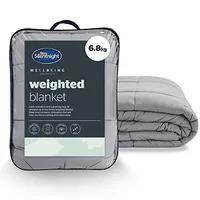
Weighted Blanket for Anxiety (Deep-Pressure / Grounding)
The body copy names this directly: 'a weighted blanket within reach, something textured to hold.' Deep-pressure input is a grounding resource the person can self-regulate with — exactly what point 3 recommends.
As an Amazon Associate, we earn from qualifying purchases — at no extra cost to you.

How much you trust the person offering that contact traces back to the attachment style shaping your relationship patterns — and the research on where those patterns come from, and how they can change.

Liforme Original Yoga Mat (Alignment System, Breathing/Grounding Base)
Point 1 is 'start with yourself' — slow, long exhales before you do anything. A dedicated mat gives the daily breathing/regulation practice a home, so your own nervous system is regulated before a crisis arrives.
As an Amazon Associate, we earn from qualifying purchases — at no extra cost to you.
If you want to go deeper on the physiological science behind how the body stores and releases threat responses — and why healing from stress and trauma is so fundamentally a social rather than a solo process — the research literature here is genuinely worth your time. What Coan's fMRI findings point to fits into a much larger picture about why co-regulation is built into our biology from the start, not added on as a feature later.

The Body Keeps the Score — Bessel van der Kolk
The definitive book on how the body stores and releases threat responses — and why healing from stress and trauma is so fundamentally a social process, not a solo one.
As an Amazon Associate, we earn from qualifying purchases — at no extra cost to you.
Design Your Evolution
Here's what I keep returning to from Coan's research.
Most of us are spending significant energy trying to manage our stress responses entirely internally — through willpower, better self-talk, journaling, meditation, habit systems. Those tools are real and worth using. But the brain-imaging data suggests we may be systematically underutilizing one of the oldest and most efficient regulatory resources humans have ever had: the calm, trusted, physically present company of another person.
Not their advice. Not their solutions. Not their words.
Their presence.
That's not a soft observation about emotional support. It's a measurable neural effect that scales with relationship quality and operates in real time during acute threat. Which means becoming someone whose presence genuinely calms others isn't only a social skill — it's a physiological one. And building the kinds of relationships where that calm transfers isn't a luxury. According to the data, it might be one of the most consequential investments in resilience — yours and theirs — that's available to you.
The question worth sitting with today: who, in your life right now, has earned that level of trust with you? And when did you last do the quiet, consistent work of earning it with someone else?
The next time someone you care about is panicking, what do you think will be harder — finding the right words, or actually saying nothing? I'd be curious to hear what you've noticed in the comments.
Was this helpful?