Mindset· 9 min read
What Are Mental Models and How to Use Them
Charlie Munger called it a latticework of models. The mental models that sharpen your thinking — and how to apply them to your own decisions.

What Are Mental Models — And How to Actually Use Them to Make Better Decisions
Three years ago, I took what looked like the perfect opportunity.
Better salary. More flexibility. Work I was genuinely excited about. Every item on the checklist looked great. I said yes within 48 hours.
Six months later, I was more stressed, less productive, and genuinely puzzled about what I'd missed. The salary was real. What I hadn't calculated was everything attached to it: two stakeholders whose priorities contradicted each other on a weekly basis, a culture that rewarded visible busyness over actual output, and a 75-minute commute that consumed the two hours of early-morning focused thinking that had been my sharpest edge for years.
The opportunity wasn't bad. My thinking was.
Not because I was unintelligent — I'd read the books, asked the right questions, believed I was being deliberate. The problem was simpler: I was analyzing the situation through a single lens. Does this look like a good opportunity? And that one lens, by design, couldn't see what was sitting in the second and third layers of the decision.
What I needed wasn't more information. I needed better thinking tools.
I needed what Charlie Munger calls a latticework of mental models — and understanding what are mental models and how do you use them to make better decisions is, I'd argue, one of the highest-leverage intellectual investments you can make.
What Are Mental Models — and Why Most People's Toolkit Is Dangerously Narrow
A mental model is a framework: a simplified map of how some piece of reality works. You already use them, consciously or not. "Past behavior predicts future behavior." "You get what you measure." "Every complex system has unintended consequences." These are all mental models.
The problem isn't that people don't use them. It's that most people use too few, and those few tend to come from a narrow band of disciplines — usually whatever field they work in. So when a complex situation arrives, one that simultaneously touches psychology, economics, systems dynamics, and human nature, the single-lens thinker sees only the portion their lens reveals.
In his landmark 1994 lecture at USC Business School, Munger was unusually blunt about this. He argued that the primary intellectual failure mode of otherwise intelligent people is the specialist's trap: the economist who interprets everything through incentives, the psychologist who sees everything as bias, the engineer who reduces every problem to specifications. Each lens is partially right. None is complete. And the person who insists on applying only one lens will keep being surprised by the parts of reality their lens can't detect.
His prescription: build a latticework of the "big ideas" from multiple disciplines — physics, biology, psychology, economics, mathematics, engineering, history — and apply them in combination to every significant problem you face. The more models you have, the more angles you can triangulate from. The result isn't just marginally better decisions. It's a fundamentally different quality of reasoning.
Munger's own speeches, letters, and annotations on this philosophy were gathered into the book that serious investors — and serious thinkers in every field — keep closest to hand.

Poor Charlie's Almanack
Munger's speeches, letters, and annotations gathered into a single volume — the definitive primary source for the latticework philosophy, organized for deliberate study.
As an Amazon Associate, we earn from qualifying purchases — at no extra cost to you.
Here are the six mental models that have changed the quality of my thinking most decisively, and how to actually apply each one before your next decision matters.

First Principles: Stop Borrowing Other People's Assumptions
First principles thinking is ancient, genuinely powerful, and mostly unused outside of academic philosophy and a handful of tech founders who've read too much Aristotle.
The idea: decompose any problem to its most fundamental, irreducible truths, then reason forward from there — not from analogy, not from convention, and not from "that's how it's always been done." Strip away the inherited assumptions until you hit bedrock, then build your answer from the ground up.
Elon Musk applied this to battery technology around 2012. The prevailing wisdom in the automotive industry was that battery packs cost roughly $600 per kilowatt-hour and that was simply the market reality — something to be accepted and worked around. Musk asked a different question: what are the actual raw materials in a battery, and what do those materials cost on the commodity market today? The answer was approximately $80 per kilowatt-hour. The $520 gap between that number and the market price was assumption, not physics. That gap was the insight that drove the Tesla battery cost reduction program.
You don't need to be building electric cars for this to apply.
First principles works on anything you've accepted as fixed. Your work schedule. Your creative process. The way your team makes decisions. Your financial structure. The question isn't "how do I optimize within these constraints?" It's "are these constraints actually real?"
The three questions that make it practical: What do I believe to be true about this situation? Which of those beliefs am I accepting on faith rather than from direct evidence? What would I design if I were starting with none of those constraints? Most people stop at question one. The leverage is entirely in question three.
why you make your worst decisions when it matters most
Inversion: Think Backwards to Solve Forward
The 19th-century mathematician Carl Gustav Jacob Jacobi had a motto that Charlie Munger has cited so many times it might as well be carved into the wall of Berkshire Hathaway: "Man muss immer umkehren." You must always invert.
Some problems are nearly impossible to approach by reasoning forward from a starting point. But they become tractable — sometimes startlingly obvious — when you flip the question entirely.
Instead of asking "how do I build a productive morning routine?" ask: "what would guarantee that my mornings are a complete waste of time?" Check the phone the moment you wake up. Have no clear intention for the day. Start reactively, responding to whatever arrives in your inbox or messages before you've done a single thing of your own choosing. Skip any form of movement. Eat something that crashes your energy by 9am.
Now just don't do any of those things.
This sounds almost trivially simple. It isn't. Inversion bypasses the optimism bias that drives most planning failures — the deeply wired tendency to model the world as we want it to be rather than as it actually is. When you explicitly map the failure conditions before you start, you identify the real obstacles before you've committed time and resources to ignoring them.
Munger applies inversion to investing constantly. Rather than asking "how do I find a great business?" he asks "what makes a business reliably terrible?" and builds a systematic avoidance list from the answers. The wisdom isn't in finding the exceptional; it's in reliably avoiding the bad. The same logic applies to your decisions.
Shane Parrish at Farnam Street has catalogued inversion alongside the other foundational models in a book that's unusually practical — built around applying these frameworks to actual decisions, not just understanding them abstractly.

The Great Mental Models — General Thinking Concepts
Shane Parrish's guide to the foundational models — inversion, first principles, second-order thinking — built around applying them to actual decisions, not just understanding them abstractly.
As an Amazon Associate, we earn from qualifying purchases — at no extra cost to you.
Second-Order Thinking: The Consequences Your Decision Creates
Every action produces a first-order consequence. Most people stop there — because the first-order consequence is visible, immediate, and easy to measure.
Second-order thinking asks: and then what? And then what after that?
The 19th-century economist Frédéric Bastiat described this problem with brilliant simplicity in 1850 through the "broken window fallacy." A shopkeeper's window is smashed. The glazier gets paid. Economic activity — great! Except: the shopkeeper would have spent that same money on new shoes. The cobbler receives nothing. The net economic effect is precisely zero; the visible benefit was celebrated while the invisible cost went entirely unnoticed.
This failure mode shows up everywhere. A company implements a policy that produces great short-term metrics and quietly destroys long-term culture. A person takes a shortcut that saves three hours this week and creates eight hours of rework next month. A government incentivizes a behavior that produces the opposite of the intended effect five years down the road.
First-order thinking notices the glazier got paid. Second-order thinking asks who didn't.
The practical discipline is simple, if uncomfortable: before any significant decision, write down the obvious first-order consequence — the one everyone can see. Then force yourself to write three second-order consequences. Go specifically looking for the unintended ones, the ones that aren't obvious, the ones that show up six months later. The second or third effect is almost always the one that matters most, and reliably the one nobody else saw coming.
Circle of Competence: The Boundary That Protects You from Yourself
Warren Buffett has said this so many times it's become invisible from repetition: know what you know, know what you don't know, and know which is which.
Most bad decisions don't come from incompetence. They come from competent people operating outside their circle of competence without realizing it. The marketing strategist confidently offering opinions on financial derivatives. The programmer certain about organizational dynamics she's never studied. The investor who compounded money well in one sector and assumes the same insight transfers cleanly to another, entirely different one.
David Dunning and Justin Kruger documented the underlying mechanism in their landmark 1999 paper: the ability to recognize your own incompetence is itself a developed skill. Beginners don't know what they don't know. Experts know exactly how much they don't know — and that calibration is precisely what makes expert judgment trustworthy.
The practice isn't complicated: before you offer a strong opinion or make a significant commitment, ask yourself honestly which circle you're operating in. Inside your circle, act decisively. Outside your circle, get curious, get genuine expert input, or get quiet. The value of the model isn't in having the largest possible circle — it's in knowing exactly where the boundary sits and respecting it.
Peter Bevelin spent years studying how Munger and Buffett actually think — not just what they say publicly, but the underlying frameworks — and synthesized the core of their approach into a book that's demanding, dense, and entirely unlike anything in the standard self-help canon.

Two Models You Can't Afford to Skip
Two more frameworks that each deserve their own section but are strong enough to share one.
The Map Is Not the Territory comes from Alfred Korzybski's work in General Semantics: every mental model, every belief, every confident "I know how this works" is a map of reality. A useful simplification. Not the thing itself. The danger — in relationships, in business, in self-knowledge — is treating your map as the actual landscape.
Your mental model of your partner is not your partner. Your model of your market is not your market. Your model of yourself — especially the limiting beliefs that feel like observations — is not you. The person who holds their models lightly, who remains genuinely curious and stays open to evidence that the map is wrong, navigates far more accurately than the person who defends their map as though it were the truth itself.
Held loosely, mental models are tools. Held rigidly, they become blindfolds.
Opportunity cost is the foundational economic mental model and the one people most reliably fail to apply to their own time and attention. Every decision to do something is simultaneously a decision not to do the next best alternative. The real cost of three hours of low-value activity isn't zero — it's whatever those three hours would otherwise have produced.
Applied clearly, opportunity cost helps you make choices that actually reflect what you value, not just what's available or convenient in the moment. That's a different standard — and a more useful one.
Quick Reference: Six Mental Models at a Glance
| Mental Model | Core Question to Ask | Best Applied When |
|---|---|---|
| First Principles | What is actually true here, vs. what have I accepted as given? | Feeling constrained by convention or past decisions |
| Inversion | How could this fail? What would guarantee a bad outcome? | Planning anything with real stakes |
| Second-Order Thinking | And then what? What does this decision create downstream? | Decisions with delayed or non-obvious consequences |
| Circle of Competence | Am I inside or outside my genuine expertise right now? | Before offering strong opinions or making big bets |
| Map ≠ Territory | Is my model of this situation still accurate? | When outcomes surprise you or someone pushes back |
| Opportunity Cost | What am I not doing by choosing this? | Allocating time, attention, or capital |
the science of time management — what research actually shows
How to Actually Build Your Mental Models Toolkit
Fair warning: here's the mistake most people make when they discover mental models. They try to learn all of them at once. They bookmark forty frameworks, buy six books, and apply none.
Start with three. For the next 30 days, actively look for those three models in every significant situation you encounter. The models you apply consistently are worth ten times the models you've merely read about.
Step 1: Choose your starting three. First Principles, Inversion, and Second-Order Thinking cover the three most common decision failure modes: inherited assumptions, ignored failure conditions, and missed downstream consequences. These three, applied consistently, will change your thinking within a month.
Step 2: Keep a decision journal. Before any consequential decision, write the question, your reasoning, which models you're applying, and your conclusion. After the outcome becomes clear, return and write what you got right, what the models missed, and what you'd change. This feedback loop is what converts reading about mental models into actually thinking with them.
Step 3: Build a physical reference system. Index cards are unglamorous and genuinely effective. One model per card: the name, a one-sentence definition, the discipline it comes from, and one concrete example from your own experience. Review the deck weekly. The models you revisit regularly are the ones you'll actually reach for when a real decision arrives.

Oxford Ruled Index Cards
One model per card, reviewed weekly — the low-tech habit that bridges reading about frameworks and actually reaching for them when a real decision arrives.
As an Amazon Associate, we earn from qualifying purchases — at no extra cost to you.
Step 4: Expand deliberately. Once you've internalized the foundational models, build systematically across disciplines. Gabriel Weinberg and Lauren McCann catalogued over 300 mental models applied to everyday decisions — from cognitive science to physics to economics — in a book that works as both a reference and a curriculum for building a genuine latticework.
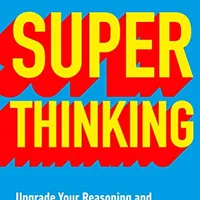
Super Thinking: The Big Book of Mental Models
Over 300 mental models — from cognitive science to physics to economics — catalogued as a working curriculum for building the multi-disciplinary latticework Munger described.
As an Amazon Associate, we earn from qualifying purchases — at no extra cost to you.

Design Your Thinking, Design Your Life
Charlie Munger read voraciously until his final weeks at 99. Not because he had something to prove. Because the latticework was never finished — there was always another model, another discipline, another angle he hadn't yet triangulated from.
What are mental models and how do you use them to make better decisions in life? They're the conceptual infrastructure beneath every consequential choice you make. The quality of your thinking determines the quality of your decisions. The quality of your decisions determines the shape of your life. And the quality of your thinking depends almost entirely on the tools you've deliberately built for it.
Most people never build this infrastructure intentionally. They use whatever frameworks they absorbed by accident — from their industry, their upbringing, their first mentor — and wonder why the same kinds of surprises keep showing up in their decisions.
Designing your evolution means designing the thinking that your evolution runs on.
The compound returns on a stronger mental model toolkit don't show up in a week. They show up five years from now, when you look back at your decisions and notice a pattern: fewer expensive surprises, more anticipated consequences, cleaner reasoning under pressure, and a growing suspicion that the world has become slightly more legible than it used to be.
Which of these models has showed up most clearly in a decision you've made recently — or one you wish you'd had when you made it? Drop it in the comments. I genuinely want to know.
→ Sliding vs. Deciding: Why Most Relationships Fail
→ You Know the AI Is Wrong. You'll Do What It Says Anyway.
→ Solomon's Paradox: Why You Give Better Advice Than You Take
Was this helpful?