Mindset· 10 min read
Why Fighting Your Emotions Makes Them Stronger
The harder you fight your emotions, the stronger they get. Psychology research on emotional suppression, the second arrow, and radical acceptance.

Why Fighting Your Emotions Makes Them Stronger — And What to Do Instead
The evening I finally understood something was wrong with how I was approaching my inner life, I was sitting cross-legged on a meditation cushion, silently telling myself that I shouldn't be feeling this anxious while meditating.
I was, in other words, suppressing my emotional experience — and about to discover what that actually does to you.
The meta-irony didn't land immediately. But here's what was actually happening: I wasn't meditating. I was running quality control on my inner experience — rating my reactions against the standard I'd decided a more emotionally evolved person would have, and firing a second shot at myself every time the anxiety didn't meet specifications. The anxiety about the anxiety was doing considerably more damage than the original anxiety ever had.

Why Suppressing Emotions Makes Them Worse: The Harvard Experiment You've Been Living
Dan Wegner spent most of his career at Harvard studying an effect most people have experienced but never formally understood. In a landmark 1987 paper in the Journal of Personality and Social Psychology — titled "Paradoxical Effects of Thought Suppression" — he documented the phenomenon that would later be formalized as ironic process theory.
The experiment is almost embarrassingly simple. Tell participants not to think about a white bear for five minutes. Have them ring a bell every time the thought enters their mind.
The bell rings constantly.
What Wegner discovered underneath this result was more important than the finding itself. The suppression process has two components: the intentional part — consciously redirecting attention away from the unwanted thought — and a monitoring process that runs in the background, scanning for the very content you're trying to suppress. This monitoring has to operate below conscious awareness. It needs to know what to watch for.
The problem is that this background monitoring keeps the suppressed content in perpetual cognitive priority. The very act of watching for the white bear keeps it relentlessly present.
And the effect gets worse under pressure. Wegner's subsequent research showed the ironic rebound is most pronounced under cognitive load — when you're tired, stressed, or managing multiple demands simultaneously. The intentional suppression degrades while the monitoring continues, producing a sudden surge of the suppressed content. This is why the person who has been managing their anxiety about a presentation all day tends to feel most overwhelmed by it in the ninety minutes before they walk in. The system collapses at exactly the wrong moment.
This dynamic extends far beyond unwanted thoughts. Any emotional regulation strategy that involves resistance to an existing emotional state activates the same architecture. The reframing frameworks that tell you to "choose a more constructive response" to what you're feeling, the advice to "move past" grief before you're ready, the internal instruction to "stay calm" while genuinely frightened — these can function, under the right conditions, as sophisticated suppression strategies. And suppression, the research keeps confirming, reliably backfires.
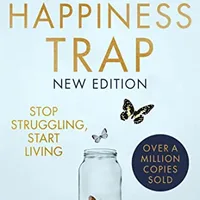
The Happiness Trap (2nd Edition) — Russ Harris
The article's whole thesis IS Acceptance & Commitment Therapy — this is Russ Harris's flagship ACT book on dropping the struggle with emotions. Perfect after the Wegner/suppression section.
As an Amazon Associate, we earn from qualifying purchases — at no extra cost to you.
The Second Arrow: The Suffering You're Adding to Your Suffering
Buddhist psychology has a concept that predates Wegner's research by roughly 2,500 years, but describes the same phenomenon from a different angle.
The first arrow is the difficult experience itself — the anxiety, the grief, the irritation. It hurts. That's unavoidable. You didn't choose it, and you can't immediately undo it by wanting it to be different.
The second arrow is what you fire at yourself in response to having the first arrow in you.
I shouldn't still be sad about this. I'm a mindful person — why am I so reactive? I've been doing this work for three years and I'm still anxious about small things. What's wrong with me?
That second arrow — the judgment, the self-correction, the evaluation of your emotional response against the standard you've set for yourself — often causes more suffering than the original experience. And here's what most personal development frameworks miss entirely: the second arrow is not an unfortunate side effect of trying to manage your emotions. It's a structural feature of it.
Tara Brach, a psychologist and meditation teacher who has spent decades documenting this dynamic in clinical practice, developed what she calls the RAIN practice: Recognize what you're feeling (name it, without evaluation), Allow it to be here (stop attempting to move it along), Investigate with curiosity (where do you actually feel this in your body?), Nurture with the warmth you'd offer a friend in the same situation.
The step that most people struggle with is Allow. Not transform. Not reframe. Not work through productively. Just allow.
That resistance to the Allow step is itself the second arrow in action — the refusal to let the original experience simply be what it is, before you do anything else with it.
When Your Self-Improvement Practice Becomes Another Form of Control
Paul Gilbert, a clinical psychologist at the University of Derby who developed Compassion-Focused Therapy, identified the specific dimension of this problem that's most uncomfortable for anyone who takes personal growth seriously.
Many people who practice mindfulness, journaling, or intentional self-reflection don't merely adopt techniques for working with difficult emotions. They adopt an entire evaluative framework in which their emotional responses are subject to ongoing monitoring, grading, and correction.
I should be more present than this. I should be less reactive than I was yesterday. I should be further along in my emotional evolution by now.
Gilbert's research documents what happens at the physiological level when you engage in this kind of self-evaluation: it activates your threat-detection system. The hypothalamic-pituitary-adrenal axis. The amygdala's threat-appraisal circuitry. The very arousal state that your practice was supposed to calm.
The person who approaches mindfulness from a place of self-correction is, at the neurological level, treating their inner life as a problem to be solved. Which activates exactly the systems that generate more of the inner-life material they're trying to manage.
Here's the distinction that matters in practice: noticing your anger is different from needing your anger to be different. Observing your anxiety is different from monitoring yourself for having anxiety. The first is awareness. The second is control — and control, in this specific territory, fires the second arrow automatically.
This doesn't mean you stop working on yourself. It means you examine the stance from which you're doing it. Are you approaching your inner life with curiosity, or with a clipboard?

Clever Fox Habit Tracker / Reflection Journal
Pairs with the 'audit your practices' and 'I notice I feel this' language-shift steps — a journal for non-judgmental emotional witnessing rather than self-correction.
As an Amazon Associate, we earn from qualifying purchases — at no extra cost to you.

Viktor Frankl's Counterintuitive Discovery
Viktor Frankl survived four Nazi concentration camps. The therapeutic framework he built afterward — logotherapy, documented in Man's Search for Meaning in 1946 — contained an unusual clinical technique he called "paradoxical intention."
The premise: instead of trying not to experience the feared response, you deliberately intend it.
The person who fears blushing in social situations is instructed to try to blush as intensely as possible. The person who fears losing control during anxiety is encouraged to attempt to lose control completely. The person who lies awake terrified of not falling asleep is asked to try to stay awake.
It sounds absurd. It works with remarkable reliability.
The mechanism is what Wegner's research would later formalize. The oppositional stance — the effort to resist the experience — is what gives the feared thing its power. When you remove the opposition and turn toward the experience with deliberate intention, the threat system loses its primary activator. The thing that felt unmanageable, encountered with curiosity rather than resistance, tends to lose the quality that made it threatening.
Frankl wasn't a mindfulness teacher. He was a psychiatrist who discovered, through the extremity of his own experience, that resistance to what already exists amplifies suffering in direct proportion to the intensity of that resistance. What you fight, you feed. What you allow, you can eventually move through.
The counterintuitive conclusion holds across Wegner's cognitive research, Frankl's clinical observations, and Tara Brach's decades of contemplative teaching: suppressing emotions doesn't make them weaker. It puts them on a loop.
What Radical Acceptance Actually Means
Marsha Linehan, the psychologist who developed Dialectical Behavior Therapy in the late 1980s and whose work has been replicated across dozens of randomized controlled trials, built her most important clinical insight on the same foundation.
The therapeutic stance that produces the most durable emotional regulation, her data showed, is radical acceptance.
Not approval. Not agreement that whatever happened was acceptable or fair. Not resignation or passivity. But the complete acknowledgment that this moment is exactly as it is — that resistance to what already exists adds a layer of suffering on top of the original difficulty without changing the original difficulty at all.
The word "radical" is important. Linehan didn't mean a partial or conditional acceptance: "I'll allow this feeling as long as it doesn't last too long." She meant total — this is what's here, right now, and pretending otherwise is the additional cost.
Her trial data showed that radical acceptance reduces emotional suffering more effectively than emotion-management strategies, for exactly the reason Wegner's research predicts: removing the meta-resistance eliminates the monitoring process that was amplifying the original experience.
There's a paradox at the center of all this research that takes time to sit with: the most sophisticated emotional practice may be the one that requires the least management of what arises. Not because emotions don't matter, but because they process most effectively when you stop treating them as problems to be solved and start treating them as information to be received.
How to Start Today
This is not a system to add on top of your existing emotional management stack. It's a different relationship to what's already happening.
Step 1: Find the second arrow. When something difficult arises — anxiety, frustration, sadness — notice whether there's a secondary reaction underneath it. Are you judging yourself for having the first feeling? Monitoring yourself for not being further along? That's the second arrow. Simply naming it is often enough to loosen its hold.
Step 2: Try the RAIN practice once this week. Recognize what you're feeling (name it without evaluation — "there's anxiety here," not "I'm being anxious again"). Allow it to be present without immediately trying to move it. Investigate: where do you actually feel this in your body? What does it need? Nurture: offer yourself the same response you'd give a friend in identical circumstances.
The whole thing takes about three minutes. The Allow step is the one most people resist. Notice that resistance — it's the second arrow introducing itself.

Liforme Original Yoga Mat (Blue, 4.2mm, alignment system + bag)
Placed at the RAIN-practice step — a dedicated mat supports the contemplative/embodied 'Investigate where you feel this in your body' practice (meditation cushion-adjacent).
As an Amazon Associate, we earn from qualifying purchases — at no extra cost to you.
Step 3: Test the paradox on something small. Next time you're gripped by an emotion you're trying not to feel, lean toward it instead of away. What does the anxiety actually feel like, physically? What color would it be, if it had one? What would happen if you let it be exactly as intense as it wants to be for sixty seconds, without trying to change it?
This is Frankl's paradoxical intention made practical. The emotion almost invariably loses intensity when you stop fighting it — not because you've managed it successfully, but because you've removed the oppositional energy that was sustaining it.
Step 4: Audit your personal development practices. Are your mindfulness, journaling, or reflection habits primarily oriented toward acceptance and curiosity — or toward monitoring, correcting, and optimizing your inner life? Both can coexist. The question is which one runs the show.
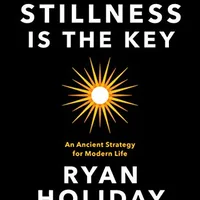
Stillness Is the Key — Ryan Holiday
Second book (within 2-book limit). Stoic + Buddhist framing of stillness over struggle — echoes the Frankl/second-arrow sections in the 'audit your practices' close.
As an Amazon Associate, we earn from qualifying purchases — at no extra cost to you.

Step 5: Replace "I should feel differently" with "I notice I feel this." It's a small language shift with a significant structural difference. The first frames your inner experience as an error to be corrected. The second frames it as information to be observed. One activates the monitoring process. The other starts dismantling it.
The Counterintuitive Thing About Designing Your Evolution
Intentionality matters. Your inner life is worth attending to carefully. The premise that you can design who you're becoming isn't wrong.
What the research in this piece adds is a necessary nuance: the quality of your design depends on the relationship you have with what you're designing.
If you approach your inner life as a project to optimize and correct, you get Wegner's monitoring process — relentlessly scanning, relentlessly keeping the unwanted material in cognitive priority, firing the second arrow every time the output doesn't meet specifications. If you approach it as something to witness, allow, and understand with genuine curiosity, something different becomes available. Not the absence of difficult emotions. The absence of the second arrow that compounds them.
Dan Wegner died in 2013. His most important finding never received the mainstream attention it deserved — perhaps because it's uncomfortable. It suggests that some of what we call personal growth is actually sophisticated resistance wearing the clothes of self-awareness.
Tara Brach has been teaching the RAIN practice for decades to people who arrive wanting to stop feeling what they feel — and who leave having discovered that the feelings, allowed, become navigable.
The white bear stops haunting you when you stop needing it not to be there.
What's one emotion you've been managing rather than allowing? And what would it feel like to simply let it be here for five minutes — without fixing, reframing, or correcting it?
Was this helpful?