Mindset· 9 min read
Stop Saying 'I': Why Your Self-Talk Pronoun Matters
Replacing 'I' with your own name in self-talk measurably lowers stress — Kross's 2014 research explained in plain language.
Stop Saying 'I': Why Your Self-Talk Pronoun Matters
Picture this: you're thirty seconds from walking into the most important meeting of your quarter.
Your preparation was solid. You know the material. But somewhere between the elevator and the conference room door, the self-talk starts. I don't know if I'm ready for this. I always freeze when it matters. What if I forget the key numbers? Why didn't I prepare more? By the time you sit down, you're not reviewing your talking points. You're managing a running crisis inside your own skull — one that has nothing to do with what's actually about to happen.
That voice isn't the problem. Almost everyone has it. The problem — and this is what stops most people from ever fixing it — is the specific word they assume is making it worse.
Most people assume the issue is the content of what the inner voice says. Too critical. Not confident enough. If you could just get it to say nicer things, everything would improve. So they try affirmations. They try reframing. They try telling themselves they're capable and prepared. Sometimes it works. Often it doesn't. And the gap between what they tell themselves and how they feel becomes its own source of friction.
Ethan Kross, a psychologist at the University of Michigan, spent years studying the actual mechanics of inner speech. His research landed on a completely different variable. It's not what you say to yourself that determines whether your inner voice helps or sabotages you under pressure.
It's the pronoun.
Specifically, the word "I."
That finding comes from a 2014 study Kross conducted with eight colleagues — Emma Bruehlman-Senecal, Jiyoung Park, Aleah Burson, Adrienne Dougherty, Holly Shablack, Ryan Bremner, Jason Moser, and Ozlem Ayduk — published in the Journal of Personality and Social Psychology under the title "Self-Talk as a Regulatory Mechanism: How You Do It Matters." Across a stressful public-speaking task and a real-world diary study of everyday worries, Kross's team tested one manipulation: instructing some participants to process their stressful situation using their own name or the pronoun "you" rather than "I."
The results were consistent and striking. Participants who used distanced language showed lower physiological stress markers after the task, ruminated less in the hours that followed, and were independently rated as performing better than participants who processed the same experience in first-person.
Same people. Same task. Same level of preparation. Different pronoun. Measurably different outcome.
What Self-Distancing Actually Means (And Why It's Not a Mind Game)
Kross built his framework around a concept he calls self-distancing — the idea that shifting the grammatical vantage point of your inner speech simultaneously shifts your psychological perspective on the situation you're processing.
When you use "I," you're immersed in the experience. First-person thinking keeps you inside the emotional event, which means you're not just thinking about the problem — you're re-experiencing it, in real time, with roughly the same physiological response the original event triggered. Your nervous system doesn't distinguish cleanly between you thinking "I might fail" and you actually failing. The threat response activates either way.
Switching to your own name or "you" does something subtle but neurologically meaningful. It creates a small psychological buffer between you and the experience. You're now processing your own situation more like you'd process a friend's difficulty.
You've probably noticed that when a friend describes a hard situation and asks for your perspective, you give dramatically better counsel than you'd ever give yourself. That's not because you're smarter about their problems. It's because you're emotionally removed from the stakes. You can see clearly from outside what's genuinely impossible to see from inside. Kross's self-distancing technique doesn't require a friend to be present — it borrows that same external vantage point by changing one grammatical feature of your thinking.
The shift is not about caring less or checking out. It's about accessing the prefrontal cortex's problem-solving capacity instead of staying locked in the amygdala's threat-detection loop. Those two systems do very different things, and the pronoun you use is one of the levers that determines which one runs the show.

Chatter: The Voice in Our Head and How to Harness It — Ethan Kross
The article names this book explicitly in the closing section ('his 2021 book Chatter... is worth reading straight through'). Highest-intent placement in the piece — the reader has just learned the self-distancing mec…
As an Amazon Associate, we earn from qualifying purchases — at no extra cost to you.
What's worth sitting with here is how deceptively ordinary the mechanism is. You don't need to restructure beliefs you've held for twenty years, adopt a new identity, or complete a twelve-week protocol first. You change one word in your internal monologue at the exact moment it matters most. That's not a shortcut. That's the finding.
Why "I" Keeps You Stuck in the Loop
There's a specific word for what happens when first-person self-talk goes badly in high-pressure situations: rumination. It's the mental repetition loop — I should have, I always, I never, I don't know if I can — that can claim hours of mental bandwidth before a stressful event or after one that didn't go well.
Kross's research found that distanced self-talk measurably reduced rumination compared to first-person processing. Participants in the self-distancing condition didn't just perform better during the task — they also spent significantly less time mentally replaying the experience afterward.
The mechanism is worth understanding in some detail, because once you see it, you recognize it everywhere.
First-person inner speech, when you're already stressed, essentially traps you inside the emotional bandwidth of the experience. You're not actually solving anything. You're looping through the feelings of the problem rather than analyzing the facts of it. The brain's threat system stays activated because the "I" framing continuously reconfirms that you are the one in danger — not some abstractly described person you're calmly observing from a step away.
Shifting to your own name introduces a buffer. Something as simple as "Okay, [your name], here's what's actually happening right now" changes the grammatical position from which your brain processes the situation. The emotional intensity drops just enough for reflective thinking to kick back in.
This matters practically because the moments when self-talk is most important — just before a difficult conversation, during a high-stakes presentation, right after you've made a mistake — are the exact moments when first-person "I" framing is most likely to compound the problem instead of help you through it.
Negativity Bias: Why Your Brain Focuses on the Bad
What Distanced Self-Talk Is NOT (This Distinction Actually Matters)
This is probably the most important section in this article, because Kross's research gets routinely conflated with something it explicitly isn't.
When most people hear "change how you talk to yourself," the immediate assumption is that the prescription is to say nicer things. "I believe in myself. I am confident. I can handle this." Repeat with conviction until the belief takes hold.
There's a documented problem with that approach. A 2009 study by Joanne Wood, Elaine Perunovic, and John Lee found that positive self-statements can actively backfire for people with lower self-esteem. Hearing "I am lovable" when you privately believe you're not produces a rebound effect — the implausibility of the statement makes the contrary belief feel even more confirmed by comparison. The gap between the affirmation and your felt reality is itself the source of the friction.
Kross's self-distancing effect works through an entirely different mechanism. You're not changing the content of what you say to yourself. You're not injecting false positivity or making claims you don't actually believe. You're changing the grammatical vantage point from which you observe your own experience.
The content can be completely realistic, even neutral. "Okay, [your name], this is a hard situation. What are the actual options here?" That works. "You've dealt with pressure before. What needs to happen in the next five minutes?" That works too. The self-talk doesn't need to be warm or reassuring. The distance itself is what generates clarity — not the cheerfulness of whatever you happen to say from that distance.
This also explains why the technique works for people across the full spectrum of self-perception. It doesn't depend on having a fundamentally positive relationship with yourself first. It works because it changes the cognitive position, not the emotional tone.
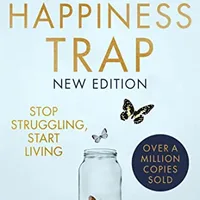
The Happiness Trap (2nd Edition) — Russ Harris
Placed at the end of the 'What Distanced Self-Talk Is NOT' section. The article has just dismantled positive affirmations using the Wood/Perunovic/Lee 2009 rebound finding — ACT's cognitive-defusion approach is the na…
As an Amazon Associate, we earn from qualifying purchases — at no extra cost to you.
Fixed vs. Growth Mindset: Why High Achievers Plateau
The Research Itself: What Kross's Studies Actually Found
Kross's 2014 paper ran seven studies to establish the effect across different contexts. The most controlled was a laboratory public-speaking task — participants were given five minutes to prepare and deliver a speech to a panel explaining why they were qualified for their dream job. A classic high-stakes situation designed to trigger the inner critic.
One group prepared and delivered using first-person "I" processing throughout. The other group was instructed to use their own name or "you" language at every stage — while thinking about their qualifications, while preparing what they'd say, and while delivering.
Independent evaluators, blind to which condition participants were in, rated the self-distancing group's speeches as significantly more confident and persuasive. The first-person group showed more self-evaluative, anxious language during the preparation phase — more "I'm worried I won't do well" type processing — and rated their own post-speech performance lower even when external evaluators had scored them similarly or higher.
The diary component of the study extended the finding outside the laboratory. Participants tracked stressful everyday events and recorded how they processed them. Those who consistently used distanced language reported less emotional distress and a higher sense of having coped with the event than participants who used first-person processing for the identical types of events.
There's an old saying that the biggest room in the world is the room for improvement. Kross's data suggests that room might actually be accessed through a door most people have been walking straight past.

One honest caveat: most of Kross's individual studies are single-session experiments. The research on whether deliberate, repeated self-distancing changes a person's default mode of inner speech over months of consistent practice is still developing. The single-session effect is substantial and replicable across multiple study designs. The longer-term question remains genuinely open. But the technique costs nothing and takes seconds to try, which means the case for testing it on yourself doesn't require certainty about long-term neural change.
How to Start Using Distanced Self-Talk Today
The mechanics are considerably simpler than they sound when described in academic language.
Step 1 — Notice when "I" is spiraling. The cue is easy to recognize once you're looking for it. It's the loop — I should have, I always, I never, I don't know if I can — usually showing up before something high-stakes or during the replay of something that went badly. When the inner monologue starts conjugating in first person under real pressure, that's your trigger point.
Step 2 — Switch to your name or "you" immediately. Not as a cheerleading exercise. Literally just: "[Your name], here's what's happening right now." The distance comes from the grammar, not from any particular warmth in how you deliver it. You can be direct with yourself, even blunt — just not immersed in first person.
Step 3 — Describe the situation as you'd describe it to a friend. What would you actually tell someone you cared about who was in your exact position right now? Give yourself that read — honest, clear, slightly outside the emotional center of gravity of the experience. That framing, not a pep talk, is what Kross's data shows actually works.
Step 4 — Don't force positivity if it doesn't fit. Neutral and clear consistently beats falsely encouraging. "Okay, [name], this is genuinely hard. What's the most useful next move?" outperforms "You're going to crush it!" when you don't actually believe the second one. Kross's research didn't require positive content. It required a changed vantage point.

Philips SmartSleep Wake-Up Light HF3520 (Coloured Sunrise Simulation, 5 Natural Sounds, FM Radio)
Sits inside Step 4 → Step 5 of the action section, where the article says to 'practice during low stakes first — the evening review... morning intention-setting before the calendar fills up.' The pain is real: the tec…
As an Amazon Associate, we earn from qualifying purchases — at no extra cost to you.
Step 5 — Practice during low stakes first. The goal is to have this as an automatic move during high-pressure moments — which means building the habit during low-pressure ones. The evening review. The processing of yesterday's setback. Morning intention-setting before the calendar fills up. Practice the grammar shift when you don't urgently need it, so it's available when you do.
Writing out your self-talk practice — describing yesterday's stressful moments in the third person, with your own name, in longhand — is one of the most effective ways to build the habit before the next high-stakes moment arrives. There's something about the physical act of writing that slows the loop down enough to insert the vantage-point shift deliberately.

Moleskine Classic Notebook — Large, Ruled, Hard Cover, Black (13 × 21 cm, 240 pages)
Placed directly after the article's most action-specific paragraph: 'Writing out your self-talk practice — describing yesterday's stressful moments in the third person, with your own name, in longhand — is one of the…
As an Amazon Associate, we earn from qualifying purchases — at no extra cost to you.
For the full scope of Kross's research — across memory, creativity, relationships, and performance, not just the single-session stress experiments — his 2021 book Chatter: The Voice in Our Head, Why It Matters, and How to Harness It is worth reading straight through. It's one of those rare science books where the prescriptions actually follow from the data rather than quietly outrunning it.
How to Build a Morning Routine That Actually Sticks

What This Actually Means for Designing Your Evolution
Here's what strikes me about Kross's research in the context of any deliberate self-improvement work.
Most frameworks assume the sequence goes: change what you believe → change how you act → change what you produce. That chain is real. And it's slow, because genuinely shifting a deep belief takes sustained effort across many months of consistent work before it shows up in your behavior under pressure on a regular Tuesday afternoon.
Self-distancing offers something rarer: an intervention that changes how you process your current beliefs without requiring you to change those beliefs first. You don't have to feel confident before you can think clearly about a high-stakes situation. You just have to change the grammatical seat from which you're observing it. That's a design decision, not a personality upgrade.
Peter Senge described the gap between where you are and where you want to be as "creative tension" — the distance itself being what pulls you forward. What Kross's research quietly suggests is that much of what we experience as "I can't close that gap" is actually "I is too immersed in the gap to see it clearly enough to move."
The fix isn't to believe differently. It's to observe differently.
So here's the actual question to sit with: what's the stressful situation your inner voice is running through right now? Take sixty seconds. Write about it using your own name instead of "I." Don't change what you say — just change the pronoun.
Notice what shifts.
Was this helpful?