Mindset· 9 min read
Why Vision Boards Alone Rarely Work
Gabriele Oettingen's research found picturing success alone can quietly undermine your drive. Here's the science of mental contrasting and the WOOP method.

Why Vision Boards Alone Rarely Work
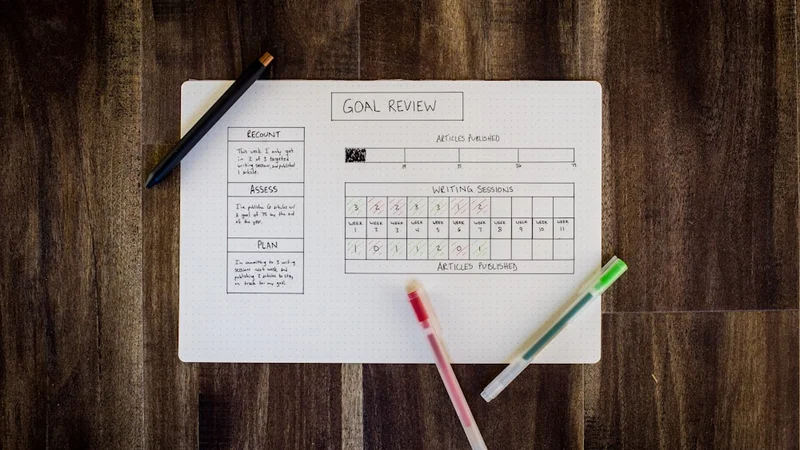
Three years. That's how long a friend of mine spent adding images to her vision board. Dream apartment. A travel shot of the Amalfi Coast. A screenshot of a savings account balance with the right number of zeros. Every January she'd make a fresh section. Every December she'd quietly wonder why the wall kept growing while the gap between her life and those pictures stayed exactly the same.
She wasn't lazy. She wasn't negative. She was doing precisely what an entire industry had told her to do — visualize the outcome, feel it as if it's already real, let the image do the motivational work. And it wasn't working. It turns out there's a specific, research-backed reason for that. And the psychologist who figured it out has spent three decades quietly dismantling one of self-help's most beloved rituals.
The Billion-Dollar Bet on Positive Visualization
The vision board industry is enormous. The Secret has sold more than 30 million copies worldwide. Pinterest has more than 600 million monthly users, many of them building digital dream collections with the explicit intention of manifesting outcomes. Guided visualization is taught in corporate wellness programs, athletic coaching, and high-school classrooms. The premise running through all of it is simple: vividly imagining a goal already achieved will motivate you to pursue it.
The problem is that Gabriele Oettingen, a psychologist at New York University and the University of Hamburg, ran the experiments.
Her research didn't begin as a takedown of positive thinking. It began with weight loss patients. In a study conducted with Thomas Wadden in 1991, she measured how positively participants fantasized about successfully losing weight — then tracked their actual results over the following year. The participants who fantasized most positively lost an average of 24 pounds less than those who didn't. Same program. Same support. The most optimistic imaginers did worst.
That result forced a question: if positive visualization isn't powering motivation, what is it actually doing? The answer, across decades of subsequent research synthesized in her 2014 book Rethinking Positive Thinking: Inside the New Science of Motivation, is that it's simulating completion.
If the obstacle feels surmountable — if, after picturing it honestly, you still feel genuinely drawn toward the goal — your commitment increases and you're better equipped to act. If naming the obstacle reveals that the goal isn't actually feasible, or that you don't want it as much as the fantasy suggested, WOOP lets you notice that before you've restructured your life around pursuing it. That's not failure. That's a different kind of information, and arguably more useful than another month of staring at an image on a wall.
Vision Boards Aren't the Problem
Before this becomes a takedown of something you've put real hope into — it isn't one.
A vision board, at its core, is a way of getting specific about what you actually want. That part is genuinely valuable. Clarity about a goal is a real precondition for pursuing it. The creative process of finding or making images that represent your goals also engages the mind differently than listing objectives in a spreadsheet, and that engagement can produce its own useful clarity about what actually matters to you versus what you think should matter.
The problem isn't the image. The problem is stopping there.
What Oettingen's data suggests is that a vision board treated as a destination map — here's where I'm going, now I'll feel it's already real — quietly undermines the drive needed to actually get there. A vision board treated as the first step of a WOOP process — here's my Wish and Outcome, now I need to name the Obstacle and write the Plan — converts the exact same image into a genuine strategic asset.
The pictures don't change. The question you ask while looking at them does.
How to Turn Your Vision Board into a WOOP Plan Today
You don't need to dismantle anything. Here's how to run the process with what you already have.
Step 1: Pick one image. Choose the goal on your board that you want most right now, or that feels most stuck. Just one. The method works best when you run it on a single goal rather than your entire board at once.
Step 2: Write the Wish and Outcome. Describe the goal in a single, specific sentence. Then write the single best outcome that would follow from achieving it — not every benefit, just the most compelling one. Keep this concrete enough that you'd recognize it if it happened.
Step 3: Name the inner obstacle. Complete this sentence honestly: "The main thing inside me that could prevent this is ___." Not external circumstances, not other people — the specific pattern within yourself that your own past experience suggests will show up. If your honest answer surprises you a little, it's probably the right one.
Step 4: Write the if-then plan. "If [obstacle] arises, I will [specific action]." One sentence. The action should be concrete enough that you'd know whether you'd done it.

Kitchen Safe kSafe Time Locking Container (Medium)
If the inner obstacle you named is 'I reach for my phone the moment it gets hard', the if-then plan needs a lock, not willpower.
As an Amazon Associate, we earn from qualifying purchases — at no extra cost to you.
That's the whole process. You can do it on a notepad, on the back of an index card, or on a sticky note placed directly on the vision board image it applies to. The WOOP My Life app (free on iOS and Android, developed by Oettingen's research team) also walks you through the process and lets you track it over time.

Oettingen's research, replicated across weight loss, academic performance, interpersonal goals, and workplace productivity, found this four-step process consistently outperformed positive fantasy alone — not because it's more pessimistic, but because it's more complete. The underlying mechanism — a felt sense of necessity produced by juxtaposing a genuine desire against a real obstacle — appears in Oettingen's data as one of the more reliable motivational structures the research has identified.
One note from the research worth holding onto: WOOP works best when you run it on goals that genuinely matter to you, not goals you think you should have. If a goal doesn't produce any real felt pull after you've written out the Wish and Outcome step, that's information worth paying attention to before you invest further in pursuing it.
Design Your Evolution, One Real Obstacle at a Time
There's a version of "Design Your Evolution" that lives entirely in the vision — beautiful, specific images of who you'll become, held vividly until they feel inevitable. Oettingen's data suggests that version, alone, costs you more than it gives you. Not because the vision is wrong, but because the premature sense of arrival quietly removes the engine.
There's another version where the vision is still there, still specific and worth wanting — but where you've also named, clearly and honestly, exactly what stands between you and it today. That version isn't less optimistic. It's more honest. And according to three decades of research, it's the one that actually moves.
Your vision board isn't lying to you. It just can't tell the whole story by itself. The inner obstacle you've been putting off naming? That's the part of the map that actually leads somewhere.
What's the single inner obstacle between you and the goal you've been staring at the longest? Write it down — and then write what you'll do when it shows up.
Sources:
- Oettingen, G., & Wadden, T.A. (1991). "Expectation, fantasy, and weight loss: Is the impact of positive thinking always positive?" Cognitive Therapy and Research, 15(2), 167–175.
- Oettingen, G. (2014). Rethinking Positive Thinking: Inside the New Science of Motivation. Current/Penguin Random House.
- Oettingen, G., Pak, H., & Schnetter, K. (2001). "Self-regulation of goal setting: Turning free fantasies about the future into binding goals." Journal of Personality and Social Psychology, 80(5), 736–753. https://pubmed.ncbi.nlm.nih.gov/11374746/
- Gollwitzer, P.M., & Sheeran, P. (2006). "Implementation Intentions and Goal Achievement: A Meta-Analysis of Effects and Processes." Advances in Experimental Social Psychology, 38, 69–119.
- Wood, J.V., Perunovic, W.Q.E., & Lee, J.W. (2009). "Positive self-statements: Power for some, peril for others." Psychological Science, 20(7), 860–866.
→ The If-Then Habit Fix: Stop Abandoning Your Goals
→ Why Most Goals Fail Before You Start (And How to Fix Them)
Was this helpful?