Mindset· 10 min read
Why You Feel Like You Have to Earn Your Worth
If love was conditional on your performance growing up, you're still paying that price. Here's the psychology of conditional worth — and how to unlearn it.

Why You Feel Like You Have to Earn Your Worth (And How to Stop)
The grade came back: a perfect score. The hardest exam of the semester, the one everyone dreaded.
You stared at it for a few seconds. Then opened your laptop and started preparing for the next one.
That's not ambition. That's something else entirely — and most people spend decades mistaking it for one when it's actually the other.
There's a specific feeling that high-achievers rarely talk about. The moment after the win that should feel like relief but doesn't. The promotion arrives, the praise lands, the number hits — and instead of satisfaction, there's a quiet, hollow nothing. Or worse: a soft dread, because the bar has already moved and you're already behind again.

If that sounds familiar, it probably isn't a productivity problem. It's what psychologists call conditional self-worth — something installed in you before you were old enough to question it.
The Psychology of Conditional Worth
Carl Rogers — one of the most influential psychologists of the 20th century, and someone whose ideas quietly shaped most of modern therapy — identified a concept he called conditions of worth.
The premise is simple, even if the implications take years to untangle: children who receive love and approval primarily when they perform, achieve, behave, or comply internalize those conditions as rules for their own acceptability. Not rules about what they need to do. Rules about what they need to be in order to deserve love at all.
Rogers contrasted this with unconditional positive regard — the experience of being accepted fully as you are, independent of your performance. His clinical observation, borne out by decades of subsequent research, is this: people who experienced conditional positive regard in childhood don't simply grow out of it when they become adults. They carry the same conditions of worth into every professional relationship, romantic partnership, and private moment of self-evaluation they'll ever have.
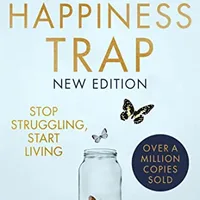
The Happiness Trap — Russ Harris
If achievement never feels like enough, ACT-based work is the most evidence-backed bridge — and Harris's book is the most accessible entry point.
As an Amazon Associate, we earn from qualifying purchases — at no extra cost to you.
John Bowlby's attachment theory adds the behavioral layer. Children who experience caregiver responsiveness as inconsistent or performance-contingent develop what researchers now call anxious attachment — a chronic hypervigilance to relational signals, a persistent monitoring of others' evaluations, difficulty self-regulating when approval is absent.
These patterns don't live in the reasoning brain. They live in the body, in procedural memory, in the part of you that flinches before a performance review even when you know, rationally, that you did good work.
The research suggests roughly 20% of adults show anxious attachment patterns. Among high-achievers who grew up in demanding or conditional environments, the prevalence is considerably higher. You may not call it anxiety. You might just call it drive.
The Hidden Rules Your Childhood Left Behind
Here's the uncomfortable thing about conditions of worth: they work.
A child who learns that warmth, approval, and emotional safety are most reliably available after academic achievement or perfect behavior will optimize for those things. They'll often become genuinely excellent at them. Conditions of worth are a rational adaptation to the environment they were calibrated for.
The problem arrives when the environment changes and the rules don't.
You're no longer a child whose physical and emotional wellbeing depends on a parent's approval. The stakes of not receiving it are no longer survival-level. But the brain doesn't update automatically. The neural pathways that connected "performance" to "safety" were built during a developmental window when the brain was specifically designed to encode such patterns as permanent — because in childhood, that's exactly what they needed to be.
So the rules persist into adulthood with the same emotional weight they had at seven.
This is why success doesn't resolve the hunger. Each achievement generates a temporary reprieve — the conditions of worth are briefly met — and then the baseline immediately resets. The bar that represented "enough" in your parents' eyes (or your own internalized version of them) has always been slightly beyond reach. That's the design. The reach is the mechanism that kept you close.
Tony Robbins famously said that success without fulfillment is the ultimate failure. He was describing exactly this gap — the space between external achievement and internal worth where people who've accomplished everything find themselves feeling like they've accomplished nothing.
Why smart people self-sabotage
Why More Achievement Won't Fix It
Here's the part that most productivity writing systematically misses.
The achievement-validation loop isn't a motivation problem. It's a source-of-worth problem. And you can't solve the second problem with more of what created it.
Extrinsic self-worth — worth derived from external feedback, performance metrics, others' approval — is structurally unstable. It requires constant maintenance. When the feedback is positive, it provides temporary stabilization. When it's absent, withdrawn, or negative, the whole structure shakes.
Intrinsic self-worth works differently. It isn't earned through performance or maintained through output. It's recognized — an understanding that your value as a person exists independently of what you produce. And the research here is consistently counterintuitive: people with higher intrinsic self-worth don't achieve less. They typically achieve more, and they recover faster after failure, because failure is no longer a verdict on who they are. It's data about what to do differently.
Research by Jennifer Crocker, published in the Journal of Personality, found that contingencies of self-worth — the degree to which self-esteem is staked on performance outcomes — were negatively associated with healthy self-regulation and intrinsic motivation. The people whose worth was most dependent on outcomes were the most emotionally destabilized by setbacks. Paradoxically, they were also the least likely to sustain the kind of long-term, self-directed effort that produces genuine mastery.
Here's the counterintuitive take worth sitting with: people who are hardest on themselves don't improve faster. Neff's research and subsequent replications show consistently that self-critical individuals don't bounce back faster after failure — they ruminate longer, disengage sooner, and sustain less genuine effort over time.
More achievement won't close this loop. More achievement gives the same brain more opportunities to feel temporarily enough — and then not enough again. The hunger resets on a schedule that performance can't outrun.

The Shame Layer Brené Brown's Research Actually Reveals
Brené Brown spent over a decade at the University of Houston studying what separates people who experience genuine belonging from those who don't. What she found — and what's worth understanding precisely — is a distinction most people never learn to articulate.
Guilt is: "I did something bad." Shame is: "I am bad."
Conditions of worth produce shame, not guilt. When your worth is contingent on performance, a failure isn't just a bad outcome — it's a self-indictment. The self is implicated in a way that a situational setback never would be.
Brown's research found that shame is highly correlated with depression, anxiety, aggression, and addiction — and inversely correlated with empathy, accountability, and genuine connection. People in high-shame states don't improve their behavior after failures. They hide, withdraw, and protect. They become less willing to take risks, admit mistakes, or ask for help. All three of which are prerequisites for meaningful growth.
This is the cruelest irony of conditions of worth: the emotional environment originally designed to produce high performance produces precisely the psychological conditions that eventually prevent it.
Brown's most practically significant finding is the one that made her famous: the people who reported the highest sense of worthiness were simply the people who believed they were worthy. Not after they'd proven it. Not once they'd earned enough to justify it. Before. Not as a delusion. As a starting assumption.

The Five Minute Journal — Intelligent Change
If your starting assumption is "I have to earn worth," a structured daily worthiness practice rewrites the baseline. Brown's research shows it can be installed — not just inherited.
As an Amazon Associate, we earn from qualifying purchases — at no extra cost to you.
What the Self-Worth Research Actually Shows
Edward Deci and Richard Ryan at the University of Rochester developed Self-Determination Theory — one of the most replicated frameworks in motivational psychology — which identifies three core psychological needs: autonomy, competence, and relatedness. Self-worth that's autonomously grounded (experienced as internal rather than contingent on external validation) is consistently associated with greater creativity, sustained motivation, and psychological wellbeing than worth that depends on approval from outside.
Kristin Neff's research on self-compassion adds the practical mechanism. Self-compassion — treating yourself with the same quality of care you'd offer a close friend facing the same difficulty — has been shown across multiple studies to produce lower anxiety, higher motivation, and more genuine accountability than self-criticism.
This doesn't mean lowering your standards. It means removing the punitive condition that says your value as a human being is under review every time your standards aren't met. The point isn't to stop caring about quality. It's to stop tying your fundamental acceptability to whether today's work was good enough.
The science of self-compassion: what 20 years of research reveals
How to Stop Basing Your Self-Worth on Achievement and Approval
This isn't a one-week fix. But there are specific entry points — and specificity matters here, because vague intentions bounce off this pattern like water off glass.
Step 1: Name your conditions of worth.
Write down the specific rules that were operating in your childhood home around love and approval. Not abstractly — concretely. "I was most warmly received when I got high grades." "Approval was available when I didn't cause disruption." "I was praised for being useful, not for simply being present." The act of naming them as external rules that were installed in you — rather than objective truths about what you deserve — is the first separation. That separation is where it begins.

Moleskine Classic Notebook — Large Hardcover Ruled, Black
The act of naming conditions of worth in physical handwriting — slow, deliberate, in a book you'll keep — is the first separation between the rules and your identity. Worth doing in something that feels like it matters.
As an Amazon Associate, we earn from qualifying purchases — at no extra cost to you.
Step 2: Audit the emotional loop.
For one week, notice when your emotional state shifts in response to achievement or approval — not just the big moments, but the small ones. A comment on your work. A message left unanswered. A project that landed differently than expected. What happens in your body? The point isn't to stop having responses. It's to start observing them as signals rather than verdicts.
Signal: information. Verdict: judgment.
Most people live their whole lives treating the first as if it were the second.
Step 3: Build corrective relational experiences.
Therapy with a relational focus — particularly Acceptance and Commitment Therapy or person-centered approaches in Rogers' tradition — works precisely because it provides a different relational experience: being fully seen without your performance being the precondition for the therapist's regard. If formal therapy isn't accessible right now, structured self-compassion practice serves a partial function.
Neff's research protocol at self-compassion.org is concrete: when the internal critic activates (typically after a failure or underperformance), ask three questions in sequence. Is this just happening to me, or is this a shared human experience? What would I say to a good friend in exactly this situation? Can I say that to myself, right now?
The third question is the one most people skip. That's where the work actually lives.
Step 4: Decouple achievement from identity.
There's a linguistic habit that quietly entrenches conditions of worth. It's the drift from situational to identity-level language: "I'm a failure" instead of "this approach didn't work." "I'm not good enough" instead of "this output was below my standard." The semantic difference is everything. Your performance is information about an action at a specific moment. It is not a verdict on your worth as a person — which was never actually on the table, regardless of what the conditions of worth told you.
Step 5: Let yourself be witnessed in progress — not only in accomplishment.

The deepest healing for performance-based worth tends to happen relationally. In relationships where your value is evidenced not by your achievements but by the quality of your presence. This requires initiating depth with people — which conditions of worth often specifically prevent, because vulnerability risks the exact rejection the pattern was designed to avoid.
But Bowlby's research is clear: the corrective emotional experience of being genuinely known — seen in your difficulty, not just your wins — and genuinely accepted anyway is the most powerful available intervention for anxious attachment. It doesn't just feel better over time. It rewires the implicit expectation structure itself.

Liforme Original Yoga Mat
The deepest layer of conditional worth lives in the body, not the reasoning brain. Daily embodied practice — slow, in a space that signals you matter — is what eventually rewires the implicit pattern.
As an Amazon Associate, we earn from qualifying purchases — at no extra cost to you.
How to deal with loneliness: what Harvard research actually found
There's a version of "designing your evolution" that looks like relentless optimization — better habits, higher output, faster progress. And none of that is wrong.
But it misses something foundational if it's built on the wrong floor.
You can't genuinely design your evolution from a deficit. You can only upgrade a foundation that already holds. And if the foundation is the belief that your worth is conditionally available — that you have to earn your place at the table through performance — then every achievement becomes another rent payment on your own existence rather than a genuine expression of who you're becoming.
What you're doing matters far less than why you're doing it. Two people can take identical actions — same habits, same output, same visible results — and one of them is building something while the other is constantly proving something. The second person is exhausted in a way the first one never quite is. And eventually, the second person hits a wall the first one never encounters.
The most important question isn't what you're optimizing for.
It's why you believe you need to optimize at all.
Because the person who achieves from fullness moves differently than the person who achieves from fear. They both produce results. But only one of them enjoys the journey. And only one of them will still be going — with the same energy, the same care, the same genuine investment — twenty years from now.

Kindle Paperwhite (2024, 16GB)
If you want to go deeper on Rogers, Bowlby, Brown, or Neff — a Kindle removes the friction between intention and the next book.
As an Amazon Associate, we earn from qualifying purchases — at no extra cost to you.
See also: Self-Compassion vs. Self-Criticism: What Research Found
What would change for you if you already knew you were enough?
Was this helpful?