Habits· 9 min read
Why You Procrastinate (It's a Mood Problem)

Why You Procrastinate (It's a Mood Problem)
The email had been sitting in your drafts for three days. You know exactly what to write. You have all the information. But every time you open it, you suddenly need coffee, or notice the dishes, or find seventeen things more urgent than the one thing that actually matters.
That isn't laziness. That isn't a discipline problem. That's your nervous system doing a job — just not the one you want it to do.
What the research actually says about procrastination
For decades, the assumption was simple: procrastination is a time management problem. The fix was always a better planner, a tighter schedule, a productivity app with more features than a Swiss Army knife.
In 2013, Fuschia Sirois and Timothy Pychyl published a paper in Social and Personality Psychology Compass that shifted the framing. Their key argument: procrastination is primarily a matter of short-term mood repair and emotion regulation, not a time management failure. When you avoid a task, you're not managing your schedule — you're managing how you feel right now.
The research is built largely on self-report data, which has limits, but the pattern holds across multiple studies.
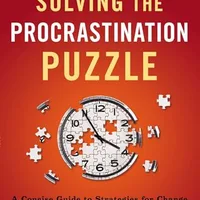
Solving the Procrastination Puzzle — Timothy A. Pychyl
As an Amazon Associate, we earn from qualifying purchases — at no extra cost to you.
The tasks we procrastinate on most tend to carry the heaviest emotional charge: boredom, self-doubt, anxiety, resentment, or fear of judgment. Your brain detects that a task feels threatening and reaches for relief. The problem is the relief is short-term. The task returns — heavier, and now carrying a fresh layer of guilt on top.
The feeling behind the delay
Before you consciously decide to avoid something, part of you is already forecasting what starting will feel like. If that forecast registers as threatening, you drift toward relief almost automatically — often before you notice making the decision.
This is why willpower alone rarely works. You're not just fighting a decision — you're fighting a prediction that happened below the surface of conscious thought.
Sometimes it's the email you're not sure how to word. The project you care about too much to risk failing. The conversation that needs to happen but keeps getting moved to next week. These carry a particular weight: the cost of engaging feels higher than the cost of putting it off again. For another hour, anyway.
| Task type | Typical emotional charge | What avoidance looks like |
|---|---|---|
| High-stakes project you care about | Anxiety, fear of judgment | Starting adjacent tasks instead of the real one |
| Difficult conversation | Dread, anticipatory guilt | "The timing isn't right yet" |
| Routine admin (tax returns, forms) | Boredom, resentment | Perpetual "I'll do it this weekend" |
| Health-related decision | Denial, fear of the answer | Vague intention, no concrete next step |
| Creative work | Perfectionism, self-doubt | Planning obsessively, producing nothing |
why your brain resists starting hard tasks
Why every productivity system eventually breaks down
If you've used the Pomodoro Technique, time-blocking, Getting Things Done, or any combination of apps and planners, you've probably noticed they work brilliantly for routine tasks. They tend to collapse the moment a task carries real emotional weight.
That isn't a failure of the system — it's a design mismatch. But if the real obstacle is a feeling, a better container doesn't solve it — you just avoid the container.
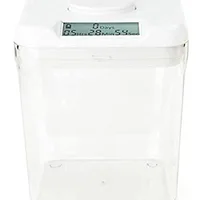
Kitchen Safe kSafe Time Locking Container (Medium, White Lid + Clear Base)
As an Amazon Associate, we earn from qualifying purchases — at no extra cost to you.
You miss a Pomodoro, blow past a time block, and now you have evidence that you're someone who can't follow through. The guilt stacks. And self-blame doesn't seem to help: in a 2010 study of first-year university students by Michael Wohl, Timothy Pychyl, and Shannon Bennett, those who forgave themselves for procrastinating on a first exam procrastinated less before the next one.
Fix the feeling, not the schedule
Stop trying to get yourself to start the task. Start trying to make the task feel different.
Self-compassion is one such mechanism. The Wohl study above is one example: self-forgiveness predicted less procrastination next time. It was an observational study, so it shows a link rather than proof of cause, but the logic fits: shame adds emotional charge to the task, making the next attempt harder.
Implementation intentions are another mechanism with solid evidence. Peter Gollwitzer's research is consistent: specific if-then plans — "when I sit down at 8:30 with my coffee, I will open the document for fifteen minutes" — tend to outperform vague intentions. The specificity isn't about discipline. It removes the decision and the delay that comes with it.
The third mechanism is the smallest useful first action. Not the first step toward finishing — the first step toward starting. There's an important difference there. Finishing requires judgment; starting just requires movement.
implementation intentions and how to build consistent habits
A 5-step protocol for the task you keep dodging
This isn't a time management framework. It's a mood management framework. Apply it specifically to the tasks that keep reappearing on tomorrow's list.
Step 1: Name the feeling. Before you touch the task, write one sentence: "I keep avoiding this because it feels ___." Boredom, anxiety, resentment, overwhelm, fear of failure — name it specifically. Affect labeling has been shown in lab studies to reduce the intensity of emotional responses. Matthew Lieberman's research at UCLA links this to lower amygdala activity — writing it down, rather than circling it mentally, is what makes the difference.
Step 2: Separate the feeling from the task. The feeling is not the task. The feeling is your nervous system's prediction about what doing it will be like — and conflating them keeps you stuck.
Step 3: Make the entry point smaller than your resistance. If the thought of starting registers as a six on a discomfort scale, make the first action a two. Open the document. Write one sentence. The goal is to disprove the prediction — to give your nervous system evidence that engaging is survivable.
Step 4: Treat what you produce as information, not a verdict. If you tie task performance tightly to your identity, every outcome becomes a referendum on who you are, and starting gets riskier. Practice treating the output as feedback: the draft is a draft, it can be revised, and nothing produced today is a permanent statement about you.
Step 5: Drop the punishment. If you didn't start yesterday, don't pile extra guilt onto today. Guilt inflates the emotional cost of the task for next time. Instead, do a quick debrief: what was I feeling, what got in the way, what's the smallest next step? Then reset. Self-compassion here isn't softness — it's reducing the emotional weight the task carries into the next attempt.
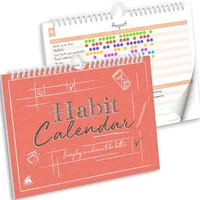
Clever Fox Habit Calendar Circle (24-Month)
As an Amazon Associate, we earn from qualifying purchases — at no extra cost to you.
One more thing: this protocol is for the specific item that keeps reappearing, not your entire list. Pick the task that has migrated to tomorrow every day this week and apply the five steps. Evidence compounds: every task you engage with this way becomes proof that resistance is survivable, which makes the next one easier to begin.
The counter-intuitive goal
The goal shouldn't be to become someone who never procrastinates. That framing sets up exactly the kind of perfectionist self-judgment that makes everything worse.
The actual goal is to shorten the gap — to notice avoidance faster, to name the feeling underneath it, and to build a first step small enough to actually take. You're training yourself to recognize resistance earlier and respond with a specific action instead of avoidance.
That isn't willpower. It's a skill. Sirois and Pychyl frame procrastination as a problem of emotion regulation, and regulation can be practiced. What matters is that it's learnable — and the first step is realizing that the thing you've been calling a time problem was never really a time problem at all.
You already know which task I'm talking about. You've been circling it since you started reading this.
What's the task that's been sitting on your list the longest? When you sit with it honestly — what feeling is underneath it?
Was this helpful?