Mindset· 11 min read
Year-End Review: Does Tracking Goal Progress Really Work?

Year-End Review: Does Tracking Goal Progress Really Work?
December has a way of arriving faster than any other month. You look up from your screen, realize the year has three weeks left, and feel that familiar mix of pride and mild dread — what did I actually do with this year?
Most people have one of two reactions. Some skip the year-end review entirely because they're afraid of the answer. Others write furiously in a fresh notebook, filling pages with reflections they'll never read again. Neither approach generates much useful signal.
Before you pick up a pen or open a spreadsheet, there's a question worth answering: does reviewing your progress actually help you achieve more? Or is it one of those productivity rituals that feels meaningful without moving the needle?
The research has a surprisingly specific answer.
What the Research on Goal Monitoring Actually Shows
In 2016, a team led by Benjamin Harkin published a meta-analysis in Psychological Bulletin that pooled results from 138 randomized studies and nearly 20,000 participants (19,951). The question was simple: does monitoring your own goal progress make you more likely to reach the goal?
The short answer is yes — but with caveats worth knowing before you design your review.
Across those studies, interventions that prompted people to monitor their progress had a small to moderate positive effect on goal attainment (d = 0.40). The effect was real, but it wasn't enormous. Tracking alone doesn't transform outcomes; it nudges them. Most of the included studies were health-related, so it's worth being cautious about how far the finding stretches to other kinds of goals.
What made the difference in the studies was what you do with the information. Participants who physically recorded their progress — writing it down rather than keeping a mental tally — showed larger effects than those who didn't. Participants who reported or made their progress public showed larger effects than those who tracked privately. The act of externalising the measurement, making it visible and social, amplified the impact.
The APA's press summary of this research adds a useful caveat: the strongest effects were in health behaviour studies — weight management, smoking cessation, exercise. That is worth keeping in mind before applying the finding wholesale to career goals or creative projects.

Clever Fox Habit Calendar Circle (24-Month Habit & Goal Tracker)
As an Amazon Associate, we earn from qualifying purchases — at no extra cost to you.
The underlying mechanism is something researchers call discrepancy reduction. When you see the gap between where you are and where you want to be, your brain registers that gap as a problem worth solving. The visibility creates productive friction. That's motivating — but it only works if you look at the gap regularly enough to act on it. The meta-analysis found that monitoring worked in part by increasing how often people checked their progress.
The Three Ways a Year-End Review Fails
Most year-end reviews fail in one of three ways, and two of them feel productive while they're happening.
-
The highlight reel trap. You remember the wins and skim the losses. It feels good. You close the notebook thinking you crushed the year. And you walk into January with no honest signal about what actually worked or what genuinely needs to change.
-
The blame spiral. You fixate on what didn't happen, construct an elaborate theory about your character, and end up feeling worse than when you started. This isn't reflection — it's self-attack dressed up as honesty. It doesn't produce anything useful, and it doesn't lead to better decisions next year.
-
The resolution reboot. The review gets hijacked by goal-setting before you've properly understood the previous year. You write twelve new goals before you've figured out why the last four stalled. The notebook fills with January's ambitions while December's lessons go unexamined.
A well-designed review avoids all three. It measures, then it explains, then — and only then — it plans.
A 30-Minute Year-End Review You Can Actually Finish
You don't need an elaborate system or a 100-page guided journal. You need a structure that keeps you honest and keeps you moving. Here's what works.
Part one: measure (10 minutes)
Go back to whatever you used to set your intentions at the start of this year — a planner, a note, a voice memo, an old email to yourself. If you can't find anything written down, work from memory, but write down that you're reconstructing.
For each goal or intention, answer two questions: Did you work on this consistently? Did you reach it? Use a simple four-point scale — not at all, partially, mostly, fully. Don't start explaining yet. Just measure.
This is where a decent goal planner earns its place. The Harkin meta-analysis found that physically recording progress produces larger effects than not recording it. The research doesn't say why, but one plausible reading is that writing something down forces a moment of attention that a passing mental note doesn't.
Part two: explain (10 minutes)
Pick the two goals you're most curious about — one that went better than expected, one that went worse.
For the win: what was actually different about how you approached this goal? Don't credit your personality ("I was more disciplined this year"). Look for a specific structure, habit, constraint, or accountability mechanism that made the difference. That is the repeatable thing worth carrying forward.
For the miss: resist the narrative. Don't write a story about who you are. Write a list of obstacles — external circumstances, competing priorities, underestimated difficulty, skills you didn't yet have. Which were within your control? Which genuinely weren't? The distinction matters for what you decide next.
Here's a concrete example of what that looks like. Say your goal was to write for thirty minutes every morning. You tracked inconsistently. For the miss, your obstacle list might read: late nights that made mornings rushed, a commute change in March that removed your usual writing window, a project that consumed three months of evenings. Looking at that list: the commute change was outside your control; the late nights were partly within it. The lesson isn't that you lack discipline — it's that your writing habit needed an earlier trigger or a weekend anchor. That is specific enough to change.
goals vs purpose the difference that changes everything
The goal here isn't self-comfort or self-punishment. It's signal extraction. You're looking for the small, repeatable conditions that helped or hurt you — because those are the only things you can actually change.
Part three: decide (10 minutes)
Based on your measurement and your explanations, make three decisions.
One thing to keep — a goal, habit, or practice you'll carry forward because it's genuinely producing what you want.
One thing to drop — something you kept on the list out of guilt or inertia, that isn't aligned with who you actually want to become.
One thing to build — a new goal or habit, grounded in what you learned about how you work best.
Three decisions. Thirty minutes. That's the entire review.
A word on the third part: these three decisions aren't micro-adjustments. Dropping something genuinely means removing it from the list, not moving it to a "someday" shelf. Building something new means identifying the specific next action, not writing a vague intention.
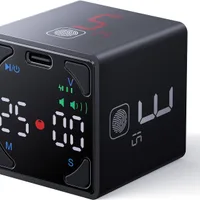
Ticktime Pomodoro Cube Timer (Black, Magnetic, USB-C)
As an Amazon Associate, we earn from qualifying purchases — at no extra cost to you.
Why Frequency Matters More Than Format
Here's the honest version of the Harkin finding: frequency matters. The meta-analysis found that monitoring interventions improved attainment partly by getting people to check their progress more often. So if you've been tracking throughout the year, your December review is a synthesis of that accumulated data.
What a year-end review does uniquely well is give you strategic distance. When you're inside a month, it's hard to see which of your habits are quietly compounding and which are quietly costing you. Twelve months of data makes patterns visible that were invisible in real time. You notice which goals appeared on three consecutive lists without meaningful progress. Which environments made consistency easy. Which relationships changed how much you actually got done. That's something weekly tracking can't replicate — and it's reason enough to do the review even if you've been inconsistent all year.
Becoming a student of your own life — studying your failures as well as your successes — is a recurring idea in the work of the motivational speaker Jim Rohn. A year-end review is exactly that: a formal practice of observation, before the year evaporates and you start fresh with another twelve months of mostly good intentions.
how to build habits that actually stick
The Tool Is Secondary. The Honesty Isn't.
There's an entire industry built around year-end reviews: guided journals, PDF templates, planners designed specifically for December reflection. Some are excellent. Most are fine. A few are elaborate enough to make the review itself feel like a creative project rather than an honest audit.
The research doesn't support any particular format. What it supports is recording your progress — physically, specifically, and with enough regularity to generate useful feedback. The format is a vehicle. What matters is whether you're willing to look at the gap honestly, extract something real, and change one thing going forward.
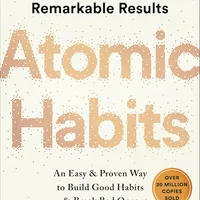
Atomic Habits — James Clear (Paperback)
As an Amazon Associate, we earn from qualifying purchases — at no extra cost to you.
If a structured annual planner helps you do that, it's worth having. If a blank notebook and a kitchen timer works better, use that. What matters is not the cover design — it's the willingness to show up for the measurement.
Design your evolution means you decide — deliberately, based on evidence — what to carry forward and what to leave behind. A year-end review is one of the simplest designs available. You don't need a perfect year to make it useful. You just need thirty minutes and the honesty to tell yourself what you actually found.
What's the one part of this year that you haven't given yourself enough credit for — and what specifically made it possible?
The Harkin et al. (2016) meta-analysis is published in Psychological Bulletin, vol. 142, issue 2, pp. 198–229. DOI: 10.1037/bul0000025. Effect sizes are drawn from that study; individual results vary.
Was this helpful?