Recommendations· 22 min read
Best Fitness Trackers 2026: The Top 7 Compared
We rank the 7 best fitness trackers of 2026 on sleep accuracy, HRV, battery, and real 24-month cost. Find the right one for your goal.
Best Fitness Trackers 2026: The Top 7 Compared
As an Amazon Associate, I earn from qualifying purchases. Prices and availability may vary.
Why Your Data Is Only as Good as the Feedback Loop Behind It
Here's the thing most fitness tracker reviews won't tell you: the device doesn't change your health. The feedback loop it creates does.
Research on wearable biometric feedback has consistently found that people who received daily biometric data — sleep scores, resting heart rate, and step counts — were significantly more likely to sustain behavioral changes at the six-month mark than those who tracked manually. That's not because the sensors are magic. It's because continuous, visible data converts the invisible (how well did you actually recover last night?) into something you can act on before the decision moment, not after.
Think about how most people approach their health. They feel tired and attribute it to "being busy." They skip a workout and call it "a rest day." They eat poorly on Tuesday and can't explain why Wednesday felt like a fog. A fitness tracker doesn't fix any of that — but it turns those blind spots into data points you can pattern-match over weeks and months. That is the design-your-biology version of what James Clear calls "making progress visible."
The science here is direct. Heart rate variability (HRV) — the variation in time between heartbeats — is the most clinically validated non-invasive marker for autonomic nervous system health, recovery readiness, and chronic stress accumulation. Research across peer-reviewed journals has found that low HRV consistently predicts overtraining, poor immune function, and elevated depression risk. The better your tracker measures HRV reliably overnight, the more actionable your daily decision-making becomes: push hard today, or back off?
The problem is that the market has exploded. There are now more fitness trackers than there are use cases, and most of them look similar on a spec sheet but diverge massively in practice — in accuracy, wearability, app quality, and the one number nobody puts in the headline: total cost over two years.
We compared the seven leading trackers and smart rings of 2026 on the dimensions that matter for anyone using wearables as a behavioral health tool. Here's what we found.
How We Selected These 7 Trackers
We didn't rank devices by headline specs. We ranked them by how well each one serves the person trying to design their health systematically — not the person who wants a fancy display on their wrist.
Our evaluation criteria:
- Sleep tracking accuracy — Does it correctly identify deep sleep, REM, and awake periods? We cross-referenced against published third-party polysomnography validation studies where available.
- HRV measurement methodology — Is HRV measured from a full night's reading (more reliable) or spot-checks? What sensor type (optical PPG vs. ECG)?
- Form factor and compliance — Discomfort causes non-wear, and non-wear corrupts data. Ring form factors tend to show higher overnight compliance in sleep studies than wrist bands, as the lower-profile form factor reduces sleep disruption and discomfort.
- App quality and behavioral design — Does the companion app give you actionable next steps or just raw numbers?
- Battery life — A tracker that dies every 48 hours will be off your body when you need it most.
- Total 24-month cost — Hardware price plus subscription fees. This number changes the value equation dramatically.
- GPS capability — Critical for outdoor runners and cyclists; irrelevant for desk workers and sleep-focused buyers.
What we rejected and why: We excluded pure smartwatches (Samsung Galaxy Watch, Pixel Watch) that prioritize notifications over health accuracy. We also excluded fitness bands with less than 4.0 stars across 1,000+ reviews — because at this price point, owner experience matters as much as specs.
The 7 Best Fitness Trackers of 2026
1. Oura Ring 4 — Best for Sleep Science and Passive Recovery Monitoring

For who: Anyone who wants the most accurate passive health monitoring available without looking like they're wearing a gadget. Ideal for people optimizing sleep as their primary lever — and anyone who's tried wrist trackers and found them uncomfortable overnight.
Why we chose it: The Oura Ring 4 sits in a category of its own when it comes to sleep architecture tracking. Its OSSA 2.0 (Oura Sleep Staging Algorithm 2.0) — validated in a published peer-reviewed study against polysomnography across 35 participants in a multi-device comparison — achieves approximately 79% agreement with lab-measured sleep stages on four-stage classification. That's higher than any wrist-based tracker in this comparison. For someone treating sleep as a behavioral health tool rather than a passive experience, that accuracy gap matters: you're not just getting a sleep score, you're getting the data that tells you whether last night's poor deep sleep was a one-off or a pattern requiring attention.
The ring form factor matters more than it sounds. Because it sits on your finger rather than your wrist, it eliminates the motion artifact that degrades optical PPG accuracy on wrist trackers during restless nights. And because it doesn't feel like anything, you actually leave it on — which is the compliance variable that makes or breaks sleep data quality over time.
The HRV measurement is the most reliable in this group: a full-night average derived from continuous overnight readings rather than a morning spot-check. Oura's nighttime resting HRV trend line is the closest consumer device currently comes to what a sports physiologist would use to assess recovery readiness.
Pros:
- Highest sleep stage accuracy among consumer devices (validated against polysomnography)
- 8-day battery life — you can wear it through a full sleep week without charging interruptions
- No display means no light disruption during sleep; no urge to check notifications at 2 a.m.
- The Readiness Score integrates HRV, resting heart rate trend, body temperature deviation, and sleep quality into a single daily number you can actually act on
- Temperature sensor tracks basal body temperature for menstrual cycle prediction and illness early warning
Cons:
- $5.99/month subscription required after hardware purchase ($349–$499 depending on finish) — full feature access requires the membership
- No GPS; no workout tracking beyond steps and intensity minutes — if you're a runner who wants route mapping, this isn't your device
- Sizing requires purchasing a sizing kit first; ring exchanges after incorrect sizing add friction
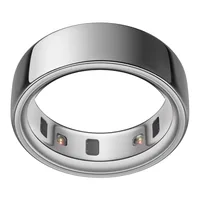
Oura Ring 4 (Smart Ring, Silver)
The most independently validated sleep-stage tracker; ring form factor removes wrist motion artifact.
As an Amazon Associate, we earn from qualifying purchases — at no extra cost to you.
2. WHOOP 5.0 — Best for Athletes Serious About Performance Optimization

For who: The person training with intent — whether that's marathon prep, CrossFit, competitive sport, or a structured exercise program where recovery decisions directly affect performance the next day. WHOOP is built for people who need to know not just how they slept but whether their body is ready to push.
Why we chose it: WHOOP 5.0 (launched May 2025) refined everything that made its predecessor compelling while fixing its most glaring weakness: battery life. The 5.0 runs for 14 days on a single charge — up from four or five days on WHOOP 4.0 — which means you're no longer managing the charging logistics that used to create data gaps at inconvenient times.
The core insight behind WHOOP remains unchanged, and it's a good one: recovery is trainable and measurable, and the biggest performance mistake most athletes make isn't under-training — it's ignoring the signals their body sends about readiness. WHOOP 5.0 quantifies this with two daily metrics: Strain (the cardiovascular load you accumulated in the past 24 hours, scored 0–21 based on heart rate zone distribution and duration) and Recovery (a 0–100% composite of HRV, resting heart rate, sleep performance, and respiratory rate). Together, they create the training load guidance that used to require a sports physiologist.
The Journal Coach — WHOOP's behavioral tracking feature — lets you log variables like alcohol intake, caffeine timing, pre-sleep screen use, and stress level, then automatically correlates them with your recovery and sleep data across weeks. After 30 days, most WHOOP users have identified two or three specific behaviors that most reliably predict their HRV the next morning. That kind of personalized behavioral intelligence is what converts raw biometric data into actual life change. For those who want the full medical suite, the WHOOP MG (available with the Life membership at $359/year) adds an FDA-cleared ECG, notifications for irregular heart rhythms, and overnight blood pressure estimates.
Pros:
- Strain and Recovery system gives the clearest workout-readiness guidance of any device in this list
- 14-day battery life — a major upgrade over WHOOP 4.0's four-to-five-day limit
- Membership-included model means no separate hardware purchase (device ships with membership)
- Continuous 24/7 heart rate and HRV monitoring (not just overnight spot-checks)
- Excellent sleep coaching with personalized sleep need calculation (not a one-size-fits-all 8 hours)
- Waterproof; comfortable for 24/7 wear; bicep and wrist band options
Cons:
- $239/year (Peak tier) totals approximately $478 over 24 months — still an ongoing subscription commitment, though meaningfully cheaper than the previous generation's monthly model
- No display at all; you must check the app for any data, which can feel limiting for people who want a glanceable interface
- GPS relies on phone connection (no onboard GPS); workout maps require carrying your phone
3. Garmin Venu 3 — Best Overall for Active Users Who Want Everything Without a Subscription
For who: The person who wants a complete health and fitness tracker — sleep monitoring, workout tracking, GPS, Body Battery energy management, and a clean display — without a monthly subscription draining their bank account indefinitely. Best for the active generalist: someone who runs, lifts, hikes, and travels but doesn't want to become a data scientist about it.
Why we chose it: The Garmin Venu 3 earns its "best overall" designation through a rare combination: no subscription, a 14-day battery life in smartwatch mode (or up to 26 hours in GPS-only mode), built-in GPS, Advanced Sleep Monitoring with sleep stage detection, and Garmin's Body Battery — a proprietary energy monitoring score derived from HRV, stress levels, and sleep quality that tells you in plain language how much energy reserve you have for the day's demands.
Body Battery is one of the most practically useful daily metrics in the wearable space — not because it's the most technically sophisticated but because it speaks the language of decision-making. When Body Battery reads 72 at 7 a.m., you push through a hard workout. When it reads 28 because you flew across time zones and slept four hours, you make a different call. That behavioral translation is what separates a useful health tool from a data-heavy expensive toy.
The lack of subscription is the financial argument that compounds over time: over 24 months, the Venu 3 costs approximately $450 total (hardware only). The Oura Ring 4 adds approximately $144 in membership fees over the same period (at $5.99/month), on top of the $349–$499 hardware — meaning total Oura costs range from roughly $493 to over $640 depending on the finish you choose.
Pros:
- No subscription — ever. Pay once, use indefinitely with full feature access
- 14-day battery life in smartwatch mode; GPS battery rated to 26 hours (GPS-only mode)
- Built-in GPS for accurate route tracking, pace, and outdoor workout metrics
- Body Battery provides the clearest daily energy guidance of any Garmin feature
- Extensive sport mode library: 25+ activity profiles including yoga, pilates, pool swimming, strength training
- Garmin Pay for contactless payments; music storage for phone-free runs
Cons:
- Sleep stage accuracy, while good, trails the Oura Ring 4 in independent validation studies — it's wrist-based, so motion artifact affects overnight readings more
- The display is the thickest form factor in this comparison; some users find it bulky for formal occasions
- HRV data is accessible but less prominently surfaced in the app than on Oura or WHOOP
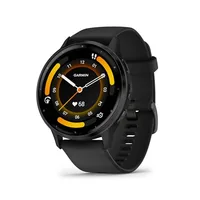
Garmin Venu 3 (45mm GPS Smartwatch)
Everything-in-one tracker with Body Battery and 14-day battery — no recurring fee.
As an Amazon Associate, we earn from qualifying purchases — at no extra cost to you.
4. Fitbit Charge 6 — Best Value with Google Ecosystem Integration
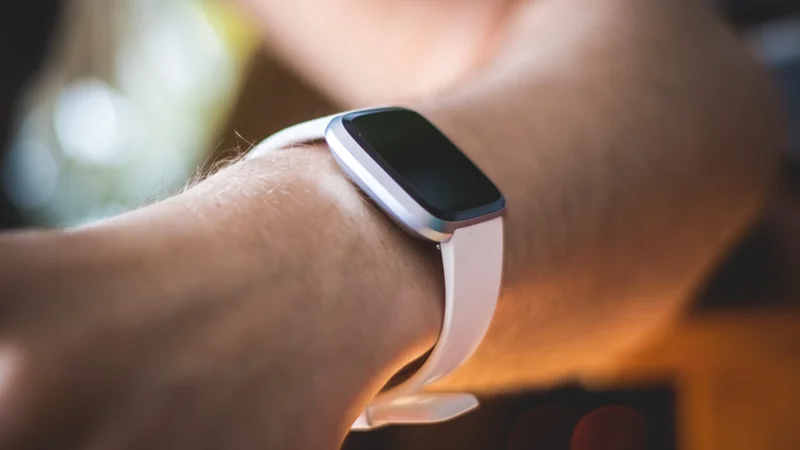
For who: Someone entering the fitness tracking space for the first time, or a Google/Android power user who wants their health data woven into the rest of their digital life. Also the right pick for anyone who wants solid fundamentals — steps, sleep, heart rate, stress — without the complexity or price of the top tier.
Why we chose it: The Fitbit Charge 6 is the rare case where "best value" doesn't mean "compromised." Google's acquisition of Fitbit produced a device with an ECG app (one of the few in this price range with a medical-grade atrial fibrillation detection capability), Google Maps navigation on-wrist, YouTube Music control, and tight Google Fit integration — all at a price point that's a fraction of the Oura or WHOOP.
Sleep tracking on the Charge 6 is reliable for cycle-level data: it accurately distinguishes between light sleep, deep sleep, and REM, and the Daily Readiness Score (a Fitbit Premium feature) pulls together sleep, HRV, and activity recovery into a single daily number. The catch is that Fitbit Premium ($9.99/month or $79.99/year) is needed for the full suite of insights — though basic tracking works fine without it.
For the person building their first behavioral health monitoring practice — using daily data to understand how food timing, alcohol, and stress affect sleep quality — the Charge 6 provides everything needed at the lowest barrier to entry.
Pros:
- ECG app for atrial fibrillation detection — the most clinically significant safety feature in this price range
- Google ecosystem integration (Maps navigation, YouTube Music, Google Pay) is genuinely useful
- 7-day battery life; small, lightweight form factor comfortable for all-day wear
- Built-in GPS (no phone required for walk/run route tracking)
- EDA (electrodermal activity) sensor for stress monitoring — measures subtle changes in skin conductance that correlate with sympathetic nervous system activation
Cons:
- Full feature set (Daily Readiness Score, advanced sleep analysis, guided programs) requires Fitbit Premium at $9.99/month
- Sleep stage accuracy is the weakest in this comparison for fine-grained sleep architecture detail — adequate for trends, less useful for night-to-night granularity
- Limited smartwatch functionality compared to full-size options; no third-party app ecosystem
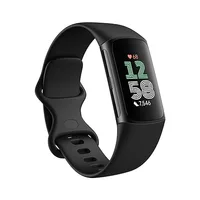
Fitbit Charge 6 (Obsidian/Black)
Lowest barrier to entry with ECG, built-in GPS and Google ecosystem integration.
As an Amazon Associate, we earn from qualifying purchases — at no extra cost to you.
5. Garmin Fenix 8 Sapphire Solar — Best for Endurance Athletes and Outdoor Performance
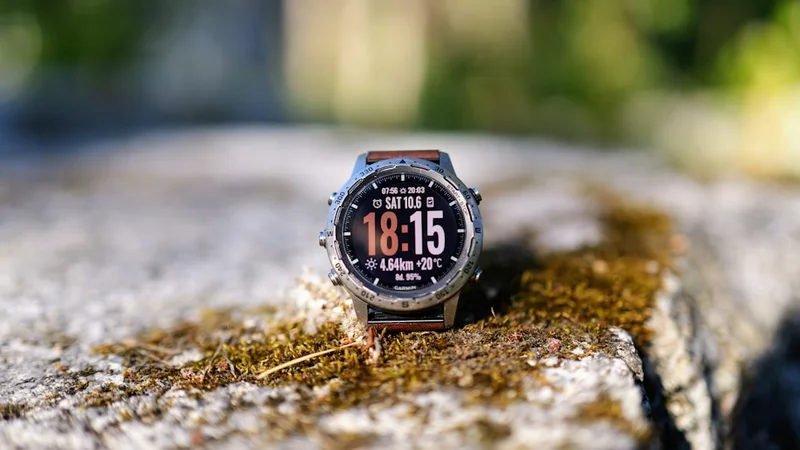
For who: The serious athlete — ultramarathoners, triathletes, cyclists logging big weeks, mountaineers, trail runners. If your workouts span multiple hours, multiple terrains, and require precision metrics like training load, VO2 max estimation, lactate threshold prediction, and multi-band GPS accuracy, nothing in this list competes with the Fenix 8.
Why we chose it: The Garmin Fenix 8 is not a fitness tracker — it's a performance computer that happens to also track your sleep and daily health. Its multi-band GPS (L1 + L5 frequencies) is the most accurate satellite positioning available in a consumer wearable, achieving sub-3-meter accuracy in challenging environments like urban canyons and dense forest canopy where single-band GPS regularly drifts by 50+ meters. For anyone whose workouts involve complex routes, elevation gain, or pace-critical training, that accuracy matters.
The Training Readiness feature — Garmin's most sophisticated performance guidance metric — integrates acute training load, chronic load history, HRV status, sleep quality, and recovery time to produce a 0–100 readiness score and specific training recommendations. It's the closest thing to having a coach review your biometric history before prescribing today's session.
The solar charging variant extends battery life meaningfully in outdoor conditions: the Sapphire Solar extends total smartwatch battery life to up to 28 days (47mm) or 48 days (51mm) with 3 hours of direct sunlight daily, meaning multi-day wilderness expeditions become feasible without carrying a charger.
Pros:
- Multi-band GPS is the most accurate available in a consumer wearable — essential for technical terrain and precise training analysis
- Training Readiness integrates load, HRV, and sleep for the most sophisticated performance guidance in this comparison
- Sapphire crystal lens (genuinely scratch-resistant); titanium/stainless build quality that survives real outdoor conditions
- Up to 21 days (47mm) or 30 days (51mm) smartwatch battery life without solar; solar charging extends this further in field conditions
- No subscription required — full feature access with hardware purchase
Cons:
- Premium price point ($999–$1,099 depending on variant) — the most expensive device in this comparison by a significant margin
- The size and weight of the Fenix 8 are appropriate for the wrist of an endurance athlete but conspicuous in a business meeting or formal setting
- Overkill for anyone not training seriously; the depth of metrics becomes noise rather than signal if you're not consistently using them
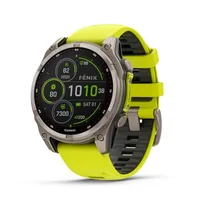
Garmin Fenix 8 Sapphire Solar (47mm)
Multi-band GPS performance computer with Training Readiness; premium endurance tier.
As an Amazon Associate, we earn from qualifying purchases — at no extra cost to you.
6. Apple Watch SE (3rd Generation) — Best for iPhone Users Who Want Health Tracking With Smart Integration
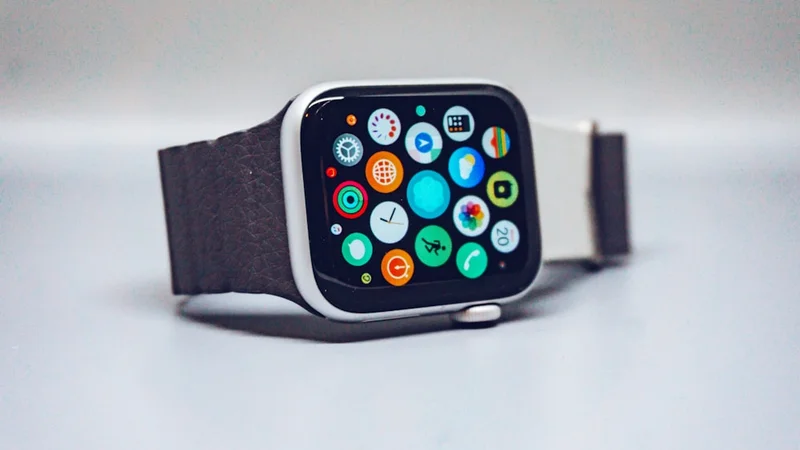
For who: iPhone users who want health monitoring woven seamlessly into the apps they already use — and who want the emergency safety features (crash detection, fall detection, Emergency SOS) that have genuinely saved lives. Not the choice for serious sleep architecture tracking, but the right choice for someone who wants one device to manage health and their digital life.
Why we chose it: Released in September 2025, the Apple Watch SE 3 landed at the same $249 starting price as its predecessor while adding meaningful health upgrades. The S10 chip brought an Always-On display — you can check your stats without raising your wrist — alongside a new wrist temperature sensor that enables retrospective ovulation estimates in the Cycle Tracking app and deeper insights in the Vitals app. Sleep apnea notifications, now built into watchOS, flag patterns that may warrant a conversation with your doctor.
Apple Health's data ecosystem remains the deepest in the consumer space: it integrates with hundreds of third-party apps, feeds data to your physician through Apple Health Records, and stores a longitudinal health record that becomes genuinely valuable over years of continuous use.
The Activity Rings system — the three overlapping circles tracking Move, Exercise, and Stand goals — is one of the most psychologically effective behavioral design tools in consumer technology. It exploits the near-miss effect: a partially filled ring is more motivating than a full one or an empty one, generating daily movement with minimal friction.
Pros:
- Seamless iPhone ecosystem integration — Health app, Fitness+, Sleep app, and third-party app compatibility are unmatched
- Always-On display (new in SE 3) lets you check stats without a wrist raise
- Wrist temperature sensor enables cycle tracking and Vitals app insights
- Sleep apnea notifications add a clinically relevant safety layer at this price point
- Emergency safety features (crash detection, fall detection, Emergency SOS) are genuinely valuable for solo outdoor activities
- No ongoing subscription required for core health features; Apple Pay, watchOS app ecosystem
Cons:
- 18-hour battery life means you either charge it during sleep (losing overnight data) or during the day (losing activity data) — the sleep tracking experience is accordingly incomplete
- No continuous overnight HRV tracking in the same form as Oura or WHOOP; spot-check HRV measurements are less actionable for recovery decisions
- Sleep stage tracking is rudimentary compared to dedicated sleep-focused devices — good for duration and apnea detection, weak for architecture detail
7. Amazfit Balance — Best Budget Option With Solid Sleep and Stress Tracking
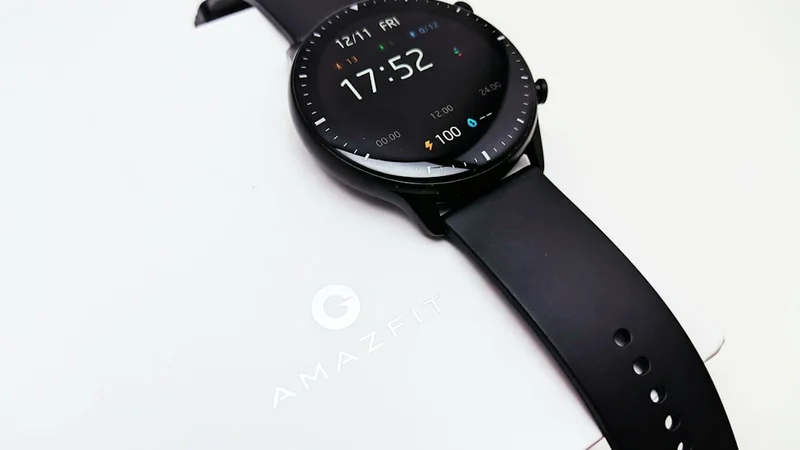
For who: The cost-conscious buyer who wants reliable biometric data — sleep scoring, HRV, stress monitoring, SpO2 — without committing to a premium device or any subscription. Also a smart choice as a "try-before-you-commit" purchase for anyone unsure whether wearable health tracking will actually change their behavior before spending $300+.
Why we chose it: The Amazfit Balance lands at roughly one-third of the Oura Ring 4's price and delivers a surprisingly complete health monitoring package. Zepp Health's AI health engine — which drives the Balance's sleep, stress, and body composition analysis — has matured significantly; the sleep stage tracking, while not polysomnography-validated, produces data that correlates well with higher-end devices in informal comparisons.
The Balance-specific feature is the Zepp Aura mindfulness and sleep improvement subscription (optional), but the hardware's core biometric data — continuous heart rate, overnight HRV, SpO2, skin temperature deviation, stress tracking via HRV-derived metrics — is fully accessible without any subscription. For a first-time tracker buyer, that's a meaningful differentiator: you get useful data immediately without a recurring cost commitment.
Battery life at 14 days and built-in GPS round out a package that genuinely punches above its weight class for the buyer whose primary goal is tracking behavioral health trends over time rather than precision athletic performance optimization.
Pros:
- No subscription required — full health feature access with a one-time purchase under $200
- 14-day battery life eliminates the charging logistics that trip up overnight sleep tracking on shorter-battery devices
- Built-in GPS for walk/run route tracking without a phone
- Comprehensive sensor suite (optical PPG, SpO2, skin temperature, bioelectrical impedance for body composition) at the budget tier
- 150+ sport modes; compatible with iOS and Android
Cons:
- HRV data is less granular than Oura or WHOOP; the algorithm smooths readings in ways that make night-to-night variation less meaningful for fine-grained recovery decisions
- App experience (Zepp Health) is functional but less polished than Garmin Connect or the Oura app — data is accessible but takes more navigation to surface insights
- Build quality and strap materials are noticeably less premium than the top-tier options; the watch case shows wear faster
Amazfit Balance (46mm Smartwatch)
Sub-$200 full sensor suite with no subscription — the try-before-you-commit pick.
As an Amazon Associate, we earn from qualifying purchases — at no extra cost to you.
FAQ
Which fitness tracker is most accurate for sleep tracking in 2026?
The Oura Ring 4 is the most independently validated consumer device for sleep stage accuracy. A peer-reviewed study comparing Oura against polysomnography found approximately 79% agreement on sleep stage classification — higher than any wrist-based tracker in this comparison. The ring form factor reduces motion artifact during sleep, which is the primary technical limitation of optical sensors on wrist bands. If accurate sleep architecture data is your primary goal, Oura wins clearly.
Is WHOOP worth it for non-athletes?
WHOOP 5.0's value proposition is strongest for people with structured training programs — the Strain and Recovery metrics are most useful when you're making daily workout intensity decisions. For non-athletes, the core benefit shifts to behavioral pattern detection through the Journal Coach feature: logging lifestyle variables (alcohol, caffeine, stress, medication) and watching them correlate with recovery scores over time. If that level of data engagement appeals to you, WHOOP delivers it better than any competitor. If you want a tracker that's more passive and less demanding, Oura or Garmin Venu 3 are better fits.
What's the true 24-month cost of each tracker?
Here's the real math, including hardware and subscriptions:
- Oura Ring 4: from $349 hardware + ~$144 in subscriptions = from ~$493 total
- WHOOP 5.0: $0 upfront + ~$478 in annual memberships (2 × $239/yr Peak tier, hardware included) = ~$478 total
- Garmin Venu 3: ~$450 hardware + $0 subscriptions = ~$450 total
- Fitbit Charge 6: ~$160 hardware + $240 in Premium = ~$400 total (or ~$200 without Premium)
- Garmin Fenix 8: ~$999+ hardware + $0 subscriptions = $999+ total
- Apple Watch SE 3: ~$249 hardware + $0 = ~$249 total
- Amazfit Balance: ~$180 hardware + $0 = ~$180 total
Smart ring vs. smartwatch: which is better for health tracking?
It depends on what you're optimizing for. Smart rings (Oura) win on sleep tracking accuracy, daytime compliance, and battery life — the form factor simply doesn't interfere with daily life the way a wrist device can. Smartwatches and wrist bands win on GPS, workout tracking depth, notification management, and smartwatch features. If sleep and recovery are your primary metrics, rings have a meaningful edge. If you want one device that does everything, a full smartwatch (Garmin Venu 3, Apple Watch SE 3) makes more practical sense.
Do fitness trackers actually change behavior?
The honest answer: the device doesn't change behavior — the feedback loop does. Research from behavioral tracking studies consistently finds that wearables increase self-monitoring, which activates the accountability mechanisms that drive behavioral change. But the people who see the most benefit are those who review their data regularly and connect it to specific decisions (workout intensity, sleep timing, alcohol intake). A tracker left unchecked in a drawer changes nothing. Used as a daily decision-support tool — particularly for sleep quality management — the evidence is genuinely positive.
Which One Should You Actually Buy?
If you had to pick one — and most people do — it comes down to your primary goal.
For sleep and recovery as your primary lens: The Oura Ring 4 is the clearest recommendation. It does less than a full smartwatch, and that's the point: by removing notifications, GPS, and the urge to treat it as a communication device, it forces the focus back onto the biometrics that actually tell you how your body is recovering. The eight-day battery means it's on your finger for a full sleep week without interruption.
For athletes who train seriously: WHOOP 5.0. The annual subscription cost is real, but the Strain + Recovery system is the best performance guidance tool in consumer wearables — and the 14-day battery finally makes it practical for people who kept losing data gaps with the old model. If you're making daily training decisions and want data-driven input on intensity versus recovery, nothing else does this as cleanly.
For everyone who wants excellent tracking without a subscription: Garmin Venu 3 wins on value. No recurring cost, GPS, 14-day battery, and Body Battery energy management in a mature, well-supported app ecosystem. Over two years, it's often cheaper than the subscription-based alternatives.
The best tracker is the one you'll actually wear. Discomfort causes non-wear; non-wear produces gaps in data; data gaps undermine the feedback loop that makes any of this worthwhile. That's why form factor matters as much as any spec — and why the right answer isn't always the one with the longest feature list.
Want to put your tracker data to work? Start by building the exercise routine that your new data is pointing you toward — the wearable tells you when you're ready to push; the habit structure determines whether you actually do.
What tracker are you currently using — and has it actually changed how you make decisions day-to-day? Drop a comment below.
Was this helpful?