Mindset· 10 min read
The Science of Communication: Why Most People Aren't Heard
Gottman can predict divorce with 93.6% accuracy from a 15-minute conversation. Here's what communication science reveals about being truly heard.

The Science of Communication: Why Most People Aren't Heard
She said "fine" and meant nothing of the sort.
You probably caught it — somewhere in the clipped delivery, or the way she'd already turned back to her phone before you'd finished speaking. You let it go. She let it go. And that small gap widened, the way gaps do when nobody says the thing that needs saying.
I've been in that room more times than I'd like to admit. And for a long time I assumed communication was one of those inherently messy human things — an art, not a science, and not something you could study with any useful precision.
I was wrong about that.
John Gottman spent forty years at the University of Washington's Love Lab watching couples talk to each other. Not casually watching — rigorously watching, coding conversations at the level of individual utterances and the microexpressions that last less than a fifth of a second. And from that mountain of observational data, he arrived at something that sounds almost impossible: he can predict whether a couple will divorce with 93.6% accuracy from a fifteen-minute conversation.
Not from their history together. Not from their income or childhood or personality types. From fifteen minutes of coded conversation.
If communication were just the messy, unpredictable art we assume it is, that number couldn't exist.

The first thing Gottman's research forces you to confront is this: most relationship deterioration isn't dramatic. It's not the explosive fight or the obvious betrayal. It's the slow accumulation of tiny communication patterns — habits so automatic you've long since stopped seeing them — that quietly erode the foundation of goodwill that every relationship runs on.
Gottman's research shows that couples who end up divorced aren't having particularly different arguments than couples who stay together. They're having those same arguments with entirely different communication patterns.
That shift in framing changes everything. It's not what you're arguing about. It's how you're communicating when the pressure is on.
And this applies far beyond romantic partnerships. The same dynamics operate at work, within families, and — most significantly — in the internal monologue you run when you're trying to understand yourself. Your communication patterns are producing results right now. The question is whether those results are the ones you actually want.
If you're curious about building deeper self-awareness through emotional intelligence, this article explores the science behind that transformation.
The Four Horsemen: Communication Patterns That Predict Failure
Gottman named them the Four Horsemen of the Apocalypse — four specific communication behaviors that, when present consistently, predict relationship failure with disturbing accuracy. Identifying them in yourself is genuinely uncomfortable. That discomfort is useful.
The first is Criticism. Not complaining — complaining is normal and healthy. Criticism is when you move from addressing a specific behavior to attacking the person's character. "You forgot to call again" is a complaint. "You're so inconsiderate — you never think about anyone but yourself" is criticism. The difference is the jump from what happened to who you are. It feels like honesty. It lands like an attack.
The second is Contempt — and Gottman considers this the single most corrosive of the four. Contempt communicates superiority: sarcasm, eye-rolling, mockery, name-calling. It says, beneath every word, I find you beneath me. Contempt is the strongest individual predictor of divorce in Gottman's dataset. And the damage isn't only relational. Gottman's research documented that partners on the receiving end of frequent contempt show measurably higher rates of infectious illness. The body keeps the score before the mind is ready to admit it.
The third is Defensiveness — responding to a perceived criticism with a counter-complaint or a protest of innocence before you've actually heard what was said. "It's not my fault — you're the one who always..." The intent is self-protection. The impact is: your concern doesn't matter to me.
The fourth is Stonewalling: the wall that goes up mid-conversation, the withdrawal into silence. Gottman's physiology research explains this one. When a person's heart rate exceeds approximately 100 beats per minute in conflict, the prefrontal cortex — the part responsible for nuanced language and regulated response — effectively goes offline. The stonewaller isn't choosing to disengage; they're physiologically flooded. The problem is that flooding from the inside looks, from the outside, exactly like contempt.
Each Horseman has a research-backed antidote. Criticism responds to a gentle start-up: "I feel frustrated when..." instead of "You always..." Contempt responds to building a genuine culture of appreciation and admiration in the non-conflict hours — the positive deposits that create enough emotional goodwill to weather the difficult moments. Defensiveness responds to taking even partial responsibility: "You have a point. I could have handled that better." Stonewalling responds to the deliberate pause — twenty to thirty minutes away from the conversation, enough for the sympathetic arousal to clear, before returning.

The Good Life — Robert Waldinger & Marc Schulz
Right after the Four Horsemen antidotes — the 85-year Harvard Study of Adult Development is the empirical backbone for 'relationship quality is built on ordinary Tuesdays', mirroring Gottman's 5:1 emotional bank account.
As an Amazon Associate, we earn from qualifying purchases — at no extra cost to you.
The 5:1 Ratio: The Number That Quietly Runs Your Relationships
Here's the finding that reframes everything quietly: stable, happy relationships maintain approximately five positive interactions for every one negative interaction.
This ratio — replicated across dozens of studies — isn't a formula to be mechanically manufactured. It's a measure of the background emotional climate between two people. The daily expressions of genuine appreciation, curiosity, humor, and recognition that build what Gottman calls the "Emotional Bank Account." The accumulated deposits that determine whether an argument is experienced as a threat to the relationship or simply a manageable disagreement between two people who fundamentally respect each other.
The implication is uncomfortable: if your relationships feel brittle — if minor conflicts escalate faster than they should, if ambiguous signals consistently read as hostile — the problem usually isn't the conflicts themselves. It's the ratio. And the ratio is shaped by what you do on ordinary Tuesday afternoons, not by the quality of your apologies during arguments.
You can't rescue a low-ratio relationship with a high-quality repair. The apology is a withdrawal. The account needs deposits first.
Nonviolent Communication: A Language Built for Needs
Marshall Rosenberg spent more than four decades working in conflict resolution — in schools, in prisons, in diplomatic negotiations between groups in active conflict. What he observed, over and over, was that escalating conflict followed the same structural pattern: people expressing their needs as accusations, and other people defending against accusations rather than hearing needs.
His response was Nonviolent Communication — a four-step framework for expressing yourself in a way that makes it physiologically easier for the other person to actually hear you. The Center for Nonviolent Communication continues to train practitioners worldwide in the approach Rosenberg developed.
Observation: What did you see or hear, stated in purely behavioral terms without evaluation. "When I came home and saw the dishes in the sink" — not "when you leave the kitchen like a disaster zone." The second version triggers defensiveness before the sentence is finished. The first one just describes what happened.
Feeling: What are you actually experiencing in response? Not the interpretive "I feel like you don't care about me" — that's a thought dressed as a feeling. The actual emotion: frustrated, overwhelmed, worried, unseen.
Need: What underlying need is the feeling pointing to? This is the step most people skip entirely, because it's the most vulnerable. Underneath every feeling is an unfulfilled need — for support, for reliability, for recognition, for safety. When you name the need, you shift from complaint to communication.
Request: A specific, actionable ask for what would actually help. Not "I need you to be more considerate" — unmeasurable, impossible to succeed at, designed to trigger more defensiveness. Instead: "Would you be willing to do the dishes before 7pm tonight?"
Observation → Feeling → Need → Request. It sounds deceptively simple. The complexity is entirely in the practice — specifically in learning to identify the need, because the need is where the real vulnerability lives. And it turns out that genuine communication requires exactly that vulnerability.
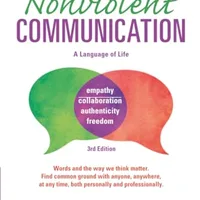
Nonviolent Communication: A Language of Life — Marshall B. Rosenberg
Directly after the Observation→Feeling→Need→Request framework — this is Rosenberg's own book, the source text for the entire NVC section. The single most on-theme product in the article.
As an Amazon Associate, we earn from qualifying purchases — at no extra cost to you.

What Active Listening Actually Means
Carl Rogers at the University of Chicago spent decades studying what actually produces change in therapeutic conversations — and his conclusion challenged everything the field assumed about technique and intervention.
The change mechanism wasn't the methodology. It was the quality of the relational presence.
Three specific conditions, to be exact. Unconditional positive regard — accepting the person independently of evaluating their current behavior or choices. Empathy — accurately perceiving and reflecting back what the person is feeling, not just the surface content of what they're saying. Congruence — genuine, present engagement rather than performed listening while your mind works on its response.
Rogers's outcome research showed these three therapist-provided conditions, independent of any specific technique, predicted therapeutic change. The quality of the communication itself was the primary intervention — not the insights delivered, not the homework assigned, not the theoretical framework applied.
Here's what that means practically: most of us aren't actually listening when we think we're listening. We're waiting. We're already formulating our response, preparing our counter-argument, or mentally planning the thing we want to say as soon as there's an opening. The words enter, but they pass through a filter made of our own experience, opinions, and the response we're building.
Active listening — the Rogers version — means setting down the formulation entirely. Your entire job in this moment is to understand what this person is experiencing as precisely as possible. Not to fix it. Not to agree with it. Not to redirect it. To understand it.
And then — crucially — to reflect that understanding back. "It sounds like you're feeling overwhelmed, and maybe a little unseen in all of this" isn't weakness or therapy-speak. It's the specific behavior that Rogers documented as the primary predictor of the other person feeling heard.
Most people have never received that level of attention. When they do, it changes the conversation immediately.

Clever Fox Habit Calendar / Habit Tracker Journal
Anchors the active-listening section into action — a place to run the 'one genuine appreciation per day for seven days' deposit practice and the weekly Four-Horsemen audit (Action Steps 1 & 2).
As an Amazon Associate, we earn from qualifying purchases — at no extra cost to you.
The Myth of the Right Words
A quick note on Mehrabian's famous 7-38-55 rule — the idea that words account for only 7% of communication, tone 38%, and body language 55%. You've almost certainly heard it cited as a universal principle.
It's almost certainly being applied wrong.
Mehrabian's original 1967 studies addressed one specific question: how do people resolve inconsistency between verbal content and nonverbal signals when evaluating whether someone likes them. Not all communication. That one very particular situation.
What the broader nonverbal communication research actually establishes: the consistency between your words and your tone is the primary cue for authenticity. The limbic system processes prosodic signals — tone, rhythm, pace — faster and with less conscious mediation than it processes semantic content. Which means "I'm not upset" delivered with a clipped voice and crossed arms doesn't communicate I'm not upset. It communicates the opposite, and the person you're talking to will believe their nervous system over your words every time.
You cannot say one thing and mean another and expect to be heard accurately. The body broadcasts what the words are trying to contain.
How to Start Today
The research converges on a handful of practices that are substantially more useful than generic advice about "communicating better."
1. Audit for the Horsemen this week. Not to judge yourself — just to notice. The moment you criticize rather than complain. When contempt surfaces as a tone you didn't plan. When defensiveness kicks in before you've actually heard what's being said. Awareness of the pattern has to precede any possibility of changing it.
2. Build positive deposits deliberately. Identify one relationship where the Emotional Bank Account might be running low. One specific, genuine expression of appreciation, curiosity, or warmth per day for seven days. Not performed — it has to be real, or the other person's nervous system will register it as hollow. But real appreciation is usually available. You've just stopped voicing it.
3. Practice the observation step before difficult conversations. Before you bring something up, write down — literally write down — the specific behavior you want to address, in purely behavioral terms. What you saw or heard. No evaluation, no character judgment. The discipline of this one step changes the entire direction of what follows.

Full Focus Planner by Michael Hyatt
Sits in the 'How to Start Today' action section beside Step 3 — literally writing down the behavioural Observation before a hard conversation. A planner gives that discipline a home.
As an Amazon Associate, we earn from qualifying purchases — at no extra cost to you.
4. Add the deliberate pause. When you notice your heart rate rising in a conflict, ask for twenty minutes. Not forever — twenty minutes. "I want to continue this conversation but I need a few minutes first" is not stonewalling. It's the physiological prerequisite for the conversation you're trying to have. Stonewalling is withdrawal without return. The pause includes a commitment to come back.
5. Read the research directly. Summaries like this one are necessarily compressed. The specificity in Gottman's work — the coded interaction studies, the longitudinal follow-up data — is humbling in ways that paraphrasing can't quite capture.

Kindle Paperwhite (2024, 12th Gen, 16GB)
Lands on Action Step 5 — 'Read the research directly.' The highest-ticket item in the mix (£4 commission), positioned exactly where the article tells readers to go to the primary sources.
As an Amazon Associate, we earn from qualifying purchases — at no extra cost to you.

For a deeper look at the behavioral science of lasting habit change, this guide walks through the research-backed approach.
The Evolution Nobody Talks About
Jim Rohn said the quality of your life is the quality of your relationships. He was right, but he didn't go far enough.
The quality of your relationships is the quality of your communication patterns. And your communication patterns are habits — learned, automated, and therefore changeable.
That's what the research keeps insisting on, almost uncomfortably: none of the Four Horsemen behaviors are personality flaws. They're learned responses, most of them picked up in childhood long before you had any say in the matter. Contempt wasn't born with you. Defensiveness wasn't written into your chromosomes. They're patterns. Patterns that have been running for decades on autopilot because nobody ever handed you a behavioral science framework for the conversations that matter most.
Which means they can be redesigned. That's what "Design Your Evolution" actually looks like at the relational level — not optimizing your morning routine or your productivity stack, but examining the specific communication behaviors that are producing the relationship quality you're living inside every day.
The career that's plateaued. The friendship that's drifted. The partnership that's become more management than connection. Almost always, there's a communication pattern underneath it that, once you see it clearly, you realize you've never actually examined.
The research gives you something rare in the personal development space: precision. Not platitudes about "being vulnerable" or "listening more." Specific behaviors, specific antidotes, specific ratios that have been tested against actual outcomes over forty years.
Which of the Four Horsemen shows up most often in your highest-stakes relationships? And — more practically — which one would you redesign first?
To understand how growth mindset principles apply to lasting personal change, explore this evidence-based framework.
Was this helpful?