Habits· 10 min read
How to Become a Lifelong Learner
Most adults learn constantly and retain almost nothing. Here's the science of lifelong learning — and a daily system that makes every new skill stick.
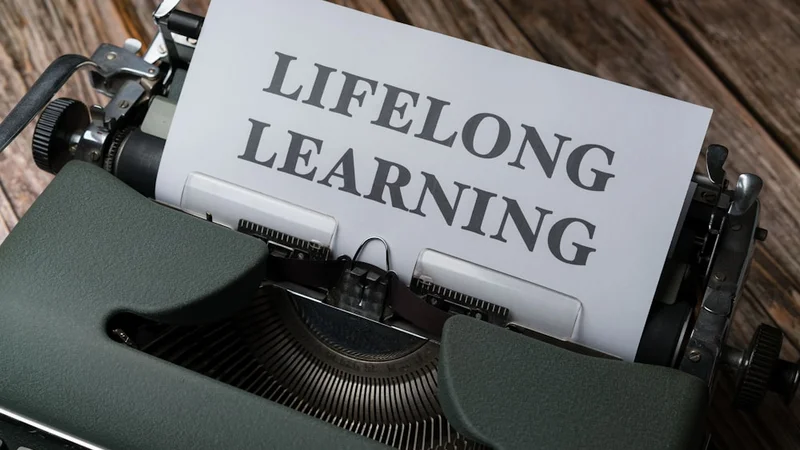
How to Become a Lifelong Learner: The System That Makes Every New Skill Actually Stick
Three years ago I had a Coursera account with eleven enrolled courses. I'd finished two.
My bookshelf was full of books that had technically been "read" — meaning my eyes had moved across every page — but if you'd asked me to explain any of them a month later, I'd have given you a patchwork of vague concepts, a few half-remembered quotes, and the hazy impression that I'd once found the thing interesting. I consumed constantly. I retained almost nothing. And for a while I convinced myself this was close enough to being a lifelong learner.
It wasn't.
The World Economic Forum's Future of Jobs Report 2023 estimated that by 2027, 44% of workers' core skills will be disrupted. That statistic gets cited everywhere. What doesn't get discussed nearly as often is the obvious follow-up question: if nearly half of what makes you valuable today will need to change within three years, what is the single highest-leverage skill you can possibly develop right now?
Not a specific skill. Not data analysis or copywriting or machine learning — though any of those might be exactly right for you.
The meta-skill. The ability to learn new skills quickly, deliberately, and continuously — without needing an institution to do it for you.
Scott H. Young spent twelve months completing MIT's entire four-year computer science curriculum without enrolling at MIT. He documented the process — the methods, the failures, the specific principles that separated genuine learning from the convincing performance of it — in Ultralearning.
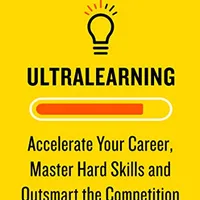
Ultralearning — Scott H. Young
The book the article is built on. Scott H. Young's twelve-month experiment completing MIT's computer science curriculum is the empirical foundation for the learning principles this article unpacks.
As an Amazon Associate, we earn from qualifying purchases — at no extra cost to you.
What he found wasn't a shortcut. It was a pattern: a small set of principles that high-performance self-educators apply almost universally and that most casual learners never touch.
The good news is that these principles aren't complicated. They're just uncomfortable. And once you understand why they work, the uncomfortable parts stop feeling optional.
Why Most Adults Stop Learning Without Realizing It
Nobody decides to stop learning. It happens by default.
Formal education ends. The external scaffolding — deadlines, tests, professors who notice when you go quiet — disappears. And without those structures, most adults drift toward something that feels like learning but is actually something else: consumption.
The distinction matters more than it sounds. Consumption is passive. Reading, watching, listening — information flows in, feels interesting in the moment, and mostly evaporates within weeks. Learning is active. It requires effort, retrieval, application, and the specific discomfort of genuinely not yet knowing something you're actively working to understand.
The adults who keep learning through their thirties, forties, and beyond — genuinely, skillfully, in ways that compound into real capability — aren't necessarily more disciplined than everyone else. They've built a different relationship with that discomfort. Jim Rohn put it plainly: "Formal education will make you a living; self-education will make you a fortune." The fortune he meant wasn't only financial. It's the compounding return on a mind that keeps getting better at understanding how the world actually works.
Most of us learned to "study" using techniques that feel productive — re-reading, highlighting, re-watching lectures — precisely because they require minimal cognitive effort. Cognitive scientists call the result the fluency illusion. Repeated exposure creates familiarity. Familiarity feels indistinguishable from understanding — until someone asks you to actually apply it, and you find you can't.
That's not a personal failing. It's a mismatch between the methods you were taught and the ones that actually work.
The Three Techniques That Science Consistently Validates
Here's where it gets counterintuitive.
The most effective learning techniques are almost universally avoided because they feel harder and produce less immediate comfort. The least effective techniques dominate because they feel productive. This is the central paradox of adult learning — and understanding it changes everything.
Retrieval practice is the single most validated technique in cognitive science. Rather than reviewing your notes to reinforce memory, you close them and attempt to recall what you learned from scratch. The awkwardness of not quite remembering something is not a sign of failure. It is the actual mechanism of memory consolidation. The effort to retrieve information strengthens the neural pathway that stores it more effectively than any passive review. Peter Brown, Henry Roediger, and Mark McDaniel compiled the full evidence base in Make It Stick.
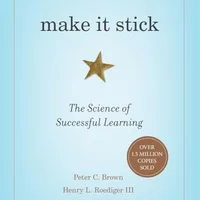
Make It Stick — Brown / Roediger / McDaniel
The most rigorous book on learning science available. Everything this article explains about retrieval practice, spaced repetition, and the fluency illusion comes from the evidence base this Harvard University Press t…
As an Amazon Associate, we earn from qualifying purchases — at no extra cost to you.
Spaced repetition builds on retrieval by timing your review sessions at increasing intervals — returning to material just as you're beginning to forget it, rather than immediately after first exposure. The forgetting curve, first mapped by Hermann Ebbinghaus in the 1880s and validated by a century of subsequent research, is the mechanism: the brain consolidates memory most efficiently when it must work to recover information from partial decay. Anki — a free app used by medical students worldwide to memorize tens of thousands of complex terms — implements this algorithm automatically. You create the flashcards; the algorithm decides exactly when to surface them.

Clever Fox Habit Calendar Circle (2-Year)
A two-year radial visual tracker that turns a daily study commitment into a visible streak — the accountability mechanism that keeps a fifteen-minute daily Anki review habit from slipping.
As an Amazon Associate, we earn from qualifying purchases — at no extra cost to you.
Interleaving is the practice of mixing different topics or problem types within a single study session rather than finishing one topic before starting the next. It feels chaotic and less organized. Studies consistently show it produces superior long-term retention and — critically — transfer: the ability to apply what you've learned to new, unfamiliar contexts rather than only in the context where you first encountered the material.
None of these techniques are complicated. All are deeply underused. Implementing even one of them changes the experience of learning from a passive drift through interesting material into something that actually builds capability.

The Identity Shift That Creates a True Lifelong Learner
Techniques are scaffolding. Identity is the foundation.
Carol Dweck's decades of research on achievement — across schools, competitive sports, professional domains — established a finding that keeps replicating: the single greatest predictor of sustained learning isn't intelligence, prior knowledge, or raw effort. It's whether a person believes that abilities are fixed or developed.
Fixed mindset learners treat every learning challenge as a test of what they inherently are. Growth mindset learners treat every challenge as data about what they need to work on. The practical consequence is stark: when fixed mindset learners hit genuine difficulty — the unavoidable difficulty that attends learning anything real — they tend to withdraw, because difficulty signals inadequacy. Growth mindset learners persist, because difficulty is, by definition, the learning.
Josh Waitzkin — chess prodigy, martial arts world champion, and the subject of Searching for Bobby Fischer — describes the same divide as "entity theorists" versus "incremental theorists." Entity theorists invest their identity in outcomes. Incremental theorists invest it in the process. The former crumbles when the outcome is uncertain. The latter thrives, because the process is always within reach.
how to develop a growth mindset as an adult
What this means practically is that becoming a lifelong learner is not primarily a behavioral change. It's an identity adoption. You stop being someone who occasionally learns things and start being someone for whom learning is a core, defining activity — as fundamental to your self-concept as your work, your relationships, your values.
That identity shift doesn't require an epiphany. It accumulates through small, consistent actions that build evidence for a new self-concept. Track what you're learning. Build artifacts that make the learning visible — notes, projects, conversations. Talk about what you're studying. The identity follows the behavior, not the other way around.
My Daily Learning System (What I Actually Use)
Here's the practical version — what I actually do, in order.
I protect forty-five minutes every morning for deliberate learning. Not professional reading. Not industry news. Self-directed study on a topic I've chosen because I want genuine competence in it — right now, behavioral neuroscience — not because it's immediately monetizable or someone told me I should.
The first fifteen minutes I work through Anki flashcards from the previous two weeks. The algorithm decides what appears; I just retrieve. Not glamorous. Extremely effective.
The next twenty-five minutes I read from a physical book rather than a screen. When I finish a chapter, I close the book immediately and spend five minutes writing what I can recall: the main argument, the evidence that supported it, one thing it contradicted that I previously believed. Retrieval practice, built directly into the reading session — and the step that makes the difference between a book "read" and a book genuinely absorbed.
The final five minutes I write a synthesis note in my learning journal — a dedicated hardcover notebook I keep exclusively for this purpose.

Moleskine Classic Notebook — Hardcover, Large, Ruled
The dedicated hardcover learning journal the article recommends for five-minute synthesis notes. Large, ruled, built for daily use — the notebook that makes the synthesis step a ritual instead of an afterthought.
As an Amazon Associate, we earn from qualifying purchases — at no extra cost to you.
Not a summary. A synthesis: what did this connect to that I already know? What question does it open that I haven't answered yet? This is the step most people skip. It's also the step that converts reading into retrievable knowledge you can still use six months from now.

The whole system takes forty-five minutes. It doesn't require peak motivation or a good day. It requires showing up and following the sequence — which is exactly why the sequence exists.
The Environment That Makes Showing Up Easier
You don't have as much willpower as you think. None of us do.
Decision fatigue is real. Cognitive depletion is real. By the time most people reach their planned learning session at 9pm, they've spent their mental resources on hundreds of small decisions, resisted minor temptations throughout the day, and have approximately enough cognitive fuel left to watch something comfortable. This is not a character flaw. It's the predictable output of trying to sustain demanding behavior through motivation in an environment engineered to ask as little of you as possible.
Cal Newport makes the most rigorous available argument for why protecting this kind of sustained attention has become both essential and specifically achievable in Deep Work. The framework is environmental, not motivational: rather than trying to resist distraction when it appears, eliminate the conditions that make distraction easy. Books visible on the desk. Phone in another room — not face-down on the table, in the other room. A specific chair or space that your brain gradually associates with focused engagement rather than entertainment. These adjustments don't require discipline. They shift the default in the direction you're already trying to go.
One principle from David Epstein's research on skill development that consistently surprises people: breadth accelerates depth. Epstein documents how the people who develop the most resilient, innovative expertise in complex fields typically sampled widely before specializing — which means exploring adjacent subjects during your learning sessions isn't a distraction from real competence. It's building the cross-referencing architecture that makes competence transferable and durable.
how to stop multitasking and focus on one thing
This is what designing your environment for learning actually means: not just removing distractions, but creating the physical and temporal conditions where learning is the path of least resistance — where the friction runs in the direction you actually want to go.
How to Start Today
You don't need to overhaul your schedule this week. You need one sustainable entry point.
Step 1: Choose one subject, not five. Curiosity is not permission to begin learning everything simultaneously. Pick one area you genuinely want genuine competence in. Commit to ninety days before you add anything else.
Step 2: Get a foundational book on how to learn. Before any specific subject, understanding how your brain actually forms and retains memories changes everything. Jim Kwik's Limitless is one of the most practical adult guides to reading faster, improving retention, and building the meta-habits that make every subsequent learning project compound faster.
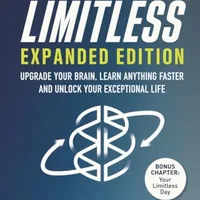
Limitless Expanded Edition — Jim Kwik
The foundational guide to how your brain forms and retains memories — the reading the article recommends before any specific subject. Covers reading speed, retention habits, and the meta-skills that make every learnin…
As an Amazon Associate, we earn from qualifying purchases — at no extra cost to you.
Step 3: Set up spaced repetition from day one. Download Anki — it's free. Create ten flashcards from what you read this week. Commit to fifteen minutes of daily review. This single habit, maintained for sixty days, will produce measurably better retention than any other single change you can make to your practice.
Step 4: Add structured, assessed practice — not just content. Passive consumption doesn't build capability. Assessed projects, problem sets, and peer-reviewed work do. A platform like Coursera Plus combines curriculum structure, real-world projects, and accountability in ways that genuinely complement self-directed reading. The projects matter as much as the lectures.

Kindle Paperwhite (12th Gen, 16GB, Without Ads)
The distraction-free reading device for serious learners. Separates deep reading from the notification environment of a phone or tablet — making the physical reading habit the article describes significantly more sust…
As an Amazon Associate, we earn from qualifying purchases — at no extra cost to you.
Step 5: Protect the environment before you protect the time. Reading Cal Newport's Deep Work before you try to build a serious learning habit is one of the highest-leverage investments you can make. Not because the framework is complicated, but because most people try to learn in environments that make real concentration structurally impossible — and keep blaming motivation for what is actually an architecture problem.
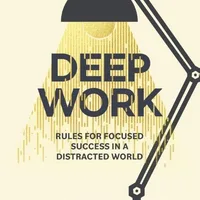
Deep Work — Cal Newport
The rigorous argument for why environment beats motivation — and how to design one where serious learning becomes structurally easier. The article calls it the most important book to read before building a learning ha…
As an Amazon Associate, we earn from qualifying purchases — at no extra cost to you.
Step 6: Explore widely, not just deeply. David Epstein's Range makes the counterintuitive case — backed by decades of research — that sampling broadly before specializing produces not dilettantism but deeper, more adaptable expertise. Give yourself permission to read in adjacent territories. The connections compound.
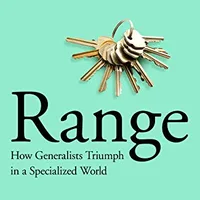
Range — David Epstein
The counterintuitive case — backed by decades of research — that exploring broadly before specialising produces deeper, more adaptable expertise. The book behind the "explore widely" principle the article ends with.
As an Amazon Associate, we earn from qualifying purchases — at no extra cost to you.
Designing your evolution is not a metaphor for vague aspiration. It's a description of a practice: the deliberate, systematic decision to develop yourself with the same intentionality you'd bring to any other project that genuinely matters.
The WEF's disruption estimate is not a reason for anxiety. It's a map. The territory is changing whether you engage with it or not. The only variable you control is whether you're building the capacity to navigate that change continuously — or waiting for circumstances to make the decision for you.
Becoming a lifelong learner as an adult doesn't require exceptional intelligence, extraordinary time, or a personality you don't currently have. It requires a system modest enough to outlast your worst days and consistent enough to pay dividends across decades.
What's the one subject you've been meaning to seriously learn for the past year but keep pushing back? Drop it in the comments — I'm genuinely curious.
Was this helpful?