Mindset· 10 min read
How to Stop Overthinking: Break the Cycle for Good
Overthinking traps you in your own mind. Here's the neuroscience of rumination — and the specific daily practices that break the loop permanently.

How to Stop Overthinking: Break the Cycle for Good
It was 11:52 PM on a Wednesday. I was completely exhausted. And yet my brain was running a full highlight reel of a conversation I'd had at work that morning — had I said the wrong thing? Did she seem annoyed when she walked away? Should I send a follow-up email? What if I've made everything awkward?
Three hours later, I was still there. Replaying the same six sentences in an infinite loop — the core of what psychologists call overthinking. Not generating any new information. Not getting any closer to a resolution. Just burning through the night on repeat, more tired and more anxious than when I'd started.
If that sounds familiar, you already know that the standard advice — "just stop thinking about it," "focus on the positive," "count your blessings" — is about as helpful as telling someone with a broken leg to walk it off. These suggestions aren't just ineffective. They make the pattern worse by adding a layer of self-judgment on top of the existing loop.
Here's what actually works. And more importantly, why it works.
What Overthinking Actually Is (Most People Have This Wrong)
The single most useful thing you can understand about overthinking is that it's not a bad habit. It's a specific cognitive pattern with a precise clinical definition — and once you understand what the pattern actually is, you stop trying to fix the wrong thing.
Susan Nolen-Hoeksema, who spent nearly three decades studying what she called rumination — research conducted at Stanford, the University of Michigan, and finally Yale, where she chaired the Psychology Department — defined it with surgical precision: "Rumination is the repetitive, passive focus on your distress and its possible causes and consequences." Two specific features distinguish it from ordinary problem-solving. First, it's self-focused rather than solution-focused. Second, it's circular rather than progressive — each pass through the loop doesn't generate new information. You rehearse the same worry, the same self-critical narrative, the same hypothetical catastrophe, and you come out the other side exactly where you started, except more depleted.
This is why the most common overthinking advice fails so completely. "Think it through" works fine for genuine problems that require deliberate analysis. It does nothing for rumination — because rumination isn't a thinking problem. It's a pattern problem.
The overthinker doesn't need to think less. They need to interrupt the specific loop that isn't going anywhere. And the way you interrupt a loop depends entirely on understanding what's generating it in the first place.
The Happiness Trap
The foundational ACT text — this is where cognitive defusion and psychological distance were first mapped into a practical, everyday system. If the defusion technique resonated, start here.
As an Amazon Associate, we earn from qualifying purchases — at no extra cost to you.
Building self-awareness and emotional intelligence creates the foundation for recognizing ruminative patterns before they fully activate.
Why Your Brain Gets Stuck: The Neuroscience Explanation
Here's where it gets genuinely interesting — and where the "just stop" advice completely falls apart at the seams.
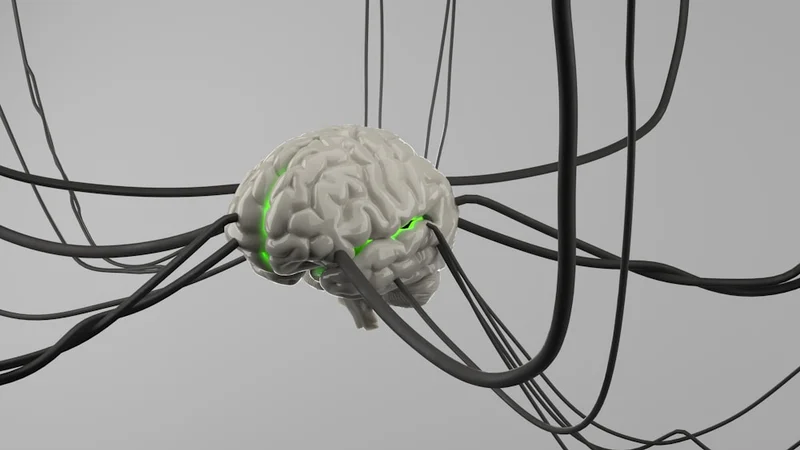
The neural mechanism underlying chronic overthinking is what neuroscientists call the default mode network, or DMN. This is the web of brain regions that activates during mind-wandering, self-referential thinking, and mental time travel — replaying the past, anticipating the future, running social simulations. It's essentially the network that switches on when nothing specific demands your focused attention.
In people with chronic overthinking patterns, peer-reviewed neuroimaging research shows a consistent structural problem: the DMN has reduced connectivity with the cognitive control network — the prefrontal cortex circuits responsible for redirecting attention and interrupting unproductive loops. The brain's own interrupt switch is less effective.
So when you tell yourself to stop overthinking, you're asking your prefrontal cortex to override the DMN. But rumination has been degrading those exact prefrontal resources. It's like trying to fix a circuit breaker using the circuit it controls. You're reaching for the tool that the problem itself has made less accessible.
This is why willpower is the wrong instrument entirely. You can't reliably think your way out of a thought loop using the same neural hardware the loop is running on.
What you need instead are interventions that operate at the level of neural architecture — not thought replacement, not positive reframing, but actual mechanisms that compete with, interrupt, and gradually rewire the ruminative pattern. There are five of them with solid research behind them.
Five Mechanisms That Actually Break the Overthinking Cycle
1. Behavioral Activation — Start Something Specific
The most counterintuitive finding in the overthinking literature: physical action is one of the fastest exits from a mental loop.
The reason is neurological. When you engage in purposeful physical activity — even something as brief as washing dishes, reorganizing your desk, or walking around the block — you recruit motor and sensory neural networks that directly compete with the DMN's self-referential processing. You're not suppressing the thoughts. You're giving the brain something else to actually run.
The key word is purposeful. Passive distraction — scrolling your phone, putting on background TV — doesn't produce the same effect because it doesn't require enough real-world engagement to pull attention genuinely outward. The activity needs to have some directionality to it.
Start small. Three minutes of something physical is enough to disrupt the loop's momentum. From there, redirecting is significantly easier.
2. Cognitive Defusion — Change Your Relationship With the Thought
This technique comes from Acceptance and Commitment Therapy, developed by psychologist Steven Hayes at the University of Nevada, Reno. It doesn't try to eliminate or replace the ruminative thought. It changes your psychological relationship to it.
Instead of: I'm going to fail this. Try: I'm noticing a thought that says I'm going to fail this.
That grammatical shift creates what Hayes calls psychological distance. The thought still exists. But instead of being inside it and experiencing it as objective reality, you're observing it — as a passing cognitive event, something your brain generated, not a fact about the world.
The moment you can observe a thought rather than inhabit it, it loses most of its behavioral authority. You're not fighting it or arguing with it. You're just watching it from one step back. Research consistently shows this reduces both the frequency and the emotional intensity of ruminative thoughts more effectively than the direct suppression that most people attempt.
3. Scheduled Worry Time — The Zeigarnik Trick
This is one of the most evidence-based techniques in cognitive behavioral therapy for anxious overthinking, developed through Tom Borkovec's extensive research at Penn State.
Designate a specific 15-minute slot each day — same time, same location — as your "worry window." Any time a rumination loop starts outside that window, acknowledge it briefly and redirect: "I see you. You're on the schedule for 4 PM." Then continue with whatever you were doing.
What makes this work is the Zeigarnik effect — the brain's built-in drive to complete unfinished business. Open loops generate persistent background cognitive activation because your brain keeps flagging them as incomplete. The scheduled worry window gives the brain a credible completion promise. That's often enough to quiet the flag temporarily.
The catch: you have to actually show up for the session. And when you do, you'll frequently discover that what felt urgent at midnight looks remarkably ordinary in afternoon light.
4. The Two-Minute Decision Rule
A surprising percentage of what people experience as "overthinking" isn't deep rumination at all. It's decision paralysis on genuinely low-stakes choices — deferred not because they're complex, but because the activation energy to decide them slightly exceeds the friction of continuing to defer.
What to cook for dinner. Whether to reply to that email now or later. Which version of the report to send. These aren't difficult decisions. They're open loops that accumulate until, collectively, they create the subjective sensation of a mind that won't settle.
The rule is straightforward: any decision that can be executed in two minutes should be made and executed immediately. Not weighed at length. Decided and done.
Barry Schwartz documented the psychology behind this in The Paradox of Choice — the more options we evaluate for low-stakes decisions, the less satisfied we are with whatever we choose, and the greater the cognitive overhead of keeping them open. The occasional suboptimal choice almost always costs less than the accumulated toll of the loop.
5. Physical Movement — The Neurochemical Reset
Wendy Suzuki, the NYU neuroscientist and author of Good Anxiety, has spent years researching what happens to the ruminative brain during cardiovascular exercise. The finding is specific: even a single 10-minute bout of moderate cardio reliably shifts the neurochemical environment — increasing norepinephrine, serotonin, and BDNF while reducing cortisol.
The result isn't simply feeling better. Attention shifts outward. Ruminative self-focus decreases measurably. The DMN loosens its grip on cognitive resources.
This isn't the generic "exercise is good for you" category. It's a targeted intervention for the specific neural state that chronic overthinking creates. You're not burning off stress in any metaphorical sense. You're changing the chemistry of the brain that was generating the loop.
Ten minutes is enough to produce a measurable effect. You don't need a full workout — you need enough movement to shift your attentional and neurochemical state before attempting to redirect.

The Night Version: Why It's Worst Between 11 PM and 3 AM
If your loops reliably intensify after dark, you're not imagining it and you're not uniquely broken.
During the day, external demands — conversations, tasks, sensory input, the ambient noise of being in the world — provide constant competition for the DMN's activity. The brain has other things to process. At night, alone and quiet, that competition disappears. The DMN, unchallenged, expands into the available cognitive space like a gas filling a room.
Add to that the prefrontal cortex's reduced function under sleep pressure — the brain literally has less capacity for the cognitive control that would interrupt loops — and you have the conditions that make midnight overthinking feel so specifically ruthless.
Three interventions work reliably for the nighttime version:
Write it down before bed. A 10-minute "brain dump" at day's end — every worry, unfinished task, or circling thought transferred to paper — closes the Zeigarnik loops before your head hits the pillow. The act of writing is the brain's completion signal. You've recorded it. You no longer need to generate it.
Use the 90-second rule. Neuroanatomist Jill Bolte Taylor identified that the physiological component of any emotional response lasts approximately 90 seconds. The chemistry peaks and subsides on its own. What extends acute anxiety past 90 seconds is almost always a cognitive story — the narrative you layer on top of the physical sensation. If you can observe the activation without adding the story for 90 seconds, the wave naturally crests and passes.
Make your sleep environment structurally hostile to loops. Phone in another room. No final email checks. A consistent wind-down routine that signals to your nervous system that the day's processing is complete. This isn't optional self-care advice — it's architectural. Environmental design is what makes behavioral patterns sustainable when motivation and willpower are at their lowest.
For more on the science of better sleep, including what most sleep advice gets wrong, see our full guide.
How to Start Today: Building Your Anti-Overthinking System
Breaking the cycle isn't a single insight you act on once. It's an architectural change to how you habitually respond to the onset of a loop — and like any architecture, it has to be built deliberately before you need it.
Step 1: Name your most common loop. What's the script you've rehearsed so many times you could recite it? Name it out loud, specifically: "That's the 'I should have done more' loop." Naming it in the third person removes some of its automatic authority. You're not the loop. You're the person observing it.
Step 2: Choose one interrupt mechanism — just one. Not all five. If you're sedentary when loops start, begin with behavioral activation. If decision paralysis is your primary flavor, begin with the two-minute rule. Match the tool to the specific pattern before adding anything else.
Step 3: Set your worry window today. Pick a 15-minute slot and put it in your calendar. Every time a worry surfaces before then, say the words — internally or aloud — "You're scheduled." Then redirect. Give this one week before evaluating.
Step 4: Move for 10 minutes before the loops get traction. Especially in the morning, before external demands fill the space. You're not solving anything — you're changing the neurochemical state from which you'll encounter whatever arises.
Step 5: Read the research. Every therapist who works with rumination recommends psychoeducation as a first step, because understanding the mechanism of your pattern changes your relationship to it before you've done any other work. Understanding that your brain is stuck in a DMN loop — not malfunctioning, not broken, just running a pattern — is itself a form of cognitive defusion.

Moleskine Classic Notebook
The brain dump technique requires something that holds without friction. A solid hardcover notebook you return to every evening makes the 10-minute wind-down ritual stick.
As an Amazon Associate, we earn from qualifying purchases — at no extra cost to you.
The most counterintuitive truth I've found in years of reading about overthinking is this: the content of the loop almost never matters as much as the pattern. You are rarely overthinking because the subject genuinely requires more analysis. You are almost always overthinking because the loop has become a habitual response to uncertainty — and the exit is almost never through the same territory.
Overthinkers aren't thinking too much. They're thinking in circles. And you cannot escape a circle by continuing to walk it.
Designing your evolution means building a mind that works for you — one that can think hard and carefully when a situation actually demands it, and can step out of the loop when the situation doesn't. That's not about positive thinking. It's about understanding what's generating the pattern, and having a specific, tested mechanism ready to use before midnight on a Wednesday when the loop starts up again.
What loop have you been running longest? I'd genuinely like to know.
Was this helpful?
Continue Your Evolution
The Frozen Goal Problem: Why Tiny Wins Beat Grand Plans
Rejection Sensitivity: Why You Keep Assuming They're Upset
The Science of Nostalgia: Why Looking Back Helps
Sedikides and Wildschut found nostalgia boosts mood, meaning, and social connection — not mere sentimentality. Here's the science and how to use it.