Mindset· 10 min read
Name It to Tame It: The Affect Labeling Science
Naming an emotion precisely measurably calms your brain's threat response. Here's the real science of affect labeling — and how to use it today.
Name It to Tame It: The Affect Labeling Science
Three years ago, I watched a colleague walk out of a meeting and put his fist through a wall.
Not metaphorically. An actual drywall situation. And afterward, when we were both standing in the corridor — him staring at his hand, me pretending I hadn't seen — he said something that stayed with me for a long time: "I didn't even know I was that angry until it happened."
That gap — between feeling something fully and knowing what it is — has a name: affect labeling, the practice of putting an emotion into a specific, precise word at the moment you feel it.
That's the thing about emotions nobody really warns you about. They don't always announce themselves clearly before they act. They build quietly, just below the surface, and then they go. And you're standing there afterward wondering who made that decision, because it certainly didn't feel like you.
What I didn't know then — and what a team of neuroscientists at UCLA had already demonstrated in print — is that there's a specific, evidence-backed technique for interrupting that sequence before it completes. It doesn't require meditation retreats or years of therapy. It takes roughly three seconds and one word. The right word.
What the Research Actually Found About Naming Your Emotions
In 2007, psychologist Matthew Lieberman and his colleagues — Naomi Eisenberger, Molly Crockett, Sabrina Tom, Jennifer Pfeifer, and Baldwin Way — published a study in Psychological Science called "Putting Feelings Into Words: Affect Labeling Disrupts Amygdala Activity in Response to Affective Stimuli".
The design was deliberately simple. Participants lay inside an fMRI machine and viewed images of faces expressing strong emotions — fear, anger, the kind of face you'd recognize from a difficult conversation at work. Some participants were asked to simply look at the face. Others were asked to do one additional thing: select a single word that named what the face was expressing.
Angry. Afraid. Disgusted.
That's it. One word.
The brain scans showed something that surprised even the researchers. Participants who labeled the emotion showed measurably reduced activity in the amygdala — the brain region most associated with threat detection and the launch sequence for an emotional reaction — compared to those who simply observed the identical image without labeling it. Simultaneously, labeling increased activity in the right ventrolateral prefrontal cortex, a region associated with regulatory control.
The brain wasn't just reporting the feeling. The act of finding the word was actively changing what was happening inside it.
How Emotions Are Made: The Secret Life of the Brain — Lisa Feldman Barrett
The article cites Barrett by name for emotional granularity research. Placed directly after the Lieberman fMRI section, where the reader has just accepted that naming changes brain state and wants the deeper science.
As an Amazon Associate, we earn from qualifying purchases — at no extra cost to you.
The Mechanism: Why One Word Does Anything at All
Here's the part that tends to get lost in how this research gets summarized.
It's not about emotional expression. Not catharsis. Not venting. The regulatory mechanism is more specific than any of that — and more useful.
When you experience a strong emotion without labeling it, your brain processes it in what you might call a diffuse, physiologically activating mode. The amygdala fires. Your heart rate climbs. Your body prepares for a threat response. You're in the feeling, fully, but you're not differentiated enough from it to do much other than be carried along by it.
The moment you translate that diffuse state into a specific linguistic category, something structurally different happens. You're recruiting a genuinely competing process — one that requires the prefrontal cortex to engage, which is itself the region responsible for dampening the amygdala's alarm. The naming isn't passive. It's a competing cognitive act that quietly interrupts the threat sequence in real time.
Think of it as two circuits wired in opposition. When one activates strongly, it suppresses the other. Naming the feeling activates the language-and-regulation circuit, which dials down the threat-response circuit. Not permanently. Not all the way. But measurably, in the moment you need it most.
This is why researchers who study trauma sometimes describe putting an experience into words — writing it, naming it precisely — as genuinely therapeutic, not merely cathartic. The words aren't just representing the experience. They're reprocessing it.
Why Vague Words Don't Work as Well (The Precision Problem)
Here's where it gets counterintuitive, and where most casual summaries of this research miss the important detail.
Not just any word works equally well.
Lieberman's broader research program — including a 2012 follow-up study led by Katharina Kircanski that put affect labeling to the test with spider-phobic participants during real-world exposure therapy — found that more specific, more negative affect words produced measurably stronger effects: the more precisely participants named their fear, the greater the drop in their physiological stress response, and the further they were able to progress through the exposure. Vague labels didn't do nearly as much work as precise ones.
The effect appears to depend on the genuine cognitive effort of finding the accurate word, not simply attaching any word. When you reach for precision, you're doing more processing, not less. You're asking your brain to locate this specific feeling on a conceptual map of emotion — to distinguish it from the twenty adjacent states it might be — which requires pulling the prefrontal cortex more fully into the work.
There's a practical consequence to this. If your emotional vocabulary is thin — if most of your internal states get filed under "stressed," "fine," or "frustrated" — you're leaving most of this effect on the table. You're using blunt instruments where precision is doing the real work.
Psychologists call this emotional granularity: the ability to distinguish between closely related feeling states rather than collapsing them into broad categories. Research by Lisa Feldman Barrett and colleagues has found that people with higher emotional granularity tend to regulate their emotions more effectively and recover more quickly from stressful events, while people who struggle to differentiate their emotions are more likely to fall back on maladaptive responses — like binge drinking or aggression — when distressed. Knowing the difference between anxious and apprehensive, between disappointed and bereft, between annoyed and contemptuous, actually changes your outcome.
What Affect Labeling Isn't (This Part Matters)
It's worth being clear about what this technique is not, because the self-help space has produced a lot of adjacent advice that sounds similar but operates on a completely different mechanism.
It's not positive self-talk. Positive self-talk tries to replace a negative thought with a better one. Affect labeling doesn't argue with the feeling — it simply names it. You're not saying "I shouldn't feel this way." You're saying: "I feel this way. And the specific word for it is dread."
It's not suppression. Suppression says: push the feeling down, don't show it, don't let it out. Research consistently shows suppression makes things worse — the feeling doesn't disappear, it just operates underground, still influencing your behavior without the benefit of a label you could work with. Lieberman's work is essentially the opposite: bring the feeling into language rather than away from it.
It's not rumination. Rumination loops — why do I feel this, what does it mean, why does this keep happening to me? Affect labeling is a single, efficient act. One word. Done. The looping is not the point. The naming is.
Related read: The 10 Cognitive Distortions That Warp How You See the World
And it's distinct from Paul Gilbert's separate research on self-criticism, which concerns the tone of your inner voice after a mistake: whether you're being self-correcting or self-persecuting in the way you process a failure. Affect labeling concerns something more immediate — naming the raw emotional state as it's actually happening, before the inner monologue even gets going. These are two separate levers. Affect labeling fires first.
The Happiness Trap (2nd Edition) — Russ Harris
Sits in 'What Affect Labeling Isn't'. ACT is the clinical tradition that formalises exactly the distinction the section draws — naming and accepting a feeling versus suppressing it or arguing with it. The reader has j…
As an Amazon Associate, we earn from qualifying purchases — at no extra cost to you.
What This Looks Like in Practice (And Where People Go Wrong)
Here's what affect labeling actually looks like in a real moment, and where most people fumble it.
Say you're in a conversation with someone and something they say lands wrong. Your stomach tightens. Your jaw does something subtle. You find yourself going quieter than usual.
The default moves are familiar: push through and feel worse afterward, or escalate. Neither one serves you.
The affect labeling move is to pause — even just internally — and ask a single, specific question: What is this, exactly?
Not "why am I feeling this." Not "is this a reasonable response." Not "what does this say about me." Just: what is the precise word for what's happening right now?
Maybe it's dismissed. Maybe it's embarrassed. Maybe it's caught off guard. These are different things with different implications. Dismissed carries a history with this specific person. Embarrassed carries something about your self-image. Caught off guard is more situational, more recoverable — it doesn't mean anything about the relationship, only about the timing.
Finding the right word doesn't just help you communicate better afterward. According to Lieberman's data, it changes your nervous system's actual response in the moment.
The mistake people make is adding an unauthorized step: they label the feeling and then immediately try to solve it or eliminate it. But the labeling itself is the intervention. Let it sit for a breath. The nervous system needs a moment to register what just happened.
Building the Vocabulary That Makes This Work
If you want to use this effectively, you need more words. Not dozens — just more than the ten most people actually use with any regularity.
Most adults have absorbed roughly a dozen broad emotional categories through daily life: happy, sad, angry, anxious, frustrated, excited, tired, overwhelmed. These work well enough for social communication. They're not precise enough to do regulatory work.
The good news is that emotional vocabulary is learnable. It's not a personality trait you either have or don't. It expands with deliberate exposure, and the expansion doesn't take long.
A few approaches that tend to work:
Read for emotional texture. Fiction is genuinely useful here in a way non-fiction rarely is. Writers like Kazuo Ishiguro or Elena Ferrante spend thousands of words distinguishing between feeling states that most of us collapse into one word. Ishiguro's The Remains of the Day is essentially a sustained, quiet study in the precise word for choosing dignity over feeling — and recognizing only afterward what that choice cost.
Use an emotion wheel. Robert Plutchik's wheel of emotions, and the various expanded derivatives of it, organizes feeling states into eight core emotions and three levels of intensity for each: anger that ranges from annoyance, to anger, to rage; fear that ranges from apprehension, to fear, to terror. Keeping one in your journal or pinned somewhere visible gives you a vocabulary to reach for when you're searching.

Kindle Paperwhite (2024, 12th Gen, 16GB, Black, Without Ads)
Placed immediately after 'Read for emotional texture', the paragraph that names Ishiguro and Ferrante as vocabulary-builders. This is the high-ticket anchor of the set (>£100) and the only product here that carries…
As an Amazon Associate, we earn from qualifying purchases — at no extra cost to you.
Practice at low stakes. Don't wait for the crisis. At the end of each day, try naming three things you felt during it — with precision. Not "stressed at work" but "resentful when the meeting ran over because it meant I lost the one hour I'd protected for actual thinking." The practice trains the habit at low cost, so it's available when the amygdala fires at full volume.
Related read: Why Your Gratitude Practice Isn't Working
How to Start Today: Five Practical Steps
You don't need a system or a course. Here's what the research and practice both support:
Step 1: Notice the body signal first. Before you reach for a word, locate where the feeling lives. Chest? Jaw? Shoulders? Stomach? This anchors you in the present-moment experience rather than in the story you're already building around it.
Step 2: Ask "what's the specific word?" Not "why do I feel this way." Not "what should I do about this." Just: what is the precise word for what's happening right now? Give yourself five seconds.
Step 3: Write it down. Silently is fine. But writing one word in a journal makes it more concrete and gives you a record of what you were actually feeling across different moments in your day — which builds emotional granularity over time.
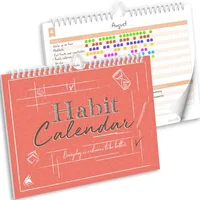
Clever Fox Habit Calendar Circle (24-Month Tracker Journal)
Lands on Step 3, 'Write it down' — the article's own instruction that writing one word per moment builds emotional granularity over time and gives you a reviewable record. A dated tracking journal is the literal tool…
As an Amazon Associate, we earn from qualifying purchases — at no extra cost to you.
Step 4: Don't immediately do anything else with it. This is where people add an unauthorized step. They label the feeling and instantly try to solve or eliminate it. The labeling itself is the intervention. Let it sit for a breath. Give your nervous system a moment to register what just happened.
Step 5: Check the word again. The first word is often approximate. After one breath, ask: is that actually the right one, or is there a more specific word closer to what's really there? The second pass often lands more precisely, and that precision is where the regulatory effect lives.
What Spinoza Got Right Without an fMRI
Benedict de Spinoza — a 17th-century philosopher whose ideas on happiness hold up surprisingly well against modern neuroscience — argued that freedom comes not from eliminating your emotions but from understanding them clearly enough that they stop running you. He called a poorly understood emotion a bondage. A named and understood emotion, something closer to power.
He didn't have access to brain scans. But he'd apparently arrived at the same conclusion Lieberman's team would publish three hundred years later: the named feeling and the unfelt feeling are not the same experience. One has a handle. The other doesn't.
Lieberman's data puts measurable biology behind that intuition. The moment you label a feeling with precision, you've already changed what's happening in your brain. The amygdala's activation drops. The prefrontal cortex comes online. You have, in the most literal and measurable sense, more of yourself available to think clearly and choose deliberately.
That's not therapy. It's not positive thinking. It's one word — used precisely, at the right moment — doing actual regulatory work.
Related read: How to Break a Bad Habit: It's Not About Willpower
"Design Your Evolution" doesn't mean eliminating what makes you human. It means learning to work with your wiring rather than against it, or worse, pretending the wiring isn't there until your fist is through a wall.
Lieberman's study cost those participants nothing but three seconds and a word. The cost of not developing this skill is usually calculated in hindsight — standing in the corridor, wondering how it got this far.
So: what's the word for where you are right now? Not "fine." Not "stressed." The real one. The specific one.
Start there.
What's one emotion you've been labeling vaguely — "bad," "off," "a lot" — that might deserve a more precise word? Drop it in the comments.
Was this helpful?