Habits· 10 min read
The Peak-End Rule: Why Your Brain Rewrites Memory
Your brain ignores how long an experience lasts — it only remembers the peak and the ending. Kahneman's peak-end rule reveals how to design habits that actually stick.
The Peak-End Rule: Why Your Brain Rewrites Memory
There's a workout I used to dread every single week.
Not because it was particularly brutal. Not because I didn't have time. I dreaded it because every time I finished, I felt vaguely defeated — stiff, slightly annoyed, and completely unmotivated to show up the following week. For months, I blamed discipline. I told myself I just needed more willpower, a better schedule, a stronger "why."
Then I read a study about colonoscopies — and discovered something called the peak-end rule. Everything changed.
That study — conducted by Daniel Kahneman and Donald Redelmeier in 1996 — wasn't about fitness at all. It was about pain management. But it revealed something about how human memory actually works that applies to every habit, every routine, and every experience you're trying to build into your life. Once you understand it, you'll never design a workout, a workday, or a difficult conversation the same way again.

The Colonoscopy Experiment That Rewrote Psychology
Here's what Kahneman and Redelmeier did. They recruited patients undergoing colonoscopy procedures — not exactly the most pleasant hour of anyone's life — and tracked pain intensity in real time, minute by minute. After the procedure, they also asked patients to rate their overall experience.
Two patients received very different procedures. Patient A had a shorter procedure with consistently high pain throughout. Patient B had a longer procedure — objectively more total pain — but the doctor extended the final minutes by keeping the instrument still, reducing discomfort slightly before withdrawal.
Which patient remembered the experience as worse?
Patient A. Every time.
The peak-end rule, as Kahneman defined it following this research published in the journal Pain, is a cognitive heuristic in which people judge an experience based almost entirely on two moments: its most intense point (the peak) and how it ended. Duration is largely irrelevant. A longer experience is not automatically remembered as worse — or better — than a shorter one.
This is duration neglect in action. Patient A experienced less total pain, but their memory encoded the experience as more painful — because their peak was high and their ending was high. Patient B had more minutes of discomfort, but a gentler ending. Their remembered experience was significantly more tolerable.
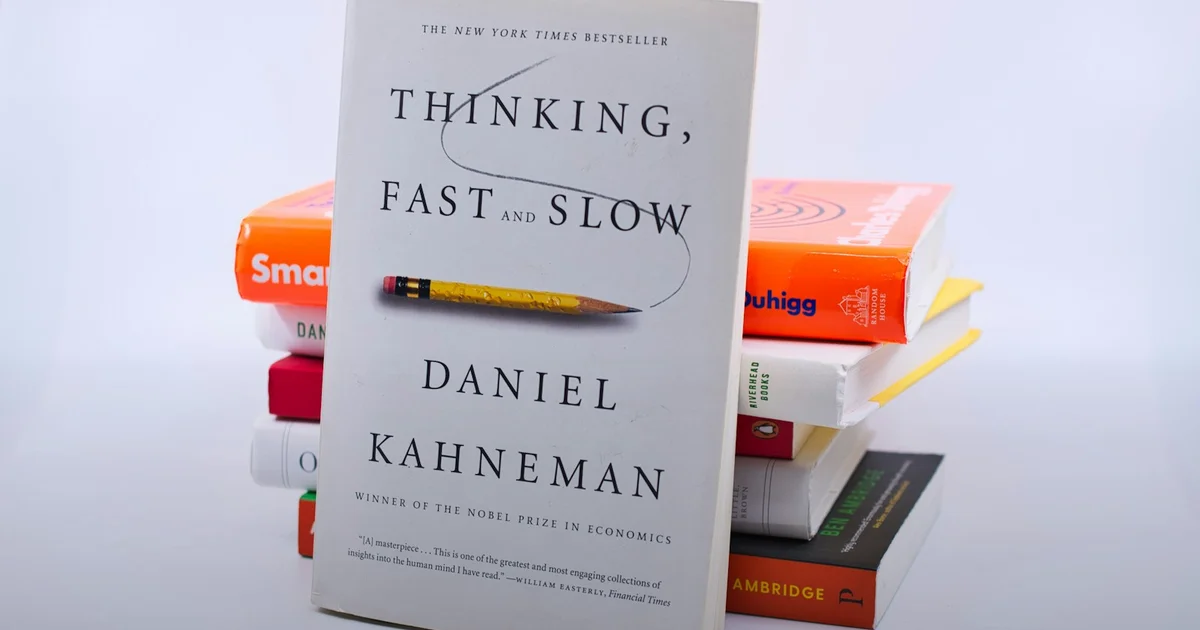
Thinking, Fast and Slow — Daniel Kahneman (Paperback)
The book where Kahneman formalised the experiencing self vs remembering self — the exact framework this whole article is built on. The primary-source read for anyone who just learned why their brain rewrites memory.
As an Amazon Associate, we earn from qualifying purchases — at no extra cost to you.
The implication is staggering: your brain does not average your experiences. It does not calculate totals. It takes a snapshot at the most intense moment and another at the very end, averages those two data points, and calls that the truth of what happened. Everything in the middle? Duration neglect. Your brain doesn't especially care how long something lasted.
Kahneman formalized this in Thinking, Fast and Slow as the distinction between the experiencing self — the you that exists moment to moment — and the remembering self — the you that tells the story afterward and makes all future decisions. The remembering self is the one in charge. And it doesn't have great data.
Why This Is Quietly Destroying Your Habits
Think about the last habit you tried to build and eventually abandoned.
You probably don't remember most of the sessions. You remember the hard ones. The one where you were exhausted and it felt endless. The one where you finished frustrated. The one where the last few minutes were grinding. Those are the data points your remembering self kept — and when the next opportunity to show up arrived, the remembering self voted no.
This is the mechanism behind what most people call "lack of motivation." It's not laziness. It's not a character flaw. It's the peak-end rule operating exactly as designed, protecting you from experiences that ended badly — even when those experiences were, on average, completely fine.
The implications here are more practical than they might first appear. You've been designing your habits from the inside out: focusing on what happens during the session. But your brain is primarily evaluating from the outside in: what the ending felt like. The last five minutes of a workout carry more weight in your remembered experience than the previous 45. The final note of a difficult meeting shapes how you remember the whole conversation. The closing moments of a study session determine whether your brain files that session under "worth doing again."

Habit Tracker Journal (Clever Fox Habit Calendar Circle, 24-Month)
Those abandoned habits you 'don't remember most of'? A tracker gives the remembering self real data points instead of just the hard sessions it kept by default. Visual proof the middle happened.
As an Amazon Associate, we earn from qualifying purchases — at no extra cost to you.
Most habit advice misses this entirely. It focuses on making the middle better — finding the right workout program, the most engaging textbook, the most effective technique. Those things matter. But the ending matters more.
The Peak Matters Too — Here's How to Engineer It
The peak-end rule has two components: the peak (the most emotionally intense moment) and the ending. Both shape memory. Both are, to a meaningful degree, designable.
BJ Fogg at Stanford's Behavior Design Lab spent years studying why habits stick and why they don't. What he found in his Tiny Habits research — documented in his book of the same name — cuts directly against most conventional habit-building wisdom. The missing ingredient in almost every failed habit, Fogg found, wasn't motivation or scheduling or accountability. It was celebration.
Not celebration as in a party. Celebration as in a deliberate, immediate positive signal injected at the exact moment of habit completion.
A fist pump. A quiet "yes." A three-second acknowledgment of what just happened. Something that generates a genuine feeling — even a small one — immediately after the behavior.
What Fogg is describing, through the lens of the peak-end rule, is peak engineering. He's creating a designed emotional high point at the end of the habit loop. That designed peak becomes the peak your remembering self encodes. The next time the habit cue appears, the memory that surfaces isn't "that's usually kind of grinding" — it's the brief flash of satisfaction from last time.

Fitness Smartwatch (Amazfit GTR 4, 46mm, GPS, 150+ Sports Modes)
The article's running example is a dreaded workout fixed by engineering its ending. A watch that logs the session and lets you close on a visible win (a completed ring, a streak) is literal peak engineering on the wri…
As an Amazon Associate, we earn from qualifying purchases — at no extra cost to you.
This is not fake positivity. It's applied memory science. You're not pretending the difficult part wasn't difficult. You're creating a genuine competing data point that your remembering self will weight heavily because it came at the right moment.
My failed workouts? The problem wasn't the workouts. It was that I was ending them mid-frustration — cutting off during a hard set, skipping the cooldown, driving home while still annoyed at my performance. I was feeding my remembering self the worst possible ending. No celebration, no wind-down, no acknowledgment. Just a neutral or negative cut to black.
Duration Neglect: The Lesson We Keep Ignoring
Here's the counterintuitive finding that's hardest to accept: longer is not better remembered as better.
If your two-hour study session and your forty-five-minute study session both end well, your remembering self will evaluate them as roughly equivalent. If your two-hour session ends in frustration and your forty-five-minute session ends in a moment of genuine clarity, your brain will file the shorter one as the superior experience — even though you covered more material in the longer one.
This has a liberating implication. You don't need to maximize duration to maximize the quality of your remembered experience. You need to maximize the quality of the ending.
Chip and Dan Heath explored this in The Power of Moments — a book that deserves to be on every designer's shelf, whether you're designing products, conversations, or your own daily routines. Their core argument: most experiences are dominated by an undifferentiated, unmemorable middle. The people who create lasting impressions — in life and in work — invest disproportionately in two moments: the peak (an experience that rises above the baseline) and the transition (an ending that marks meaningful change).
The Power of Moments — Chip & Dan Heath
Cited by name in this exact section — the Heath brothers' case that people remember peaks and transitions, not averages. The applied companion to the Kahneman read above.
As an Amazon Associate, we earn from qualifying purchases — at no extra cost to you.
The Heath brothers call these "defining moments," and the research they synthesize is consistent: people remember peaks and transitions, not averages. A mediocre meal with one extraordinary dish is remembered as a better meal than a consistently decent dinner. A meeting that ends with a clear, energizing next step is remembered as a better meeting than one that was substantively identical but trailed off into logistics.
For habit design, this means the last two minutes of any session are worth engineering more deliberately than the first thirty.
How to Use the Peak-End Rule in Your Daily Routines
This is where theory becomes practice. The peak-end rule isn't a philosophical curiosity — it's an operational design framework. Here's how to apply it:
-
Design your endings first. Before you plan what you'll do during a workout, a study session, or a creative work block, decide how it ends. Not just when — how. What does the final moment look, feel, or sound like? My workout now ends with three minutes of stretching music I genuinely enjoy, followed by one deliberate acknowledgment of something I did well that day. That's it. That's the designed ending. Everything before it is fuel. Those last three minutes are the data point my remembering self keeps.
-
Identify your natural peaks and amplify them. Every experience has a natural high point — the moment of most engagement, most challenge, most satisfaction. Most people let it pass unremarked. The peak-end rule says to linger there, briefly. If you finish a chapter and something clicks, pause for ten seconds before moving on. Let the brain encode that clarity as the peak of the session, not just another data point lost in duration.
-
Repair bad endings retroactively. This one is counterintuitive but powerful. If a session ends badly — the workout felt terrible, the meeting collapsed, the study session drifted into distraction — take two minutes to manufacture a small win before you close the loop. Do one set you can complete well. Write one clear summary sentence. Make one decision you're confident in. You're not pretending the session was great. You're inserting a better final data point into the memory your brain is about to file.
-
Use this for conversations, not just tasks. The peak-end rule applies to every interaction, not just solo habits. The person you spoke to this morning will remember that conversation primarily through its most emotionally significant moment and its ending. If you want a difficult conversation to be remembered as productive rather than painful, the ending is the highest-leverage design point you have. End with specificity and warmth — a concrete next step, a genuine acknowledgment — and the remembered quality of the whole conversation improves substantially, independent of how rocky the middle was.
Why You Make Your Worst Decisions When It Matters Most
- Apply duration neglect strategically. Shorter sessions with engineered endings are frequently more effective than longer sessions with neglected endings. If you're consistently abandoning a 60-minute study habit, try a 25-minute version with a designed ending — and watch whether your remembering self starts voting yes more reliably.

The Book That Ties It All Together
Daniel Pink's When: The Scientific Secrets of Perfect Timing is the clearest popular treatment of why beginnings and endings carry disproportionate psychological weight. Pink synthesizes the behavioral economics of temporal landmarks — why Monday morning hits differently than Tuesday afternoon, why the last quarter of any project ignites effort that the middle rarely can, why endings shape retrospective evaluation in ways that beginnings and middles cannot match.

Kindle Paperwhite (2024, 12th Gen, 16GB)
Sits beside the Daniel Pink 'When' recommendation — the device for the reader who just collected four books in one article (Kahneman, Fogg, Heath, Pink). 'Finish the chapter' is one of the article's own examples. High…
As an Amazon Associate, we earn from qualifying purchases — at no extra cost to you.
The synthesis of Pink, Fogg, the Heaths, and Kahneman points to a single operational principle: the most under-designed element of any habit, routine, or experience is its ending. We spend enormous energy on the content, the tools, the schedule, the technique. We spend almost nothing on the final two minutes.
Those final two minutes are doing most of the work of memory formation.
The Science of Gratitude: What Actually Works
A Note on the Experiencing Self
There's one objection worth addressing directly: isn't it dishonest to engineer your memories? If a workout was hard, shouldn't you remember it as hard?
Kahneman himself grappled with this in Thinking, Fast and Slow. His conclusion was not that we should manipulate memory, but that the systematic distortions of the remembering self — duration neglect, peak-end compression — mean our memories are already inaccurate representations of our experienced lives. The experiencing self lives in a richer, more continuous reality than the remembering self reports.
Designing the ending of an experience isn't deception. It's correcting for a systematic bias. The three minutes of deliberate closure after a hard workout aren't fake — they're real moments, genuinely experienced. You're not lying to your remembering self. You're giving it better data from the experiences you're actually having.

Premium Planner (Full Focus Planner by Michael Hyatt)
The closing 'design your evolution starting at the end' section and the evening-journaling image. A planner is where you pre-decide how each session ends — the article's single operational ask, made into a daily tool.
As an Amazon Associate, we earn from qualifying purchases — at no extra cost to you.
The workout was hard and it ended with something meaningful. Both are true. The remembering self just has a way of keeping only one. You're choosing which one it keeps.
Design Your Evolution — Starting at the End

Here's what I know now, after fixing those workouts I used to dread: the problem was never the workout itself. I was building the same habit every week — and then undermining the memory of it in the final moments. All that effort, systematically erased by a bad ending.
The peak-end rule doesn't require you to overhaul your routines. It requires you to add one deliberate design decision to every significant experience: what does this end like?
Not how long it runs. Not how efficiently you fill the middle. How does it end.
That's the question your remembering self is going to answer on your behalf, whether you've thought about it or not. The only question is whether you've designed the answer — or left it to chance.
What's one routine in your life right now that consistently ends on a flat or negative note? And what would it look like to spend ninety seconds engineering a different ending?
Drop it in the comments. I'm genuinely curious what surfaces when you think about this.
Was this helpful?