Habits· 10 min read
Why Sleep Decides What Your Brain Actually Keeps
Your brain files memories during sleep, not while you study. Walker's research reveals what all-nighters actually cost — and what to do instead.
Why Sleep Decides What Your Brain Actually Keeps
The night before my university finals, I did what everyone does. I made a pot of coffee, spread my notes across the desk, and committed to staying up until I'd memorized every last formula.
By 2am I was highlighting things I'd already highlighted. By 4am I was rereading the same paragraph three times without it landing. I showed up to the exam feeling like I'd studied, but a strange fog had settled over everything I thought I knew. Half of what I'd spent the night reviewing was just... gone.
I assumed I was bad at memorizing things. It took me years to understand that the problem wasn't my memory at all. It was that I'd spent the night actively sabotaging the one process my brain uses to turn learning into knowledge.
What We Actually Get Wrong About Memory
Most people think of memory like saving a file. You encounter information, it gets stored, and it's there when you need it. Sleep, in this model, is just what happens between study sessions — neutral downtime.
That model is wrong. Dangerously wrong if you're in school, learning a new skill, or trying to retain anything that matters.
Here's the real version: the moment you learn something, your brain creates a fragile, temporary trace in a structure called the hippocampus. Think of it like a sticky note — it holds the information briefly, but it's vulnerable. It can be overwritten. It decays. And it absolutely cannot transfer itself into stable, long-term storage on its own.
For that transfer to happen, you need sleep.
Matthew Walker, a neuroscientist at UC Berkeley and director of the Center for Human Sleep Science, spent more than two decades studying what the sleeping brain actually does to memories. His book
Why We Sleep — Matthew Walker (Paperback)
The article cites Walker's Why We Sleep by name as the source of the core memory-consolidation research — the most natural, non-salesy book placement possible.
As an Amazon Associate, we earn from qualifying purchases — at no extra cost to you.
Why We Sleep is one of the most readable accounts of this research — and one of the more alarming ones, because the data on what sleep deprivation costs you is difficult to look away from.
Walker's core finding, replicated across dozens of controlled studies, is this: sleep doesn't just help you recover from the effort of learning. Sleep is part of the learning process itself. Skip it, and the learning is incomplete.
The Overnight Filing System: What Happens While You're Unconscious
Your brain is busier during sleep than most people realize.
During NREM (non-rapid eye movement) sleep, particularly during stage 2, the brain produces brief, rhythmic bursts of electrical activity called sleep spindles. These bursts — you'll have hundreds of them across a night — are the mechanism by which the hippocampus begins handing off memory traces to the neocortex, the region responsible for long-term storage.
Walker's research, along with parallel work by Robert Stickgold at Harvard Medical School, describes this as a "dialogue" between two brain regions. The hippocampus replays the day's events in compressed form; the neocortex gradually encodes them into stable, integrated knowledge that can be retrieved days, months, or years later.
The number of sleep spindles you produce in a given night predicts how well you'll remember what you learned the day before. People who sleep more deeply — producing more spindles — retain more. People who sleep poorly retain less, even when they were equally alert and attentive during learning.
This is the part that changes how you think about studying. The hours you spend reviewing material aren't the whole equation. They're only the input. Sleep is what converts the input into lasting output.
why you forget almost everything you read
The All-Nighter Tax Is Bigger Than You Think
Here's what most people assume: pulling an all-nighter is a bad idea because you'll be tired the next day. The fix, in this view, is caffeine. Power through, take a nap later, you'll be fine.
Walker's research dismantles this pretty thoroughly.
The cost of skipping sleep isn't just fatigue. It's a two-part penalty that hits your memory from opposite ends.
First, you lose the consolidation window. Whatever you learned before the all-nighter doesn't get properly transferred. The hippocampal sticky note stays fragile and begins to degrade. When you sit down the next morning to review — or worse, to take the exam — you're working from an unprocessed, unstable trace. That's why post-all-nighter recall feels slippery. The memories were never moved to permanent storage.
Second, your encoding capacity drops before you even start. This is the less intuitive finding, and in some ways the more troubling one. Walker's controlled studies showed that sleep-deprived brains show measurably reduced activity in the hippocampus even before any new material is presented. You haven't started learning yet, and the recording mechanism is already impaired.
One study from Walker's lab found a roughly 40% deficit in the ability to form new memories after a night without sleep. Forty percent. No amount of caffeine, focus, or sheer willpower closed that gap — it was a structural consequence of the missing sleep.

Fitness Smartwatch / Sleep Tracker — Amazfit GTR 4
Slot text discusses seeing your actual NREM stage-2 sleep distribution. The article names Oura Ring as the example; the Amazfit GTR 4 is the catalog-validated sleep-stage tracker with full UK/US/ES/BR coverage (BioTra…
As an Amazon Associate, we earn from qualifying purchases — at no extra cost to you.
A good sleep tracker (like an Oura Ring) can show you your actual sleep stage distribution — how much time you're spending in NREM stage 2 where those critical spindles occur. Once you can see it, you stop guessing.
Skill Learning Has Its Own Sleep Debt
Walker's research on memory goes beyond facts and recall. Some of his most striking studies involved motor skills — musicians, athletes, surgeons-in-training — and the findings are consistent with everything else: sleep makes the difference between performance that consolidates and performance that evaporates.
In one set of experiments, participants practiced a finger-tapping sequence (essentially a keyboard piano pattern) to a specific level of performance. Half then slept; half stayed awake for the same number of hours. When tested again, the sleep group had improved their speed and accuracy significantly. The awake group hadn't.
What was happening? During sleep — specifically during late-night NREM stage 2, which is disproportionately present in the final hours before waking — the brain was replaying and refining the motor sequence offline. Not consciously. Not through effort. Just automatically, as part of the consolidation process, the sleeping brain was doing the practice that the waking brain couldn't.
This extends to cognitive skills, creative problem-solving, and language acquisition. Sleep doesn't pause learning. It continues it.
Jim Rohn used to say that you don't get paid for the hour — you get paid for the value you bring to the hour. Applying the same logic: you don't get results from the study session. You get results from what the study session becomes overnight.
Creating the right sleep environment matters here more than most people think. Heavy blackout curtains are one of the simpler, higher-leverage investments — light exposure during sleep disrupts the stage structure and reduces the deep NREM phases where memory consolidation is most active.
Why More Hours in Bed Isn't Enough
You might be thinking: I sleep eight hours. I'm fine.
Maybe. But total sleep duration and sleep architecture aren't the same thing.
The NREM stage 2 spindles that matter most for memory consolidation are disproportionately concentrated in the last two hours of an eight-hour sleep window. Cut from eight to six hours — something more than a third of working adults do on a regular basis, according to CDC survey data — and you lose a disproportionate share of the highest-value memory-processing time, not just 25% of it.
Alcohol is another factor worth naming. It's commonly mistaken for a sleep aid because it accelerates sleep onset. But alcohol suppresses REM sleep and significantly disrupts NREM structure, producing a fragmented sleep architecture that scores poorly on any measure of consolidation quality. You might spend eight hours in bed after a couple of drinks and wake up feeling like you barely slept — because neurologically, you mostly didn't.
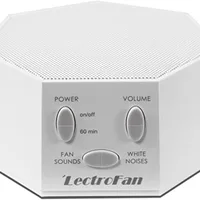
White Noise Machine — LectroFan Classic (Global Power Edition)
Slot text: 'A white-noise machine can improve sleep continuity more than most people expect.' LectroFan is the catalog-validated triple-parity (UK/US/ES) unit.
As an Amazon Associate, we earn from qualifying purchases — at no extra cost to you.
A white-noise machine or similar acoustic environment tool can improve sleep continuity (the unbroken stretches of NREM that allow spindle-dense phases to develop) more than most people expect. Ambient sound reduces the micro-arousals caused by variable noise, which interrupt sleep staging without necessarily waking you fully.
Here's the thing that shifts your whole relationship with sleep once it really lands: rest isn't the opposite of productivity. It's the biological mechanism that makes your effort stick. You can read that sentence and nod. But the real test is whether you act on it — whether you schedule sleep the way you schedule work, as a non-negotiable block rather than whatever's left after everything else. Bob Proctor talked about aligning your actions with how things actually work. The brain's memory architecture is one of the clearest examples. Sleep isn't a reward for a productive day. It's the process that decides whether the productive day counted.
For people who sleep lightly or wake easily, a weighted blanket has solid evidence behind it for improving sleep continuity — the steady pressure activates the parasympathetic nervous system, promoting deeper, more sustained rest.
you can't outwork bad sleep with more effort
How to Start Sleeping Smarter Tonight
You don't need to overhaul your life. You need to make three specific decisions that Walker's research actually supports.
1. Treat your last two hours of sleep as sacred. This means your sleep window ends at a consistent time every morning — not when you feel like waking up, but the same time daily, including weekends. Consistency anchors your circadian rhythm and protects the late-NREM phases where memory work happens. If you're staying up late on Fridays and sleeping in on Sundays, you're creating what chronobiologists call "social jetlag" (a term coined by researcher Till Roenneberg, and a pattern Walker discusses at length) — and your consolidation suffers for it.
2. Learn before you sleep, not after. The timing of learning relative to sleep matters. If you have something to retain — a presentation, a language lesson, a technical concept — reviewing it in the evening before bed gives you the shortest possible gap between encoding and the consolidation window. Your brain will prioritize what you reviewed most recently when it begins its overnight replay.
3. Treat caffeine as a tool with a cutoff. Caffeine blocks adenosine, the sleep-pressure molecule that builds across the day. If adenosine is suppressed too close to bedtime, you'll reduce sleep pressure and delay sleep onset. The half-life of caffeine is roughly five to six hours — meaning a 3pm coffee still has half its load in your system at 9pm. That doesn't mean you can't drink coffee; it means you need to know what you're asking your brain to skip.
how to build a morning routine that actually sticks
What You're Actually Designing When You Protect Sleep
Every skill you're building, every conversation you're trying to learn from, every book you're reading to grow — it all passes through the same bottleneck.
Your brain at night.
The ancient Stoic Epictetus said that it's not events that disturb us, but our judgment about events. There's a parallel idea in sleep science: it's not the hours you put in that determine what you become, but what your brain does with those hours while you're completely unconscious.
That's not a passive process. It's one you design.
A consistent sleep schedule. A room engineered for darkness and quiet. A cutoff time for caffeine and alcohol. A habit of reviewing what matters in the evening. These aren't luxury choices. They're the infrastructure that decides whether today's effort becomes tomorrow's capability — or just tomorrow's forgotten night. Design your evolution, starting with tonight's sleep.
What's one thing you learned this week that you genuinely want to keep? Leave it in the comments. And then — for once — go to bed on time.
Sources: Walker, M. (2017). Why We Sleep. Scribner. | Stickgold, R. (2005). Sleep-dependent memory consolidation. Nature, 437(7063), 1272–1278. | Gais, S., & Born, J. (2004). Declarative memory consolidation: Mechanisms acting during human sleep. Learning & Memory, 11(6), 679–685. | Walker, M. P., & Stickgold, R. (2004). Sleep-dependent learning and memory consolidation. Neuron, 44(1), 121–133. | Yoo, S. S., Hu, P. T., Gujar, N., Jolesz, F. A., & Walker, M. P. (2007). A deficit in the ability to form new human memories without sleep. Nature Neuroscience, 10(3), 385–392. | Roenneberg, T., Wirz-Justice, A., & Merrow, M. (2003). Life between clocks: Daily temporal patterns of human chronotypes. Journal of Biological Rhythms, 18(1), 80–90.
Was this helpful?