Mindset· 10 min read
Post-Traumatic Growth: Why Hard Times Build You
Tedeschi and Calhoun found that growth after adversity is real and measurable — distinct from resilience. Here's what their research actually shows.
Post-Traumatic Growth: Why Hard Times Build You
There's a version of you that exists on the other side of something terrible.
Not a healed version, necessarily. Not a fixed version. Just a version that somehow knows things you couldn't have learned any other way — about what you actually care about, who will genuinely show up for you, what you're capable of surviving. You might have caught a glimpse of that person during the worst year of your life and then promptly dismissed the thought, because it felt disrespectful to the pain. It felt like trying to find a silver lining where there wasn't one.
But here's the thing: the research on post-traumatic growth doesn't talk about silver linings. It talks about something far more specific, and far more interesting.
What Tedeschi and Calhoun's 1996 Research Actually Found About Post-Traumatic Growth
In 1996, psychologists Richard Tedeschi and Lawrence Calhoun published "The Posttraumatic Growth Inventory: Measuring the Positive Legacy of Trauma" in the Journal of Traumatic Stress. They weren't writing a self-help book. They were solving a measurement problem.
Clinical psychology had spent decades studying what adversity takes from people — the diagnostic criteria for PTSD, the mechanisms of trauma, the cascading damage that serious loss or crisis can leave behind. What it had mostly overlooked was a pattern Tedeschi and Calhoun kept noticing in their clinical work: a meaningful proportion of people who lived through genuinely shattering events didn't just survive them. They reported coming out different in ways they couldn't entirely attribute to coping. Not better, exactly. Just more.
So Tedeschi and Calhoun built an instrument to measure it — the Posttraumatic Growth Inventory (PTGI), scored across five distinct domains:
- New possibilities — seeing paths or directions that weren't visible before
- Relating to others — deeper, more authentic connections with people
- Personal strength — a revised sense of one's own capacity
- Spiritual change — a reconfigured sense of what matters and why
- Appreciation of life — a genuine, not performed, heightening of what gets noticed
The data that followed — from their own work and from the substantial body of research the PTGI launched — found something worth sitting with. A meaningful proportion of people who'd lived through serious adversity, illness, loss, disaster, the genuinely life-shattering kind, reported change in at least one of these domains that measurably exceeded their prior baseline functioning.
Not a return to how they were before. Not simply getting back to normal. An identifiable expansion beyond it.
This distinction between surviving and expanding is also the subject of our broader look at how a genuine crisis can change who you are, if you want to sit with it further before we get into the specific domains.
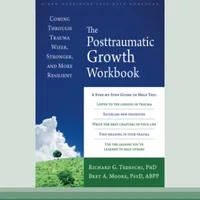
The Posttraumatic Growth Workbook — Richard G. Tedeschi & Bret A. Moore
The section just above lists the five PTGI domains. This is the workbook written by Tedeschi himself — the step-by-step version of the instrument the reader has just been introduced to. The single most on-theme purcha…
As an Amazon Associate, we earn from qualifying purchases — at no extra cost to you.
Why the Shattering Has to Happen First
Here's what makes post-traumatic growth different from ordinary personal development, and also what makes it uncomfortable to study.
You can't engineer it from a comfortable life.
Psychologist Ronnie Janoff-Bulman's assumptive world theory helps explain why. All of us carry a working set of largely unconscious assumptions about how the world operates — that it's basically safe, that events make sense, that good things generally happen to good people, that tomorrow will resemble today. These assumptions aren't naïve exactly; they're necessary. They let you function without re-evaluating reality from scratch every morning.
A genuinely seismic event — the kind Tedeschi and Calhoun were studying — doesn't just hurt. It invalidates the model. A serious diagnosis, a sudden loss, a betrayal of the magnitude that rewrites your past, these don't just cause pain; they pull out the assumptions the pain was leaning on. The world-as-you-understood-it stops being a reliable guide to the world-as-it-actually-is.
And this, specifically, is where post-traumatic growth becomes possible. Not because suffering is secretly good. But because the work of rebuilding those shattered assumptions — deliberately, honestly, without pretending the break didn't happen — produces something the original, intact model couldn't.
The catch: this is the effortful part. Tedeschi and Calhoun's broader research found it's specifically the deliberate, cognitive processing of the rupture — not avoidance of it, not suppression, not rushing past it — that predicts real growth. The people who found ways to short-circuit the discomfort, to get back to normal as quickly as possible, tended to miss what was available on the other side.
Jim Rohn used to say that the major value in life isn't what you get — it's what you become. What he meant, I think, is that your character is the real constraint — and character doesn't update from pleasant experiences. It updates from the ones that force you to find out what you're actually made of.
The research now has a name for what he was describing.
Growth and Pain Aren't Opposites — They're Neighbours
This is the part that most popular writing on post-traumatic growth gets wrong, because getting it right is harder to sell.
PTG doesn't mean the pain resolves. It doesn't mean you stop grieving, stop struggling, stop carrying what happened. Tedeschi and Calhoun were careful about this from the beginning: growth and distress are not mutually exclusive. The same person can report genuine, measurable post-traumatic growth in specific domains while still carrying real, unresolved pain from the same event.
Growth doesn't erase the hurt. It coexists alongside it.
This matters because most people implicitly assume a linear sequence — first you hurt, then you heal, then maybe you grow. The actual pattern is more complicated and less tidy than that. People reporting the strongest growth sometimes also reported the most ongoing distress. The growth wasn't a sign that the event was processed and complete. It was more like a new structure being built inside an active wound.
What this means practically: if you're in a hard season right now and you haven't noticed any dramatic transformation, that doesn't mean growth isn't happening. And if you have noticed real change in how you see yourself or what you're capable of, that doesn't mean you're obligated to feel okay about what caused it.
Both things get to be true.

Option B: Facing Adversity, Building Resilience, and Finding Joy — Sheryl Sandberg & Adam Grant
The section above is the one that insists growth and pain are neighbours, not opposites. Option B is the best-known first-person account of exactly that — real grief that never resolved, alongside real, documented gro…
As an Amazon Associate, we earn from qualifying purchases — at no extra cost to you.
The Five Doors Where Growth Actually Shows Up
It's worth spending a moment with the five PTGI domains individually, because they're specific enough to be useful — far more specific than the vague idea of "being changed by adversity."
New possibilities. This one surprises people. After something major collapses, the prior path often collapses with it — a career direction, a relationship future, a version of yourself you'd been building toward. What the research found is that for a meaningful subset of people, that collapse opened visibility into directions they genuinely couldn't have seen from within the structure they'd been inside. Not better paths, necessarily. Just paths that weren't previously imaginable.
Relating to others. It's often said that the quality of your life is largely shaped by the quality of your relationships. What Tedeschi and Calhoun's data found is that serious adversity — when processed honestly — tends to recalibrate those relationships sharply. Who showed up. Who didn't. What real support actually feels like versus what you'd assumed it would. The result for many people was fewer, deeper, more honest connections.
Personal strength. Here's the counter-intuitive version of this one: knowing you can survive something terrible doesn't make you feel invincible. It makes you feel accurate. People reporting growth in this domain didn't describe feeling stronger in the action-hero sense. They described a quieter, more reliable sense of their own capacity — the knowledge that they'd faced something genuinely hard and hadn't been destroyed by it.
Spiritual change. For the majority of Vanulos readers who aren't drawn to spiritual frameworks, this domain still applies. It just shows up less as theology and more as a fundamental reconfiguration of priorities — what actually matters, what doesn't, where your finite time should go. The event that broke your assumptions also broke your assumptions about time.
Appreciation of life. Not gratitude-journaling appreciation. Not "I'm grateful for my coffee." The specific, sometimes startling heightening of ordinary things that can follow serious loss or illness. The light at a particular time of day. A conversation that wouldn't have mattered before. The research treats this as a genuinely distinct domain because it is — it's a perceptual shift, not a cognitive one.
The Most Important Thing Post-Traumatic Growth Is Not
Post-traumatic growth is not resilience.
This distinction is Tedeschi and Calhoun's most important methodological contribution, and it's worth being clear about it. Resilience research — associated primarily with Ann Masten and colleagues — concerns a person's capacity to return to their prior level of functioning after adversity. It's about getting back to baseline. And that matters. The ability to bounce back from setbacks is genuinely valuable.
But PTG concerns something different. It concerns exceeding that prior baseline in specific, identifiable ways. Not recovering. Expanding.
If resilience is the capacity to return to your previous cruising altitude after turbulence, post-traumatic growth is finding yourself, after the turbulence, at a different altitude entirely.
Neither is better. Both are real. But conflating them — assuming that getting back to normal is the same as growing — means missing what the research has actually documented. It means celebrating a return when something more was available.
It's worth pairing this with what the resilience research itself has found — see the science of resilience and why you're stronger than you think for the other half of this picture.

Kindle Paperwhite 2024 (12th Gen, 16GB, Black)
This slot lands right after the PTG-is-not-resilience distinction — the point where a curious reader wants the primary literature, not a summary. A dedicated reading device lowers the friction of building the interpre…
As an Amazon Associate, we earn from qualifying purchases — at no extra cost to you.
The authors themselves have been careful to note that not everyone experiences PTG, and that's not a moral failure. Exposure to genuine adversity doesn't guarantee growth any more than planting a seed guarantees a harvest. The conditions — the willingness to sit with the rupture, to process it honestly rather than bypass it, to rebuild assumptions deliberately — matter enormously.
But those conditions aren't mysterious. They're practicable.
Building those conditions often starts with how you treat yourself in the aftermath, which is exactly what the research on self-compassion and resilience gets into.

How to Start Recognizing Your Own Post-Traumatic Growth Right Now
You don't need to have lived through a catastrophe to apply what Tedeschi and Calhoun documented. Most serious adversity is quieter than the clinical examples — the relationship that failed in a way you didn't fully recover from, the career that ended before you were ready, the period of illness or exhaustion or loss that changed your coordinates without announcing it.
Here's a framework drawn directly from the PTGI research:
Step one: Name the rupture. Not to dramatize it. Just to be precise about which event actually broke something you'd been assuming. Vague trauma is harder to process than named experience. What, specifically, shifted your understanding of how the world works?
Step two: Audit the five domains, honestly. Look at Tedeschi and Calhoun's five areas and ask yourself, for each: has something changed here since that period? Not should something have changed. Just has it, measurably, concretely? You might find nothing in some domains and something genuine in others. That's the typical pattern.
Step three: Resist both forcing and dismissing. The two failure modes are mirror images. Forcing PTG — deciding you must have grown because suffering without growth would be unbearable — produces a kind of false positivity that bypasses the actual processing. Dismissing it — assuming nothing good could come from something that hard — closes off an honest accounting of what actually changed.
Step four: Let growth and grief coexist. If you find genuine evidence of growth in one domain, you don't have to feel resolved about the event that caused it. The research specifically notes these aren't mutually exclusive. You can have grown and still not be okay about what grew you. Both are true. Both are yours to carry.
Step five: Keep accounting. PTG isn't always immediate. The research documented growth that took months or years to register as growth — what felt at the time like barely surviving turned out, in retrospect, to have been building something. Staying curious about your own development across time, rather than asking for a verdict right now, is how you eventually see it clearly.

The Version That Exists on the Other Side
Every meaningful change in who you are has a cost. That's not a comforting idea, and the research doesn't try to make it one. Tedeschi and Calhoun weren't arguing that adversity is good. They were documenting what happens when a person, faced with something that breaks their prior model of the world, does the hard work of building a new one instead of papering over the damage.
The result isn't happiness. It isn't the erasure of what happened. It's a different kind of capacity — the specific kind that only gets built from the inside of something genuinely difficult.
Napoleon Hill wrote that every adversity, every failure, every heartbreak, carries with it the seed of an equal or greater benefit. It's a beautiful idea, but the research gives it a more useful shape: the benefit isn't automatic. It grows from the rebuilding, not the breaking. And the rebuilding requires a specific kind of honesty — about what actually changed, in which domains, and what that genuinely means for who you're becoming.
Design Your Evolution isn't a promise that the hard seasons have a tidy upside. It's a commitment to looking, honestly, at what the hard seasons are actually building — because the data suggests that's worth looking for.
So here's the question I'd leave you with: When you think about the hardest period you've lived through, which of Tedeschi and Calhoun's five domains shows up, even slightly, even uncomfortably, when you look with honest eyes? I'd genuinely like to know what you find.
Sources and further reading:
- Tedeschi, R. G., & Calhoun, L. G. (1996). The Posttraumatic Growth Inventory: Measuring the positive legacy of trauma. Journal of Traumatic Stress, 9(3), 455–471. https://pubmed.ncbi.nlm.nih.gov/8827649/
- Janoff-Bulman, R. (1992). Shattered Assumptions: Towards a New Psychology of Trauma. Free Press.
- Masten, A. S. (2001). Ordinary magic: Resilience processes in development. American Psychologist, 56(3), 227–238. https://pubmed.ncbi.nlm.nih.gov/11315249/
- Tedeschi, R. G., & Moore, B. A. (2016). The Posttraumatic Growth Workbook. New Harbinger Publications.
- Sandberg, S., & Grant, A. (2017). Option B: Facing Adversity, Building Resilience, and Finding Joy. Knopf.
Was this helpful?