Mindset· 9 min read
Why You Can't Stop Worrying (Intolerance of Uncertainty)
Freeston and colleagues found it's not potential danger that drives chronic worry — it's intolerance of uncertainty. Here's what the 1994 research reveals.

The Real Reason You Can't Stop Worrying (And It Has Nothing to Do With Danger)
The email sat in your drafts for two days. You'd written it. You just hadn't sent it.
Not because you'd said something wrong — you'd read it six times and it was fine. But between pressing send and knowing what would happen next, there was a gap. A period of not knowing. That gap, it turned out, was completely unbearable. So you kept the email in drafts, kept rewriting the third paragraph, kept waiting for certainty that was never going to arrive.
That's not an anxiety disorder. That's not catastrophizing. Researchers have a name for it: intolerance of uncertainty. And once you understand the concept, a lot of the worry that seems irrational starts to make a different kind of sense.

The Study That Reframed Everything
In 1994, Mark Freeston, Josée Rhéaume, Hélène Letarte, Michel Dugas, and Robert Ladouceur published a paper in Personality and Individual Differences with a deceptively simple title: "Why Do People Worry?"
It sounds like a philosophical question. It turned out to be a technical one.
Freeston and colleagues developed a specific, testable construct they called intolerance of uncertainty — defined as a person's dispositional difficulty accepting that a negative event might occur, however small the actual probability, simply because its outcome cannot be known in advance. They built a questionnaire to measure it, tested it against existing worry measures, and found something that researchers in the anxiety field hadn't cleanly articulated before: the relationship between worry and intolerance of uncertainty was stronger than the relationship between worry and the actual likelihood of the feared outcomes.
Read that again. It wasn't how likely the bad thing was that predicted how much someone worried. It was how much that person struggled to sit with not knowing.
People who scored higher on intolerance of uncertainty didn't just worry more about one thing — they worried more intensely about a wider range of completely unrelated topics. Health, finances, relationships, work. The content shifted; the underlying driver didn't. The worry wasn't tracking real risk. It was tracking the sheer presence of an unresolved unknown.
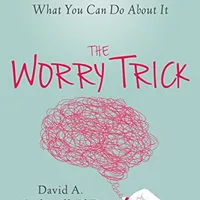
The Worry Trick — David Carbonell (Paperback, New Harbinger)
The article names this exact book as the clearest plain-English guide to uncertainty exposure — the recommendation is already made in the prose, the slot just makes it buyable.
As an Amazon Associate, we earn from qualifying purchases — at no extra cost to you.
Why an Open Question Feels Like a Threat
Here's the mechanism Freeston and colleagues proposed, and it's genuinely elegant once you see it.
For most people, an unanswered question is just that — open. Uncomfortable, maybe, but not alarming. For someone high in intolerance of uncertainty, an unresolved "what if" functions differently. It operates less like an open question and more like an active threat signal.
The brain doesn't like incomplete loops. There's well-documented work in cognitive psychology on the Zeigarnik effect — the tendency for unfinished tasks to occupy mental bandwidth more than completed ones. Freeston and colleagues were pointing at something related but distinct: for certain people, the unresolvability of a future outcome isn't just cognitively sticky, it's experientially aversive. It feels, at some level that bypasses logic, like something needs to be done about it.
And so worry kicks in. Not as a character flaw, not as weakness, but as the mind's attempt to mentally simulate every possible version of an outcome in advance — as if rehearsing enough scenarios might somehow produce the certainty that isn't actually available yet.
The problem is obvious once you name it: you can't think your way to certainty about a genuinely uncertain future. You can spend four hours running every possible scenario about what a doctor's appointment might reveal, and at the end of those four hours, you still don't know what the appointment will reveal. The worry accomplishes nothing except exhaust you and consume the time you had.
Why Facts Don't Change Minds (Identity-Protective Cognition)
The Breadth Problem Is the Tell
One of the most practically useful things that came out of Freeston's research, and from the decades of follow-up work it launched, is this: intolerance of uncertainty predicts worry across domains better than the specific content of any single worry does.
In other words, if you find yourself worrying intensely about your health one week, then your finances the next, then a relationship the week after that — and none of those situations has materially changed — the worry's topic isn't the real signal. The breadth is the signal.
This matters because most self-help approaches to worry try to address the content. They say: let's examine whether this health worry is actually rational. Let's look at the evidence. Let's reality-check whether the financial concern is proportionate to the actual numbers.
Those approaches aren't useless. But if the underlying driver is intolerance of uncertainty rather than a specific, content-level distortion, then successfully defeating one worry just frees the anxiety to find a new topic. You've addressed the leaf. The root is still there.
There's a similar principle in how people talk about chronic money problems: the specific overdue bill isn't the real problem — it's a symptom of a deeper pattern that keeps producing overdue bills. Freeston and colleagues were making a structurally similar point about worry. The topic isn't the problem. The relationship with uncertainty is.
The Happiness Trap (2nd Edition) — Russ Harris
Placed after 'The Breadth Problem Is the Tell' — ACT's root-vs-leaf framing is exactly the article's argument that defeating one worry just frees the anxiety to find a new topic.
As an Amazon Associate, we earn from qualifying purchases — at no extra cost to you.
How This Differs From "Just Control What You Can Control"
At this point, someone usually says: "But this is just about locus of control, right? People need to focus on what's in their control."
It's not the same thing — and the distinction matters for how you actually approach the problem.
Julian Rotter's locus-of-control research — rooted in the social learning theory of personality he introduced in 1954 and formalized as "locus of control" in his 1966 paper on internal versus external control of reinforcement — concerns a stable, broad personality-level tendency: the degree to which a person generally believes outcomes in their life are caused by their own actions (internal locus) or by external forces (external locus). It's a trait-level orientation that shapes a huge range of behavior across many domains.
Intolerance of uncertainty is more specific. It concerns a person's difficulty tolerating the state of not knowing itself, regardless of whether the outcome is within their control. You can have a very strong internal locus of control — genuinely believe you're the primary author of your outcomes — and still be high in intolerance of uncertainty. Because intolerance of uncertainty isn't about who's in control of the outcome. It's about the unbearability of not yet knowing what the outcome will be.
Someone high in IU doesn't primarily need to be reminded to focus on what they can control. They need something different: the specific, practiced capacity to sit in the presence of an unresolved unknown without treating that unresolvedness as an emergency that demands immediate mental action.
Illusion of Control: Why Letting Go Works
What the Research Actually Recommends
Here's what gets counterintuitive: the most effective response to intolerance of uncertainty isn't a better way of reasoning about uncertain outcomes. It's building genuine tolerance for the experience of not knowing.
The therapeutic approach most directly descended from Freeston and colleagues' work is intolerance-of-uncertainty-focused CBT, which includes a specific component called uncertainty exposure. The idea is exactly what it sounds like: deliberately practicing sitting with unresolved situations — not seeking premature closure, not running every scenario, not googling symptoms at midnight — and discovering, over repeated experience, that the discomfort of not knowing is survivable and that it fades on its own.
David Carbonell's The Worry Trick is one of the clearest practical guides to this territory that exists in plain English. Carbonell's argument, which tracks closely with the research, is that the harder you try to resolve or push away a worry, the more you signal to your brain that the worry requires urgent attention. Treating the discomfort of uncertainty as something that needs to be fixed is, paradoxically, what keeps the fix from arriving.

Kindle Paperwhite 2024 (12th Gen, 16GB, Black, Without Ads)
Sits right after the Carbonell/uncertainty-exposure section: a device with no notifications and no browser is the anti-reassurance-loop reading surface — and it carries the IU-CBT literature.
As an Amazon Associate, we earn from qualifying purchases — at no extra cost to you.
The first move, in both the research-derived therapy and in Carbonell's approach, is accurate labeling. Not "I'm worried about this appointment" but "I'm experiencing intolerance of uncertainty about this appointment." The shift is subtle. The effect, over time, is not.
When you name it accurately, you're doing something important: you're separating the actual situation from your reaction to its unresolvedness. The appointment itself is neutral data. Your discomfort with not yet knowing the outcome is a recognizable, manageable phenomenon with a name. Those are two different things. And the moment you can see them as two different things, the worry loses some of its automatic claim on your attention.

How to Start Working With This Today
None of this requires a therapist, though working with one trained in IU-focused CBT is worth it if worry is significantly affecting your daily life. Here's what you can begin doing on your own.
First, audit the breadth. For the next week, jot down what you were worrying about each evening. Don't analyze it — just note the topic. If you find yourself cycling through unrelated domains (health one day, a professional relationship the next, finances the day after), that pattern is useful data. It suggests you're dealing with intolerance of uncertainty rather than a specific, topic-level problem that reasoning can fix.
Second, practice naming accurately. When you notice worry arriving, say to yourself — out loud if that feels useful — "This is intolerance of uncertainty. I don't yet know how this will resolve, and I'm finding that genuinely uncomfortable." Full stop. Don't add "and here's what might happen." Don't continue the scenario-running. Just name it and observe what happens to the discomfort over the next few minutes when you don't try to fix it.
Third, resist the reassurance trap. One of the most consistent findings from follow-up research on intolerance of uncertainty is that seeking reassurance — googling symptoms, asking friends the same question repeatedly, checking in on a situation you can't actually change yet — provides momentary relief and then reliably makes the next bout of uncertainty feel more urgent. If you find yourself asking "but what do you think will happen?" to the same person for the third time about the same situation, that's the trap at work.

kSafe Time Locking Container (Medium, White Lid + Clear Base)
Directly after 'resist the reassurance trap' — this is the physical version of not googling symptoms at midnight. Highest emotional-conversion item on the page.
As an Amazon Associate, we earn from qualifying purchases — at no extra cost to you.
Fourth, introduce small, deliberate uncertainty exercises. Freeston and colleagues' work launched a therapy approach that includes exactly this: structured, voluntary exposure to low-stakes uncertainty. Go to a restaurant and order something without reading the menu first. Make a small decision without researching it. Sit with an unopened piece of mail for ten minutes before opening it. These feel absurd on paper. In practice, they're doing genuine training — teaching your nervous system that the presence of an unresolved unknown is not, in itself, an emergency.
A good notebook kept specifically for this kind of observation — tracking your worry topics, noting when you sought reassurance, recording how discomfort changed when you named rather than chased it — turns the practice into data you can actually learn from.

Clever Fox Habit Calendar Circle (24-Month Tracker Journal)
The paragraph literally asks for 'a good notebook kept specifically for this kind of observation' — worry topics, reassurance episodes, how discomfort moved.
As an Amazon Associate, we earn from qualifying purchases — at no extra cost to you.
Why You Procrastinate (3 Psychological Traps)
The Distinction That Changes the Whole Problem
There's a line near the end of Freeston and colleagues' original paper that doesn't get quoted much, but it's the one that stuck with me. The researchers note that intolerance of uncertainty isn't about being afraid of specific bad outcomes. It's about a dispositional difficulty with the state of not-yet-knowing — a state that is, by definition, permanent whenever you're dealing with the future.
You are always, in every meaningful domain of your life, dealing with outcomes that haven't resolved. That's not a design flaw in your circumstances. That's what time is. The future is always, structurally, uncertain.
The question Freeston and colleagues' research really asks is: what's your baseline relationship with that fact?
And the remarkable thing about their data is the implication it carries. Since intolerance of uncertainty is a dispositional response that can be measured and changed — not a fixed feature of your personality — your relationship with uncertainty is something you can actually design. Not by eliminating the uncertainty, which isn't possible. By genuinely building the capacity to sit in it without triggering a five-alarm mental search for resolution.

That's what designing your evolution looks like in this domain. Not a morning routine that eliminates open loops. Not a productivity system that resolves every unknown. The willingness to let an outcome be unresolved without treating that unresolvedness as proof that something is wrong — and the specific, practiced tolerance that comes from confronting that discomfort deliberately rather than fleeing it.
Freeston and colleagues gave us thirty years of research that says the discomfort is survivable, and that the attempt to escape it is what makes it worse.
The email in your drafts? You already know it's fine. The question is whether you can send it before you know what comes back.
What's the one uncertain outcome you've been trying hardest to resolve in advance — and what would actually happen if you named that as intolerance of uncertainty rather than a problem to solve?
Was this helpful?